‘I asked why my sister was being taken into custody, but a policeman grabbed my hair in reply’
In the late hours, cops swooped on the house where Roboni’s family lived and took her sister Sambika into illegal detention — an act that culminated in NHRC ordering Rs 1.5 lakh as compensation Nimdih, Jharkhand: “It was around 11 pm when we were jolted out of sleep by knocking sounds. On opening the door, a few policemen rushed in and started beating us. They were here to arrest Sambika didi. One of them grabbed me by the hair and verbally abused me when I asked why my sister was being taken into custody,” recalled Roboni Kora, the younger sister of Sambika Kora. The incident occurred at Ramnagar under Nimdih Police Station in Jharkhand’s Saraikela-Kharsawan district on March 25, 2022. Sambika, then 19, was taken into custody over a land dispute in the family and was released around 8 am the next day, after her husband was called to the police station. Around 9 am, the couple was dropped off in Balidih village. The arrest violated Section 160 of the Code of Criminal Procedure (now Section 179 of Bharatiya Nagarik Suraksha Sanhita (BNSS), stipulating that no woman of any age should be required to attend any place other than their residence for interrogation. Also, no record of an FIR or complaint registered was available concerning her custody. No paperwork was done at the time of release as well. Roboni said that she had asked if the officers possessed an arrest warrant. “They refused to offer any explanation. My mother was also interrogated and verbally abused, but we somehow escaped and took shelter in a school in the nearby village. They did not even spare our grandmother. She was also taken with my sister, but deboarded after some distance,” added Roboni, who was 16 at the time of the incident. As per her complaint to the National Human Rights Commission (NHRC), Sambika claimed that she was locked up in custody, with the policemen verbally abusing her until dawn. There were no women police on duty. She was even denied water to drink.Roboni told this reporter that her sister was beaten with shoes, but that was not mentioned in Sambika’s statement to NHRC. Twisted truthPolice stations are meant to be spaces where anyone can file a complaint, but a majority of women are afraid to report a crime, fearing further mistreatment. In Sambika’s case, the police station became the site of crime. Sambika was advised by a resident of Ramnagar, who does not want to be named, to meet Vishwajit Karmakar, an advocate in Civil Court, Ranchi, and also a member of the Network of Advocates for Rights and Action.On March 28, 2022, Karmakar lodged an online complaint to the NHRC on Sambika’s behalf. “As per the complaint, Sambika was brought to the jail without any coherent reason, contravening the provisions of BNSS. As per Section 179 of BNSS, her statements can only be recorded where she resides in the presence of a woman constable and family members. In case she has to be arrested, the police should have orders from the magistrate,” explained Karmakar.“It was a civil matter between Sambika’s family and her paternal uncle, and the police came at the uncle’s behest,” added Karmakar. In civil cases, the police have no authority to resolve disputes. They can intervene only in situations where criminal activity or a threat to peace is involved. Sambika protested the most against illegal detention that night, so she was taken into custody. However, when contacted, Sambika refused to share details of the family dispute with this reporter.Taking note of the complaint, NHRC on April 4, 2022, directed its registry to transmit a copy of the complaint to the superintendent of police (SP), Saraikela-Kharsawan district, and submit a response within four weeks. Pursuant to the same, SP sent a report to the NHRC on September 3, 2022. The report submitted by the sub-divisional police officer of Chandil, Jharkhand, carried statements of policemen at Nimdih station. The statements recorded on April 30, 2022, stated that a domestic quarrel occurred between Sambika and her husband on March 25, 2022, which led to police intervention. They claimed that the police did not abuse them, but they were taken to a nearby public health centre for treatment as they had suffered injuries during the quarrel. After counselling, they were taken back to their home in a police van. Subsequently, on September 19, 2022, NHRC directed Sambika to submit her response regarding the police statement. On September 30, 2022, Sambika, in her response, denied their statement and reiterated allegations against the police. The NHRC then directed the SP on December 9, 2022, to further investigate the matter. On March 15, 2023, the SP again submitted a report observing that there was a lapse on the part of the station house officer (SHO) as he kept a woman in the police station premises in the wee hours without any coherent reason. “The police have framed these lies to defend themselves. They could not attach any report from the hospital or produce any statement from the doctor. There was also no injury report or the mention of the kind of treatment given,” Karmakar said. The NHRC found a lapse on the part of the SHO, so they directed the SP to again submit a report on April 17, 2023. The SP submitted a report on September 27, 2023, stating that the departmental inquiry against the then sub-inspector, Amit Kumar Gupta, was completed and he was found guilty, so his salary increment for six months has been suspended. Curiously, only the sub-inspector was found guilty and no action was taken against SHO, without whose permission the incident would not have happened. After the suspension, the NHRC issued a show cause notice regarding compensation to the Jharkhand Chief Secretary on April 29, 2024, stating that although the sub-inspector was duly punished, the state was vicariously liable for his action. It said the NHRC considered the case fit for Rs 1.5 lakh compensation under Section 18 of the Protection of Human Rights Act, 1993. The notice clearly stated that in case of non-compliance, the case would be reopened after six weeks. Due to the non-compliance, the NHRC reopened the case on February 20, 2024. On May 13, 2024, the NHRC received a copy of the communication from the under secretary, Home, Jail and Disaster Management Department, Government of Jharkhand, addressed to the accountant general, Jharkhand, wherein it is maintained that the recommendation of compensation of Rs 1.50 lakh has been sanctioned. The said copy has also been addressed to the deputy commissioner, Seraikela-Kharsawan, with a direction to make payment to Sambika. However, the compliance report of payment is still awaited. Fight for justice continuesSambika’s abuser was suspended only because of NHRC intervention. Karmakar had filed the case directly to the NHRC and not to the Jharkhand State Human Rights Commission because the state wing had remained inactive since COVID-19 period. “For families like Sambika’s, NHRC is a great forum as one can register their complaint online free of cost as compared to the courts where one has to be physically present to file the petition, and then the case gets forwarded. Once a person complains, the commission verifies from their end and directs an inquiry. Hence these forums are best for economically weaker sections of society,” said Karmakar. However, when it comes to punishment, are suspensions enough? They are swift, more aimed at appeasing public anger than delivering real accountability. “To address such incidents, we need stringent legal reforms, institutional accountability, gender sensitisation training and a broader cultural shift within the police force,” emphasised Karmarkar. Meanwhile, Sambika’s fight for justice continues as she is yet to receive the compensation. Though both NHRC and SHRC can investigate and decide on compensation, their power is usually advisory, with no authority to take direct action or impose penalties. Additionally, the delay in compensation stems from a combination of reasons such as institutional apathy, systemic bias, legal complexities and bureaucratic inefficiencies. Lack of timely action contributes to the prolonged suffering of victims. Sambika was never formally charged with any crime. She knew why she was taken into custody. This incident particularly did not affect the civil case in her family, as there was no formal complaint registered against the uncle, which underscores a broader societal problem where abuse is normalised within families. Sambika is grateful for the justice she received from NHRC, and is hopeful that one day she will receive the compensation as promised. This story was originally published as a part of Crime and Punishment project in collaboration with Vidhi Centre for Legal Policy.Cover Photo - Representative image/ AI-generated using Canva

University vs us: The story behind CUJ's incomplete buildings
A drawn-out struggle for fair compensation, amidst amendments to land acquisition laws, has left residents unable to move on, while the new Central University of Jharkhand struggles to complete infrastructure work. Ranchi, Jharkhand: In the villages of Manatu and Cheri in Kanke panchayat of Ranchi district, 139.17 acres of land slated to be acquired for the Central University of Jharkhand are stuck in limbo. In 2011, the Ministry of Education made a formal request to the state government for 500 acres of land for establishing CUJ. However, the villagers were not aware of the plan until the district land officer (DLO) notified them on January 5, 2012, that the CUJ would acquire 107 acres in Manatu and 60 acres in Cheri, a combination of private and raiyat lands, i.e., land leased from the government for purposes of agriculture.The villagers objected to the plan during the gram sabha at Manatu on January 27 that year. “We knew we would be deprived of many things if the university acquired the land. We used to do farming near the riverbank, growing rice and grains, and later vegetables. The university wanted to acquire land on the western part of our village, where crop productivity was much better than in the east. Moreover, the acquisition would block the roads leading to the lands of many villagers. Above all, land price has remained consistently low here,” said Ratan Mahto (62), the president of Manatu Bhumi Sangrakshan Samiti formed in December 2024, who was also a ward member in 2012. (Above)Ratan Mahto addressing a village meeting held in Manatu (below) Ratan Mahto showing the boundary wall.(Photo - Nisha Kumari, 101Reporters)Though the notification was revoked following objections, CUJ initiated construction work on some of the government as well as raiyat/private lands.“The university started constructing Vivekanand Central Library in 2012-13. In 2014-15, the university asked us to vacate my livestock shelter to build a road to the library. When we refused, they threatened us with shelter demolition,” alleged Kanchan Mahto (53) a resident of Manatu. With Kanchan refusing to budge, the university road was then diverted. Kanchan Mahto standing outside his shop in Manatu (Photo - Nisha Kumari, 101Reporters)However, on October 8, 2018, DLO released another notification regarding the acquisition of 79 acres in Manatu and 56.74 acres in Cheri, and 3.64 acres in Sukurhutu. “Sukurhutu has a lot of gairmajaura land, which is usually public land. Therefore, the state has the right to settle them,” explained Ratan. The notification ordered gram sabha meetings in Sukurhutu on November 26, 2018, Manatu on December 4, 2018, and Cheri on December 6, 2018. Despite these meetings, the locals were still not convinced about their employment prospects, compensation or resettlement for the affected parties. The sticking pointsKanchan was offered compensation for his three dismil land (0.03 acre) acquired for the library. “It was residential land, but the university offered compensation as per the market rate of agricultural land. Why would I accept that compensation? Agricultural rate is the lowest when compared to residential, commercial and industrial rates. And they are offering me as per the current market rate,” fumed Kanchan.The villagers have been demanding that they be offered the market rate in 2017; in that year, many lands in the area were re-categorised by the Jharkhand government. Until then, there were only residential and commercial categories of land. In 2017, the residential rate for Manatu was Rs 1,33,949 per dismil, while the agriculture land rate in 2024 was Rs 89,347 per dismil.The land in Sukurhutu has a higher market rate. However, Manatu- Cheri residents demand a similar compensation. They cite Section 26(b) of the Right to Fair Compensation and Transparency in Land Acquisition, Rehabilitation and Resettlement (RFCTLARR) Act, 2013, which specifies that while assessing and determining the market value of the land, the average sale price should be given for similar types of lands situated in nearby villages. However, DLO Krishna Kanhaiya Rajhans told 101Reporters that they act in accordance with the LARR Act. “If any raiyat has any problem with the compensation, they can express their disagreement,” he assured. Employment is another sticking point. Kanchan said that when he objected to the acquisition, he was assured of employment and compensation. “We had no objection to this proposal because we were happy that a Central University was coming up. But, to date, our children have not been employed, nor has the university considered our compensation demands.” The demand also states that permanent job offers should be given to the members of the affected families as per Section 31(h) and Schedule 2(4) of the RFCTLARR Act. However, they insisted that they should not be employed through an agency or third party.Ratan Lal showing lands whose paths were obstructed due to the boundary built by the Central University of Jharkhand (Photo - Nisha Kumari, 101Reporters)Diluting powers of the panchayatSection 41(c) of the RFCTLARR Act gives special powers to gram sabhas under the Fifth Schedule of the Constitution, stating prior consent shall be obtained from the families affected by acquisition in Scheduled Areas. Manatu-Cheri falls under Ranchi district, one of the 13 districts in Jharkhand that come under the Panchayat (Extension to Scheduled Areas) Act, 1996.So, whenever the state intends to acquire land, it needs to consult the panchayat or gram sabha concerned and carry out a Social Impact Assessment (SIA), which was also proposed in the 2013 Act. However, in 2015, Raghuvar Das-led government passed an amendment bill to address the delays inherent in the SIA process.As per a 2018 report, Section-10A of the amended RECTLARR Act, 2015, exempts the government from conducting SIA for infrastructure projects, including universities, schools, irrigation, etc. In contrast, Section 40 of the RFCTLARR Act, 2013, exempted the SIA only for defence projects or national security, or in case of an emergency in natural calamities or any other emergency, with approval from the President. The amendment diluted the powers of the gram sabha in intervening in land acquisition, so CUJ continued the construction of boundaries, electric wires, buildings, etc., on government as well as raiyat lands. The DLO too did not consider the demands of villagers.The villagers had also requested that the Tangtang Toli Road that passes through CUJ should not be made a private path of the university, as it connects around 100 families of Manatu with the panchayat bhavan at a distance of 2.5 km. Without this road, the distance would exceed seven km. For now, its status quo remains unchanged. At any rate, the villagers don't have faith in the panchayat functionaries and believe them to be working with the authorities, not for the people. Constructions that shouldn’t have beenThe CUJ is operating campuses at Brambe and Manatu-Cheri. Most of the departments are being temporarily run at the 45-acre Brambe campus, located 25 km from Ranchi, as the Manatu-Cheri campus (17 km from Ranchi) has many incomplete buildings, with the acquisition process in limbo and stalled construction activities.“Since 2012, the university in Manatu-Cheri has been under construction. There have been multiple instances when the university started building boundaries, electric poles, etc., on our lands without completing the process of acquisition,” said Ratan.This has been possible due to the amended RFCTLARR Act, which doesn’t state that the construction cannot start until the land acquisition is complete.The villagers claimed that the then mukhiya had requested them to let the university build its boundary walls, and the villagers acquiesced on the condition that the compensation would come through. When it didn't, the villagers then moved the Jharkhand High Court, with Jayanti Devi from Manatu filing the first writ petition on February 12, 2021, to stop the construction of boundary walls on raiyat lands. Subsequently, three other petitions were filed. Sunil Singh's wife Veena Devi standing outside their shop built on the land that the university intended to acquire (Photo - Nisha Kumari, 101Reporters)Veena Devi from Manatu said in her petition (filed under the name of her deceased husband Sunil Singh) that CUJ built bore wells and installed electric poles on her 5.70 acres of land. They refused to refused to compensate her, citing its gairmajaura khas (public) land status.However, Vishwajit Karmarkar, an advocate practising in Civil Court, Ranchi, told 101Reporters that there is a provision in the Jharkhand Land Acquisition law that allows compensation in such cases. “As per this law, in the special onsite survey conducted by the district administration on the government land allotted for projects of central public sector undertakings, the persons having land holdings, who have been legally registered more than 30 years from the date of transfer from landowner to tenant, in whose name the jamabandi [settlement] is running for more than two or three years, will be given the admissible compensation amount at the same cost as the raiyats,” he detailed.Since Veena’s family has been residing on those lands for 30 years, the compensation applies to them as well. The Jharkhand High Court gave a single judgment on September 20, 2023, as the subject of the case in all four petitions was similar. The judgment restrained the CUJ from making any construction until the process of acquisition was completed, which included compensation, rehabilitation and resettlement.Following the judgment, the construction work on Veena’s land was stopped. She recently built a canteen for college students on her land. She is yet to receive the compensation, but the judgment has given some relief to the families affected. Construction work stopped by the University after the high court ruling on the writ petitions (Photo - Nisha Kumari, 101Reporters)Conflict takes new turnDespite the HC order in their favour, villagers claimed that CUJ has been intimidating and harassing them using police force. One such conflict stems from Kanchan’s 0.18-acre land connecting the university's Science City Centre and the girls' hostel. It goes back to 2018 when the CUJ figured that a path here would make commuting to the girls' hostel easier. Kanchan’s family did not have problems with it back then, but when the university tried to get the road paved in 2020, they objected.His earlier conflicts with the CUJ impacted his judgment this time. According to him, if the road was permanently constructed, then the court would ask why he did not object earlier. Therefore, Kanchan was one among the petitioners who, along with Ratan Mahto who filed a writ petition in 2021 to the Jharkhand HC to stop the CUJ from constructing anything on the lands of raiyats without completing the acquisition process. Only after the HC’s judgment did the road construction stop. The CUJ in 2021 offered a temporary job as an electrician to Kanchan’s elder brother’s son, Ajay Kumar. However, after two years, they fired him. Kanchan believes that this has happened because of the objection to road construction.Though 101Reporters approached the CUJ authorities for clarity, there was no response. Kanchan alleged that the university and Kanke Police have intimidated him several times. According to him, on February 16, 2023, an undergraduate first-year student of the Environmental Studies Department filed a complaint to the CUJ administration stating that she and her friend (who is unnamed in the FIR) were harassed by three men on a scooter inside the CUJ campus around 4 pm on February 13. It said the men grabbed her arm and abused her. She further claimed that this has happened to many girls in the hostel. She did not know the three men, but was confident that they were locals. The CUJ’s security officer approached Kanke Police Station, where an FIR under Sections 341, 353, 354, 504, and 34 of IPC was registered, stating that on February 20, 2023, the path leading to the girls' hostel was blocked by local miscreants and people on foot were pelted with stones and abused. Kanchan and his brothers claimed that the police have been unofficially questioning them since the day the FIR was filed. “Although they were not named in the FIR, Kanchan, his three brothers, and two sons of his elder brother filed for anticipatory bail on August 2, 2023, in the Judicial Commissioner’s Court, Ranchi, fearing police action,” said Vishwajit.Also, the student who filed the complaint later withdrew from her statement (as per the testimonials of the villagers wishing anonymity), and no evidence was produced. On August 7, 2023, the SI submitted its report, saying that this case was regarding the possession of the land by the CUJ and that they could not find any evidence supporting the claims made in the FIR. Cover Photo - Locals passing by the road built on Kanchan Mahto's land, that connects the Science City Center and Girls Hostel of Central University of Jharkhand (Photo - Nisha Kumari, 101Reporters)
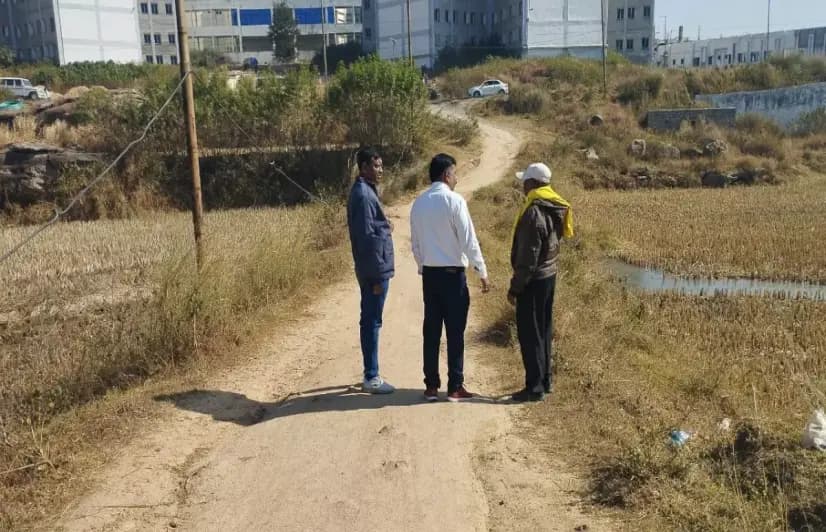
Common lands, no common laws: tribal law blocks land acquisition in one village, while the other falters
The leasing episode involving Patanjali Yogpeeth Trust in two villages of Jharkhand shows it is time all village common lands are protected from outside interference, irrespective of whether they belong to tribals or the government Ranchi, Jharkhand: “We grew suspicious as we saw unknown faces with JCBs in our fields. We questioned them and learnt that the government has allocated our 62.26 acres to Patanjali Yogpeeth Trust for establishing a research centre. My father and the then gram pradhan [village head], Bandhu Munda, along with locals protested, asking how anyone can build anything on our zameen [land],” said Etwa Munda (34) of Dami village in Bundu panchayat, recalling the 2007 incident. This gairmajaura khas land was where 150 to 200 families grazed their cattle, so they did not budge when the MLA and officials came to hold discussions. “The officials told us to take our animals to Taimara hills, but that is five km from Dami. How would our animals go that far? The land given to Patanjali is only half-a-km away,” Etwa went on. Moreover, people worshipped village deities and collected firewood from the land, which hosted medicinal plants such as karanj, siduaar, neem, rori and kusum. Tribals of Chotanagupur region have been using them for centuries. “So we dismissed their offer and chased them away,” he added. As per the reply to a Right to Information (RTI) application filed in 2021 by Sunil Kumar Mahto, an RTI activist and advocate at Jharkhand High Court, two kinds of land were allocated in the name of Patanjali in Ranchi district. It said that on March 29, 2006, the Cabinet of Jharkhand allocated 62.26 acres for establishing the Centre for Research and Cultivation of Medicinal and Aromatic Plant in Bundu panchayat and another 15 acres in Bargawan panchayat to build an ayurveda college. In both cases, the token amount for transfer was Rs 101 and the lease period was 30 years. Unlike in Bundu where protests scrapped the project, Bargawan saw activities of a different kind. When locals learnt about the ayurveda college proposal, they readily agreed by holding a gram sabha meeting in the presence of the then gram pradhan Dema Tirki, who told them that they would be employed in the facility. “Patanjali wanted to build an ayurvedic facility where its products would be manufactured. We agreed to provide land as this was in favour of the community. The locals would be employed in both manufacturing and sales. However, we were clueless that they would build a school instead,” Sushma Hemron, a panchayat samiti member and former ward member of Bargawan, told 101Reporters.Acharyakulam, an educational institution for schoolchildren, was built in 2013. However, according to Hemron, the locals cannot afford to send their children there. Echoing her, Krishna Gop, a businessman and Bargawan resident, said, “A child from my family studies in class 5 at Acharyakulam. His admission fee was around Rs 50,000, excluding quarterly fees, bus fare, library fees, and curricular activities.”Despite the breach of trust, the villagers did not launch a protest when things went awry. Moreover, they had nothing to show as a document as there was no official agreement between the villagers and Patanjali. In those days, the village head and communities managed their affairs through an informal, locally organised system of governance. The decision was made much before the establishment of the panchayat system in the state in 2010. “I became a ward member after the first panchayat elections in 2010. In 2014, I visited the school in my capacity as a gram sabha member and requested the authorities to employ locals as per their skills as this school stood on tribal land. But they said they do not acknowledge representatives of the gram sabha,” Hemron informed.“What is the point of contesting these elections,” she asked disappointingly. The main building of Acharyakulam campus (Photo - Nisha Kumari, 101Reporters)Landing in trouble Not just in Bargawan or Bundu, common lands are facing significant challenges these days, affecting the livelihood of the communities dependent on it directly or indirectly. When Bargawan residents decided to lease out land to Patanjali, little did they know that it was a smooth way of converting their common land into revenue land.The land on which Acharyakulam was built is gairmajarua aam, which means uncultivated common land whose ownership lies with the government.Elaborating on this, Anmol Gupta, an independent legal researcher, told 101Reporters that usually pastoral/community land is recorded as government land in revenue records. “So if the government takes them over for any other purpose, communities will usually not be able to approach court because there is no technical violation of the law." On the other hand, the land in Bundu eyed by Patanjali was of gairmajaura khas type. As per Section 3 of the Bihar Land Reforms Act, 1950, gairmajaura khas lands are vested with the state. However, the gairmajaura khas land in Bundu panchayat falls under the Mundari Khuntkatti system (original settlers of land among the Mundas) protected by the Chota Nagpur Tenancy (CNT) Act, 1908, which exempts it from the provisions of the Land Reforms Act. Although the Act has reduced the Khuntkattidars to tenants, the power to manage the land is still with the traditional tribal institutions and village councils."In the Mundari Khuntkatti system, the pradhan collects revenue and the state has no right to such lands. The CNT Act strictly prohibits any kind of land allocation or transfer to non-Mundas. Yet, in this case, the Cabinet allocated 62.26 acres to Patanjali," added Advocate Mahto.However, locals in Bundu were able to exercise their rights because the CNT Act protected their ownership. Like this law, there are other legislations that protect the customary rights on public lands in Jharkhand, such as the Santhal Parganas Tenancy Act, 1949, the Forest Right Act, 2006, the Panchayats (Extension to the Scheduled Areas) Act, 1996, and the Right to Fair Compensation and Transparency in Land Acquisition, Rehabilitation and Resettlement Act, 2013.This is the entrance view of the Acharyakulam building (Photo - Nisha Kumari, 101Reporters)Murky deals?The management of lands, especially common lands, falls under the jurisdiction of the Department of Revenue, Registration and Land Reforms. When the state allocates public land to a private company, the aim is to stimulate economic development through infrastructure projects, often with an expectation to receive benefits such as tax revenue, job opportunities and improved public services. In case of violations of the terms and conditions, the department reserves the right to take disciplinary action against the lessee. Strangely, the lease agreement executed on April 27, 2006, between the Governor of Jharkhand, represented by the then Deputy Commissioner of Ranchi, Pradeep Kumar, and Patanjali Yogpeeth Trust general secretary Acharya Balkrishna does not mention the word ‘Acharyakulam’ or ‘school’, which violates lease terms.“This indicates that the school is built to earn a profit, where there is no concession for the people of Jharkhand. The contract includes a reversion clause that says that the government reserves the right to terminate the lease agreement and repossess the land if the land undertaken for a particular purpose is not used for that purpose,” Adv Mahto stated. The reversion clause was also mentioned in the lease agreement. However, the Department of Revenue, Registration and Land Reforms did not respond to the questions in this regard.In Bundu, the land records (as per register 2) mention the Centre for Research and Cultivation of Medicinal and Aromatic Plants, Patanjali Yogpeeth Trust, as the raiyats, which is lawfully incorrect. However, the department did not comment on this as well.Though 101Reporters approached Acharyakulam school administration to clarify their position on the questions raised, they kept dodging the issue even after expressing willingness to speak and after giving dates for an interview. Suggested measuresLand is a controversial subject and is central to the majority of conflicts in Jharkhand. A 2016 study by the Rights and Resources Initiative and Tata Institute of Social Sciences states that three-quarters of the land-related conflicts involved common lands, either forest or non-forest.There is a steady decline in gairmajaura lands in Jharkhand because of unattended encroachment as per a report titled Land Governance Assessment Framework, Jharkhand, from the National University of Study and Research in Law, Ranchi. It further states that little regard has been paid for the protection, development and reinvigoration of such lands. The report also suggested that the implementation of the Bihar Public Land Encroachment Act, 1961, would be helpful in surveying town common lands in headquarters and later fencing them to identify and protect them from further encroachment. The last documented assessment of India’s common lands happened in 1998. An updated national land database would help the government to facilitate informed management and decision-making. Also, land conflicts can be avoided if ownership details based on gender and community are available. The information on community lands should be made public.The Central government has set up land banks in the past by including details of common lands and unused lands of various state departments. Land bank as a concept was introduced under the leadership of the then Chief Minister of Jharkhand, Raghubar Das, in 2016, which gave the government absolute power to acquire, manage and repurpose vacant, abandoned or foreclosed properties. Commenting on this, Sudhir Pal, founder and managing trustee, Manthan Yuva Sansthan, said, “Land bank is central to the political discourse in Jharkhand. Frequent attempts are being made by the state government to bring common lands [like the protected one in Bundu] under the land banks. But communities here have always opposed this concept because common lands like sarna and masna carry deep religious values, and we have seen many instances where tribal lands have been transferred to non-tribals.” Encroachments of common lands as seen in Bargawan and Bundu are often legalised by the local institutions themselves. Therefore, for better management of common assets, a land database should include the historical and customary uses of lands and measures to build boundaries to prevent further privatisation. Also, provisions for non-land owners should be included to give the locals power to manage their community lands. Article 39(b) of the Constitution of India states that the “ownership and control of the material resources of the community” should be distributed “to sub-serve the common good”. Even if the state has absolute ownership of such lands, the commons draw strength from the Public Trust Doctrine that protects certain components of natural resources from exploitation. Although these are held by the state, it should be for the people, who are, in the real sense, the owners and the beneficiaries of the same. Cover Photo - Leasing episode involving Patanjali Yogpeeth Trust in two villages of Jharkhand shows it is time all village common lands are protected from outside interference (Representative image/AI-generated using Canva)
-76.webp&w=3840&q=75)
Write For 101Reporters
Follow Us On
101 Stories Around The Web
Explore All News