How Kolkata’s cremation workers are navigating a changing profession

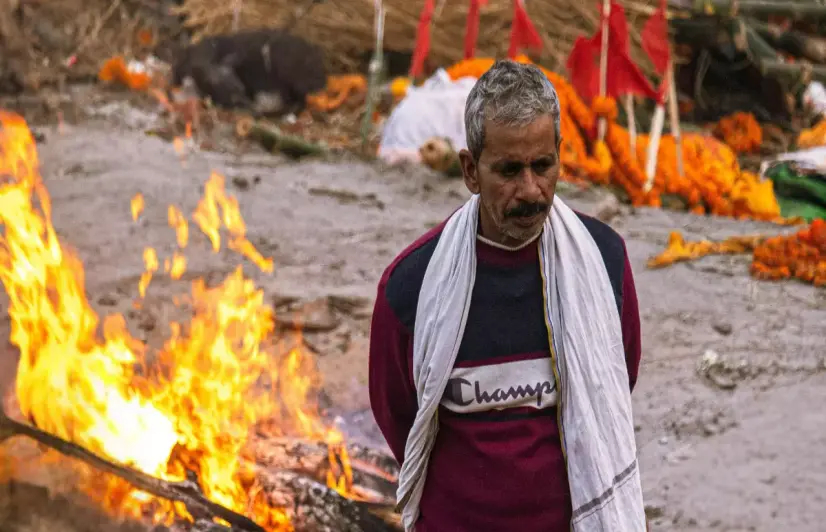
How Kolkata’s cremation workers are navigating a changing profession
Electric furnaces, municipal salaries and shifting caste boundaries are reshaping cremation work in the city, though contractual workers say insecurity and stigma persist.
Kolkata, West Bengal: “We have endured enough hardship,” said Asha (name changed), the wife of a cremation worker at a Kolkata burning ghat. “I want my son to get a good job and my daughter to be married into a good family. I have seen my father-in-law suffer from respiratory disease because of the smoke. Now my husband’s health is getting affected. I do not want my son to go through the same.”
Her daughter has completed Class 12, and her son is pursuing graduation.
At Kolkata’s cremation grounds, where smoke rises long before dawn, and the clang of iron stretchers signals another arrival, an ancient profession is quietly being reshaped. Some of it by electricity, but mostly through municipal systems and government payrolls, say locals.
For generations, members of the Dom community, now officially referred to as satkar karmis after a West Bengal government notification in December 2023, handled cremations through knowledge passed down within families. The Doms, a Scheduled Caste community, have historically been associated with occupations related to death and sanitation.
At Kolkata’s cremation grounds, that history is still visible — in the rituals surrounding the pyre, the smoke rising over the river and the generations of workers who learned the trade from their fathers.
Workers say that the landscape has been steadily shifting over the decades. Electricity, municipal systems and new career aspirations are slowly reshaping the profession.
For some families, the change means that the work will end with them.
Once a caste-bound occupation dependent on informal payments from grieving families, cremation work in Kolkata has gradually become a salaried municipal job. Electric furnaces now operate alongside traditional wooden pyres, and there are proper roads that lead to the ghat.
But there is still a degree of unevenness in the transformation. While some satkar karmis draw government salaries and enjoy greater social stability, many continue to work on contractual wages with little security. There is also the stigma around the occupation, which has reduced a little due to the tag of a government job, but it has not completely disappeared.
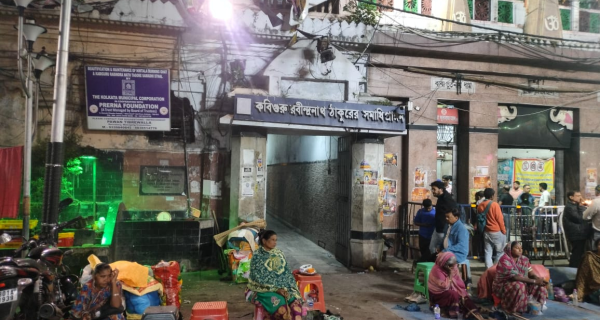
Inherited occupation
For much of the city’s history, cremation workers relied largely on what bereaved families chose to give them. “There was no fixed payment earlier,” workers said. “Whatever the family offered was what we earned.”
Historical records show how modest the earnings once were. In Municipal Calcutta: Its Institutions in their Origin and Growth (1916), SW Goode, then chairman of the Calcutta Corporation, described the functioning of the city’s cremation grounds in the early twentieth century.
According to the book, two sub-registrars issued death certificates at the cremation ghats. At the time, only two dom workers were officially appointed to assist with cremations, though their numbers increased later.
Goode recorded that the cost of cremation was three rupees, two annas and nine paisa for adults and one rupee, eight annas for minors, while poor families were not charged. Between 1913 and 1914, 10,344 bodies were cremated at Nimtala Ghat, one of Kolkata’s oldest cremation grounds.
The monthly salary of a dom worker at the time ranged from Rs 2.50 to Rs 3.50.
For decades afterwards, the occupation remained largely hereditary. Children learned the work by assisting their fathers and relatives, gathering wood, preparing pyres and observing rituals associated with cremation.
The work was physically demanding and carried social stigma.
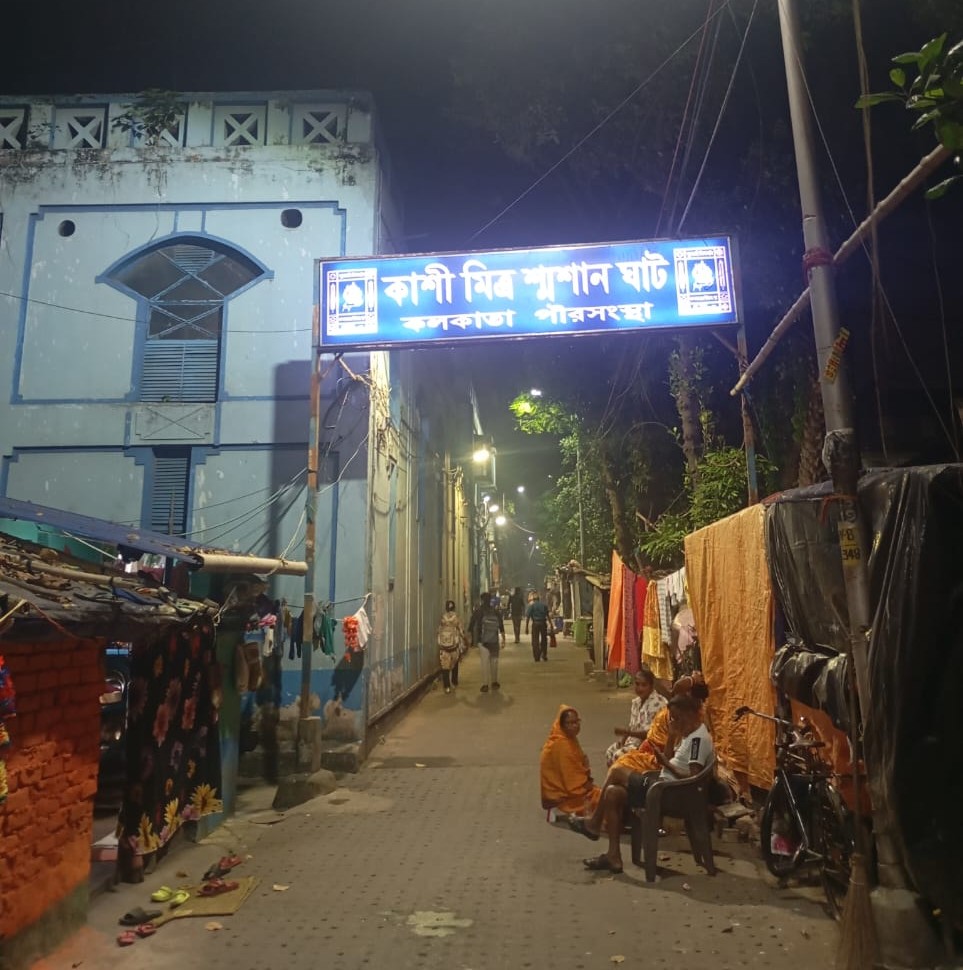
Manik Mallick, 56, who has worked at the Kashi Mitra Burning Ghat in north Kolkata since the early 1990s, remembers a time when the cremation ground looked very different. “There used to be a single low-power bulb and a stock of wooden logs piled up. Taxis would never come within this periphery, and movement of the public here was rare.”
Workers say the shift toward formal government employment began gradually between the late 1990s and early 2000s, when cremation workers were brought under the Kolkata Municipal Corporation’s payroll.
Many appointments happened through hereditary recruitment after the death or retirement (at age 62) of a parent already working at the cremation grounds.
Under the West Bengal government’s pay structure, permanent satkar karmis are now entitled to Pay Level 1 under the West Bengal Services (Revision of Pay and Allowances) Rules, 2019, earning roughly Rs 35,000 a month, depending on grade and allowances.
“When I started, I earned Rs 600 a month,” said Mallick. “After more than three decades, it has reached around Rs 35,000. That itself shows how much has changed.”
Permanent satkar karmis now receive fixed monthly salaries, and some are provided with government quarters. Payments arrive regularly, unlike earlier, when income depended entirely on the families of the deceased. For older workers, the shift brought stability that had been absent for generations.
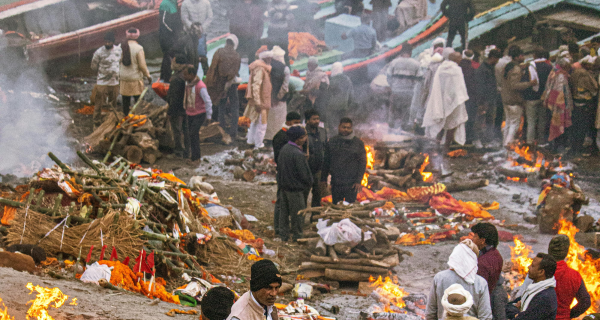
Lakkhichand Mallick, around 70, entered the profession at the age of 14, learning the work from his grandfather. “Earlier we washed the body, prepared it for cremation and earned very little,” he said. “After the government recognised us as employees, financial stability came. Our social status improved. Our children’s lives changed.”
The move to government employment also altered who entered the profession. According to Sanjay Ray, honorary trustee of the Hindu Satkar Samity, cremation work had long been confined to a single caste group.
“Earlier satkar karmis came from one caste,” Ray said. “Once a government salary became possible, people from other castes also entered. It became more like any other job.”
Formal employment, workers say, reduced stigma within the workplace, as attested by a contractual worker at Keoratala Mahashamshan. “Earlier, untouchability was stronger. It has reduced,” he said.
But outside, it still exists. “When it comes to getting my daughter married into a good family, difficulties remain.”
Changing ghats
Kashi Mitra Burning Ghat, established in the early nineteenth century on the banks of the Ganga, once stood in a poorly lit and sparsely populated stretch of north Kolkata.
Workers recall that during the 1970s and early 1980s, the area lacked proper electricity and was considered unsafe at night. From the early 1990s onward, the neighbourhood began to change gradually. Streetlights were installed, and small tea stalls and shops appeared along the riverfront.
Today, the stretch of the Ganga in north Kolkata attracts daily visitors. Tea stalls and snack shops line the riverbank, and residents often gather there in the evenings. The Nimtala and Kashi Mitra crematoriums stand along the same riverfront, reflecting the coexistence of everyday public life and long-standing ritual spaces in the area.
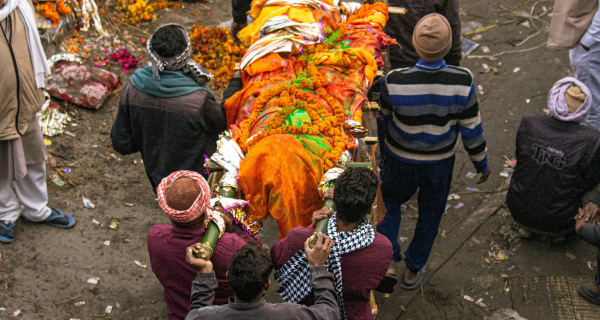
Infrastructure improvements also altered how bodies arrived at the ghats. Earlier, cremation workers often carried bodies themselves over long distances on stretchers. With better roads, hearse vans began bringing bodies directly to the cremation grounds. A railway line running parallel to the river near Nimtala and Kashi Mitra crematoriums also became part of the changing urban landscape.
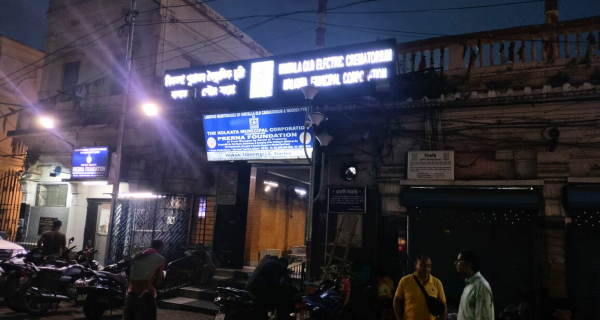
For workers like Mallick, the biggest shift came with the introduction of electric crematoriums. Kolkata’s first electric crematorium began operating in 1960, according to environmental studies on the Ganga basin. Since then, electric furnaces have gradually been installed at several burning ghats.
The new systems significantly reduced the physical labour involved in cremations. “The work was far more physically punishing earlier,” he said. “We carried the bodies ourselves, prepared the pyres and inhaled the smoke. Infrastructure was nothing like today.”
“Now there is a more human approach towards us,” Mallick added.
Electric crematoriums and traditional wooden pyres continue to operate side by side across the city. A wooden pyre typically takes five to six hours to fully burn a body and requires around 500 kilograms of wood. Electric cremations generally take about three hours.
This affects the cost of conducting the funeral. The complete charge for an adult cremation on a wooden pyre is Rs 2,392, while the registration fee for an electric cremation is Rs 250. “It depends on what the family wants for their loved one,” Lakkhichand Mallick said.
For older workers, cremation work involved far more than operating machinery.
Baleshwar Mallick, 75, said he learned the profession through years of practice under the guidance of his father and uncles. “My father and uncles showed us everything — how much wood to use, how to build the pyre, when to light it, how the rites are done,” he said. “It was never just about burning a body. From setting the pyre to finishing the last ritual, the full responsibility was on us.”
He believes younger workers are less familiar with traditional practices. “Now the job is more about operating the machine,” he said, pointing to a growing gap between generations.
Risks
Despite technological changes, the job remains physically demanding. Those working with wooden pyres continue to face heavy smoke exposure. Others spoke about heat stress from long hours near high-temperature furnaces and the risk of sudden flare-ups if the furnace door is opened too early. Poor ventilation in some older buildings adds to the problem.
Workers said protective equipment is largely absent. While permanent satkar karmis earn around Rs 35,000 a month, many others remain employed on contractual wages.
A contractual worker said he began the job earning Rs 1,800 per month. “After 20 years, it has increased to only Rs 12,000,” he said. “It is impossible to run a family of four in Kolkata with this amount.”
He said contractual workers have repeatedly approached the Kolkata Municipal Corporation seeking permanent appointments. “Everyone gives us hope, but nothing happens,” he said. “We are still not permanent.”
Despite the challenges, he said he has managed to send his children to school. “My children are studying. But I will never allow them to enter this profession,” he added.
Cremation workers across Kolkata came into public attention during the COVID-19 pandemic. Crematoriums at Nimtala, Garia and Dhapa were designated to handle the bodies of people who died of the virus. Workers said that at the peak of the crisis, as many as 300 bodies arrived daily at Nimtala.
“There were endless queues,” said a worker at Dhapa. “It was an unbearable sight.”
Several workers were appointed during the pandemic, many on a contractual basis. He rejected allegations that crematorium staff charged excessive fees. “People gave us baksish on their own,” he said. “We never charged.”
For some permanent workers, the pandemic years led to modest financial improvements. A few were able to purchase motorcycles or small plots of land. Contractual workers said little had changed for them.
“The pandemic made people notice us,” one worker said. “But it did not guarantee our future.”
For many families, the profession may end with the current generation. Naresh Mallick, 46, said he does not want his son to follow him. “My son is studying BCom,” he said. “I am the last generation in my family doing this work. After studying BCom, why will he burn bodies?”
He said discrimination in the profession has reduced over time. “Why shouldn’t he take advantage of that?” he asked.
Others are waiting for recruitment to resume. Bhaglu, a satkar karmi, said his four sons hope to secure municipal jobs if hiring restarts. Recruitment for satkar karmis has reportedly been stalled for the past four to five years.
Cover image - Representative image (Abhishek Mishra/Pexels)
Would you like to Support us
101 Stories Around The Web
Explore All News