How a dying river is taking a dialect with it
How a dying river is taking a dialect with it
Purba Medinipur, West Bengal: When Mrinmoy Mondal (38) stepped into his early youth, he began to notice something familiar from his everyday life slipping away. Words like Halā (small boat), Mong (front of a boat), Chuā (small pond), Hadā (water hyacinth), Chāgdi (a patch, such as of hyacinth), Bāsā (a place where fish frolic), and Jāt (village fair) were becoming estranged.
Mondal is a resident of Pashchim Medinipur, a district in West Bengal, born and raised by the river Keleghāi. These lost words belong to his regional sub-dialect, itself a sub-dialect of the Bānglā dialect called Rādhi. Mondal's generation grew up using these words daily. Now they survive mostly among the elderly of the previous generation — never sown into the memory of the young, and so foreign to them.
The river's disappearance has not only eroded language and culture but also severed the mycelial web that once held lives and livelihoods together, shaping the identity, philosophy, and spirituality of the local community
Words like Mādāgādi and Chaudā have gone astray. Madagadi is a small trench, manually dug to reserve the river water, which was later used to manually irrigate the agricultural lands using a hand-held metal container. Later, technology replaced this excruciating task and the need for a “Madagadi”. Mondal’s forefathers earned a livelihood predominantly through fishing. Once local fishing practices involved Chāudā, a hand-held traditional fishing instrument made with thin bamboo sticks. However, in Mondal’s view, what lay behind the obsolescence of these words was not just the gradual “thinning” of the river, but also the technological advancement that replaced these tools. Ultimately rendering the words obsolete.
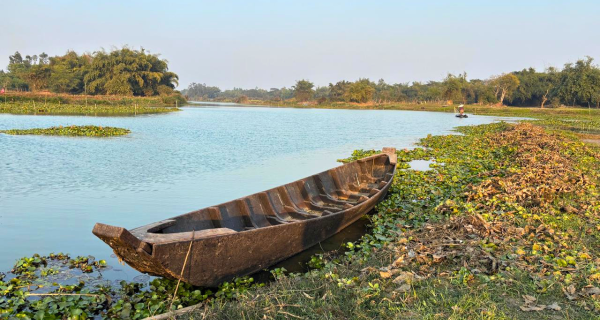 A wooden boat moored on the drying banks of the river among vegetation (Photo - Madhurima Pattanayak, 101Reporters)
Words more widely used elsewhere in Bengal are replacing these local terms, gradually eroding the linguistic diversity that Bangla once held. As the word Hadā faded, Kochuripānā — the more widely used Bangla word for water hyacinth — took its place. Regional terms once used for different parts of a boat, such as Halā, have grown rare, even though Mondal's generation and those before it were once fluent in them.
"Keleghāi did not just shape our local livelihoods and transportation systems, and create a vivid regional culture," said Mondal, standing by the river. "The river is a way of life."
As he spoke, his eyes reflected how deeply the river is rooted in the psychosocial and individual fabric of their lives. He was proud of the river, even as it was dying.
The Keleghāi originates near Jhargram and flows through Pashchim Medinipur before meeting the Haldi river in Purba Medinipur.
 Source of Keleghai In Badina ( Photo sources - Madhurima Pattanayak, 101Reporters )
According to the 2011 Census, 78.6 million people speak Bānglā in West Bengal — 86.22% of the state's population. Mondal and his fellow villagers grew up speaking Rādhi, a dialect of Bengali; they are not its only speakers, but they are among the few communities that speak this particular sub-dialect of it.
As described by late linguist Suniti Kumar Chatterji in The Origin and Development of the Bengali Language, Bānglā's dialects align with four ancient regional divisions — Rādha, Pundra (or Varendra), Vangā, and Kāmrupa. Both Medinipurs, Jhargram, Murshidabad, Birbhum, Bankura, Bardhaman, Howrah, Hooghly, Nadia, and Kolkata fall under Rādhi, which itself splits into several sub-dialects. The variety spoken across both Medinipurs and Jhargram differs from the rest.
"As the river is now dying, the history, culture, and memory attached to it are fading from our collective memory," said Mondal. "I believe if we kept the river alive, people would have remembered the history and culture attached to the river, and vice versa."
An article by Sushilkumar Barman, retired professor at Jhargram Raj College, mentions that when Chaitanyadeb travelled to Odissa through Keleghāi, the river had dangerous eddies named Tetulāgarh, Batrishāgarh, and Burāburi Daha. As Keleghāi lost her depth and her breadth shrank, the undercurrents and their names were erased from the collective memory.
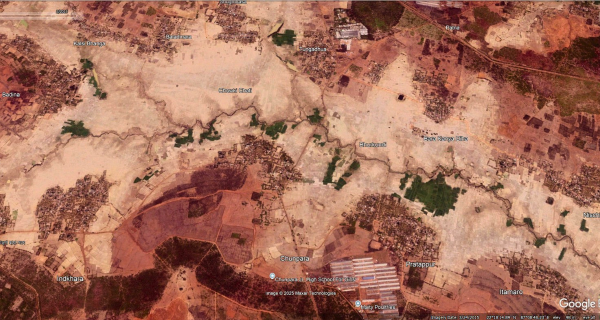
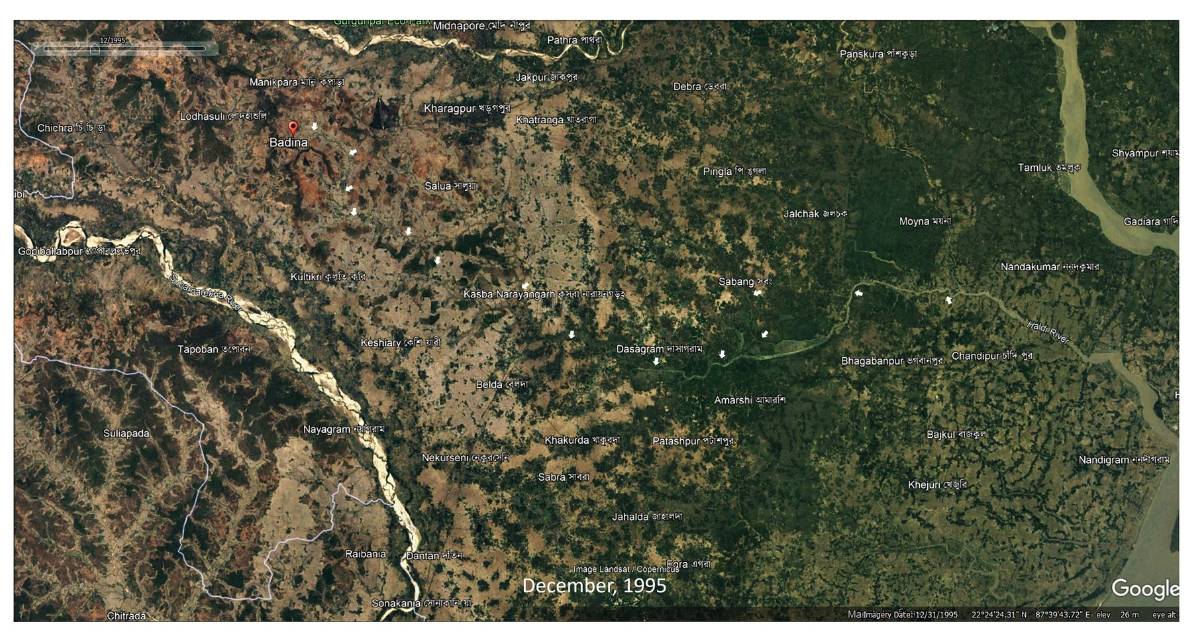 A satellite map view detailing the narrowing flow of the river track ( Photo sources - Madhurima Pattanayak, 101Reporters )
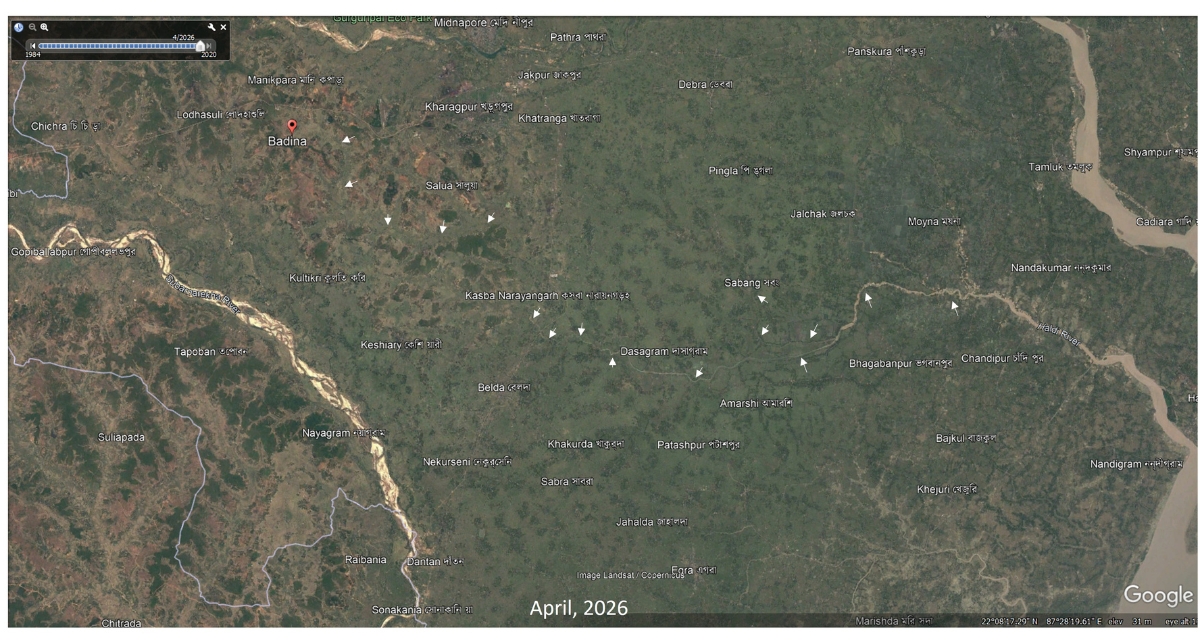
A river in decline
The Keleghāi is a rain-fed river, and increasingly erratic rainfall has altered its flow. The monsoon now often arrives later, while dry spells have become more frequent even during the rainy season. Higher temperatures accelerate evaporation, leaving stretches of the riverbed dry and cracked. In places where water remains, dense mats of water hyacinth and algae have spread, while illegal encroachment has further narrowed the river's course.
"In seasons other than the monsoon, groundwater helps sustain the river's flow," Dr Sujoy Bandopadhyay, a geologist and assistant professor at Kazi Nazrul University, told 101Reporters over the phone. But rampant groundwater extraction, especially for agriculture, irrigation, and household use, has caused levels to decline. For small rivers like the Keleghāi, he said, illegal encroachment is another major challenge.
"At least in this part of Medinipur, the Keleghāi began drying up after it was cut off from the adjacent wetlands that once replenished it," added Mondal, who closely observes the local ecosystem, biodiversity, and environment. Those wetlands have since been converted into commercial fish-breeding enclosures, locally known as bheris.
"But we cannot rule out human-induced climatic variations, especially those seen over the last century," Bandopadhyay added.
A 2020 report, Observed Rainfall Variability and Changes Over West Bengal States (Ministry of Earth Sciences), found dry days increasing in both Medinipurs even as days of intense rainfall exceeded historical records, cumulative rainfall largely unchanged, but concentrated into shorter, harsher bursts followed by long dry spells. A March 2021 report by SwitchON Foundation found the sharpest post-monsoon groundwater decline in West Bengal since 2013 — up to 11 metres in neighbouring Bankura — with groundwater in Pashchim Medinipur and Jhargram falling 4.69 metres and in Purba Medinipur 1.72 metres between 2013 and 2019, leaving levels 15–21 metres below ground by 2019.
According to Vimal Mishra, a hydrologist and professor at IIT Gandhinagar, erratic rainfall — short bursts separated by long dry spells — reduces the natural recharge of groundwater even as extraction remains unchecked, a double blow that often leaves rivers like the Keleghāi drying up.
According to Tapas Das, an activist with the Nodi Banchao Andolan, erratic rainfall, pollution, and illegal encroachment are together damaging the health of Bengal's rivers, rivulets, and paleochannels.
The Assessment of Climate Change over the Indian Region (Ministry of Earth Sciences) found West Bengal among five states showing significant declines in southwest monsoon rainfall over 1989–2018, with dry days rising in almost all districts and June rainfall declining significantly, even as no major decline was seen in other months. IMD data show a similar decline in annual rainfall across Jhargram and Pashchim Medinipur. The Ministry's Annual Climate Summary (2024) found 2023 temperatures 0.5-1°C above the 1991-2020 average across eastern India, especially Bengal.
Disappearing ecosystem
Scientists and linguists have long recognised a link between biodiversity and linguistic diversity: as rivers, glaciers, or species disappear, the languages and lexicons once tied to them fade with them.
"When dialects and languages erode, culture loses an important dimension," John Lipski, senior linguist and emeritus professor at Pennsylvania State University, told 101Reporters over email.
As sub-dialects disappear, so too does traditional knowledge of fishing, fish-breeding cycles, flood patterns, boat-building, and seasonal rhythms, weakening cultural identity and fraying intergenerational ties.
Humans have co-evolved with nature over millennia, developing thousands of languages, dialects, and sub-dialects that reflect different ways of understanding and relating to the environment, Lipski said.
An estimated 2,400–3,000 languages could go extinct by the end of this century; India alone has lost more than 220 in the past 50 years, and nearly 400 have disappeared worldwide over the last century. Across the Arctic and Sweden, the nine Sámi languages still in use contain more than 300 words for snow and recognise eight distinct seasons. As glaciers melt and snow-dependent biodiversity declines, many of those words are fading too.
In this case, it is not an entire language but a sub-dialect that is disappearing—as if a tributary of a larger river had died. Even that loss erodes linguistic diversity and threatens the richness of human culture.
"People tend to see regional, social, and ethnic dialects as symbols of identity," Lipski said. "Language is an inseparable part of human identity and culture."
Trying to save both
Mondal believes that if the river were still alive, people would have been more careful about preserving their riverine culture, language, and history. He is trying to support the Keleghāi's recovery by raising awareness through articles, magazines, and vlogs, and by reintroducing dying words to younger generations in classrooms and everyday life.
Climate change and environmental degradation are not the only forces behind this loss. Linguists, including Lipski, argue that globalisation and urbanisation have also accelerated the erosion of smaller dialects and sub-dialects, particularly among smaller communities.
Das and others in the Nodi Banchao Andolan continue campaigning to protect Bengal's rivers and the cultures they sustain. Despite bureaucratic hurdles and social resistance, they persist in raising awareness about rivers facing the same fate as the Keleghāi.
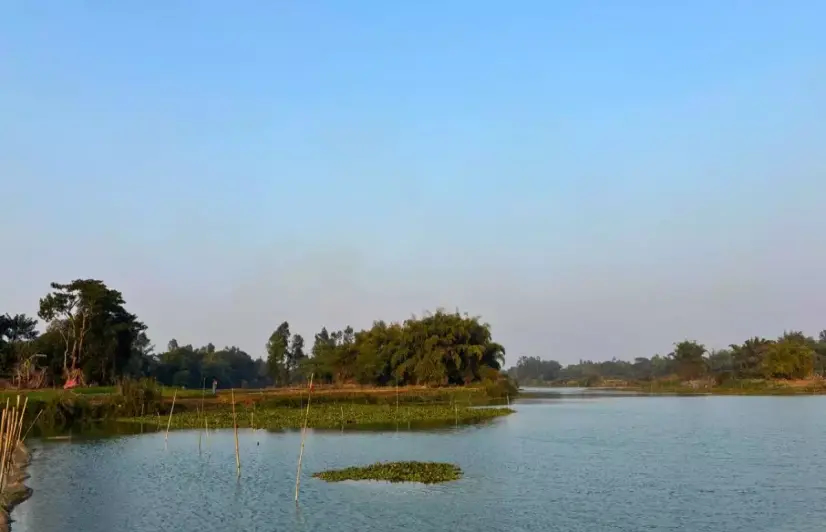
Cover Image - Banks of the Keleghai river channel ( Photo sources - Madhurima Pattanayak, 101Reporters )
Would you like to Support us
101 Stories Around The Web
Explore All NewsAbout the Reporter
Write For 101Reporters
Would you like to Support us
Follow Us On