Water-intensive Mathania chilli awaits GI recognition amid groundwater crisis

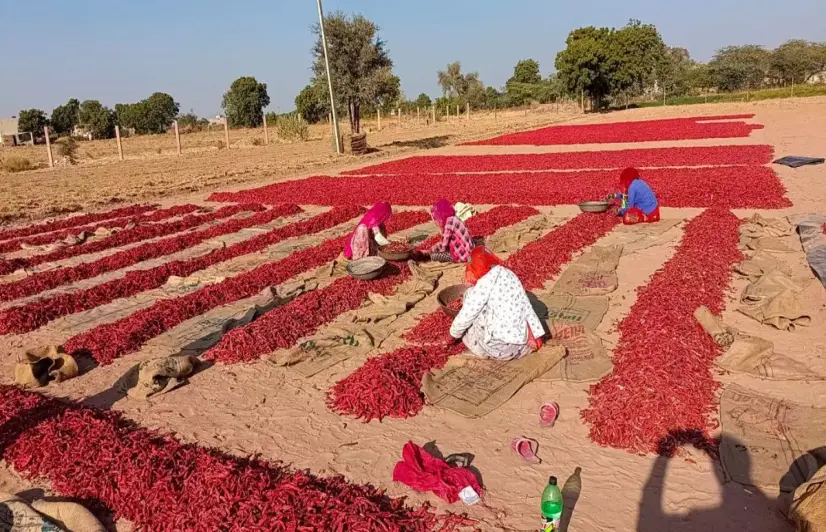
Water-intensive Mathania chilli awaits GI recognition amid groundwater crisis
As it moves closer to a GI tag, production of one of Rajasthan’s trademark chillies remains at its lowest level in decades.
Hanumangarh, Rajasthan: The Mathania chilli of Rajasthan’s Jodhpur district is likely to soon receive a Geographical Indication (GI) tag. The preliminary hearing on the application filed nearly a year ago by the Tinwari Farmer Producer Company, supported by the National Bank for Agriculture and Rural Development, has been completed, and expert evaluation is at an advanced stage.
Yet even as legal recognition moves forward, cultivation has reached its lowest point. The chilli whose name is being protected has almost disappeared from the fields.
Three decades ago, Mathania and its chilli were nearly synonymous. Spread across villages in the Tinwari and Osian blocks, winter fields once turned a striking red as chillies ripened and dried in the sun. The crop was grown on nearly 70,000 hectares, with annual production reaching 1.3 million metric tons.
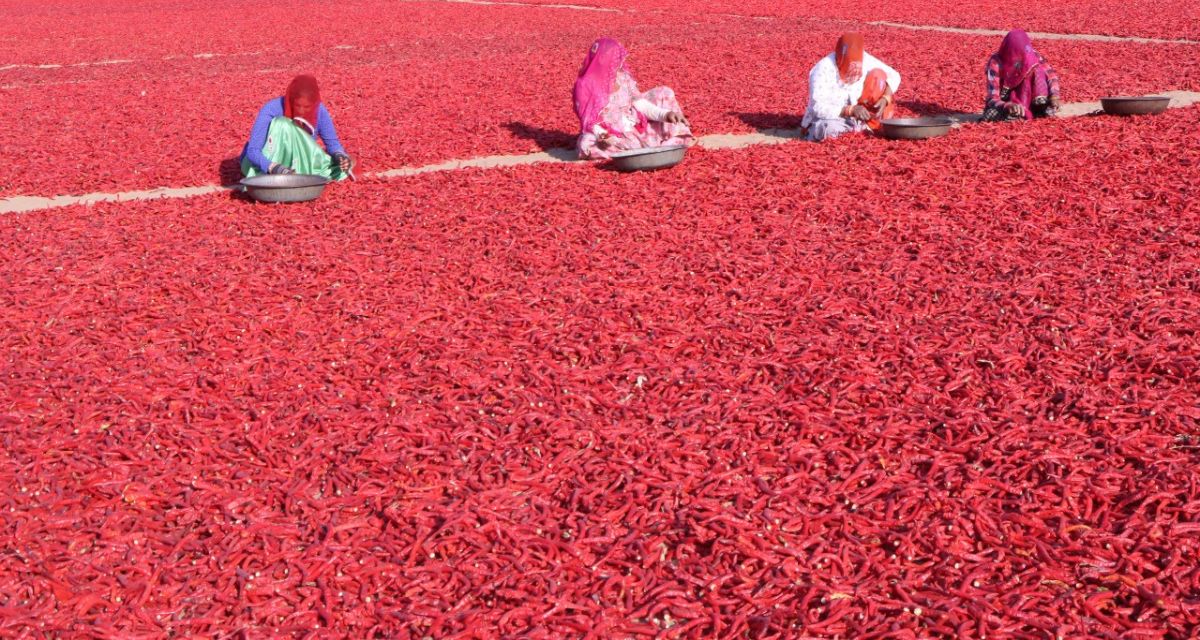 Farmer families busy drying chilies in the fields in the Mathania-Tinwari agricultural area of Jodhpur district (Photo - Jethmal Jain)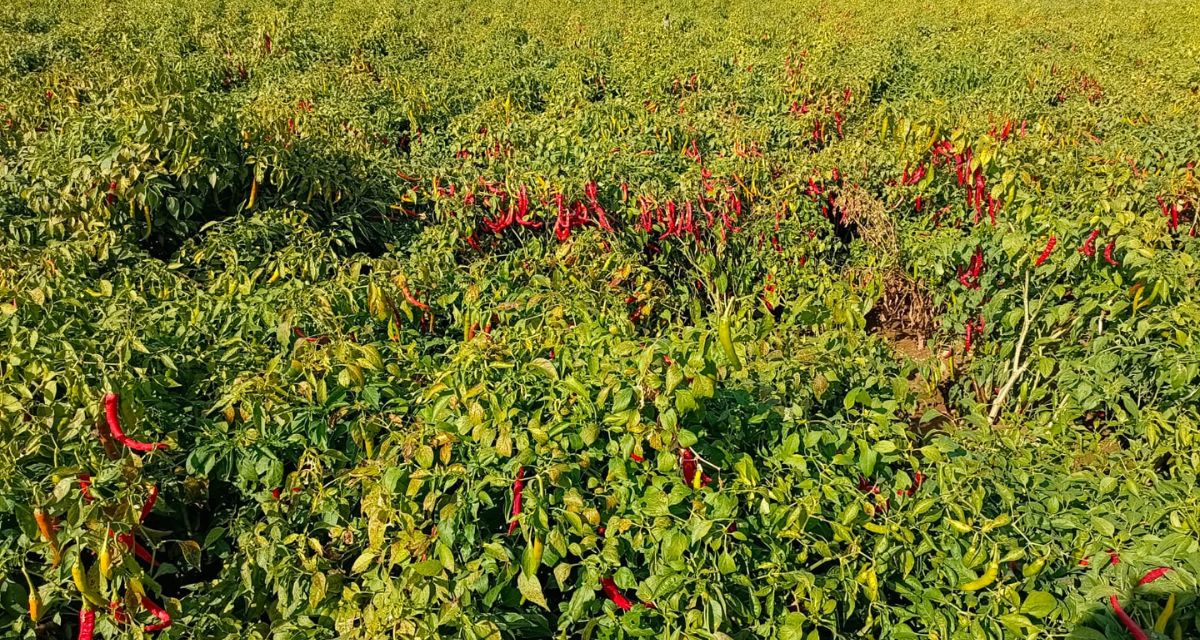
It was exported to the United Arab Emirates, the United States, Saudi Arabia, the United Kingdom and Indonesia. Traders travelled directly to villages, and Mathania chilli became known internationally for its deep colour, pungency and aroma.
Today, the landscape has changed. According to Rupesh Lava, Deputy Director of the Horticulture Department in Jodhpur, chilli was sown on just 750 hectares in 2024-25 and again in 2025-26, with production at only 1,650 metric tons, the lowest ever recorded. He attributed the decline to decades of water scarcity and shifts in farming patterns.
 Chilli crop in a field in Bada Kotecha village in the Mathania-Tinwari agricultural area of Jodhpur district (Photo - Jethmal Jain)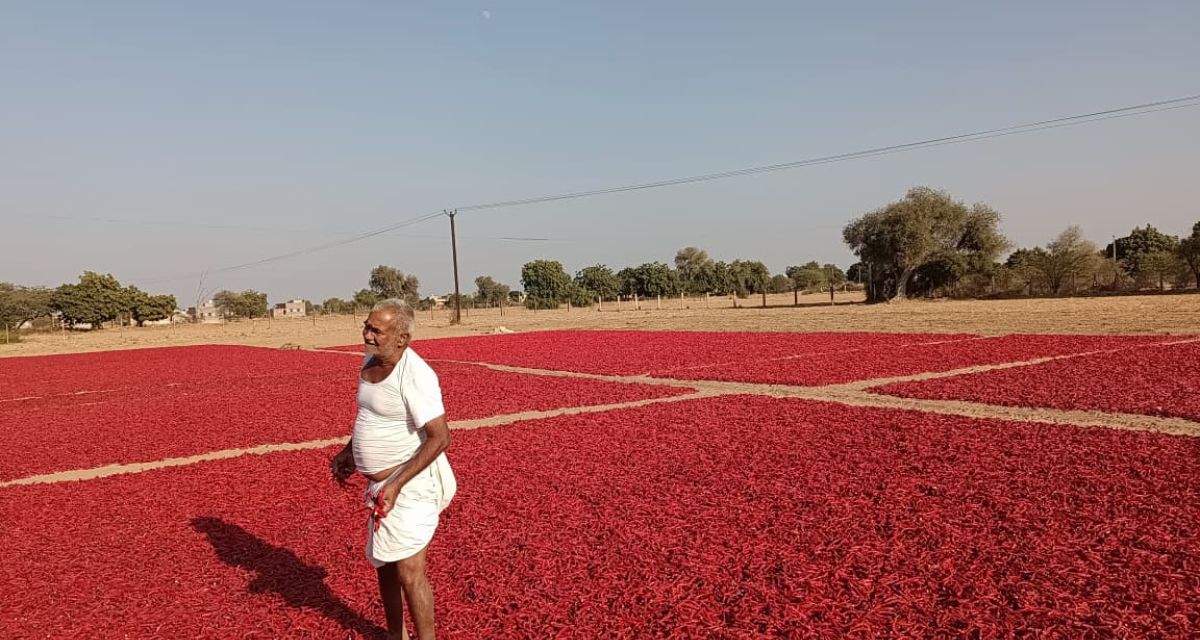
Years in the making
The primary cause has been the over-extraction of groundwater. The crisis could have been foreseeable ages ago. In a 1988 study, University of Minnesota sociologist Michael Goldman documented that some farmers in the Jodhpur region were extracting up to 50,000 gallons of water daily and irrigating chilli fields 40 to 60 times over a nine-month cycle. This far exceeded natural recharge capacity.While most food crops require irrigation four to ten times per season, chili cultivation pushed the entire region into a long-term water crisis
The situation worsened in 2001, when authorities began drawing groundwater from Mathania and surrounding areas to meet Jodhpur city’s drinking water needs. This situation proved fatal for water-intensive crops like chilies. Poor water quality, increasing salinity, soil salinity, and pest infestations like nematodes, head-spinning, thrips, and whiteflies all increased. Indiscriminate pesticide spraying led to the development of resistance in pests, and this crop gradually became a loss-making proposition for farmers.
The impact extended beyond agriculture. Jetmal Jain, a farmer and agricultural journalist from Tinwari, says chilli once generated such prosperity that young people did not consider salaried jobs. Now, many have lost interest in farming altogether. Kaluram Bhati of Balarwa village, who once cultivated 50 bighas of chilli, now sows just six. His son is preparing for the Rajasthan Administrative Service.
Chandrakant Khatri of Tinwari told 101Reporters that 25 families in his extended family cultivated chilli on 1,200 bighas of land. In the 1960s, water was found at a depth of 40 to 50 feet. Today, it lies 1,000 to 1,200 feet below ground. Due to poor water quality, the TDS and other contaminants in the water increased, which then formed a layer on the soil, depleting the soil's nutrients. Pest infestations in chili peppers continued to increase. Indiscriminate use of pesticides led to insect resistance, and ultimately, chili cultivation had to be abandoned.
The family shifted to mustard, wheat and peanuts. Initially profitable, even these crops now yield significantly less. Of 1,200 bighas, only 150 to 200 are currently cultivated. Mustard yields have nearly halved. Wheat output has dropped sharply and its production continues to decline.
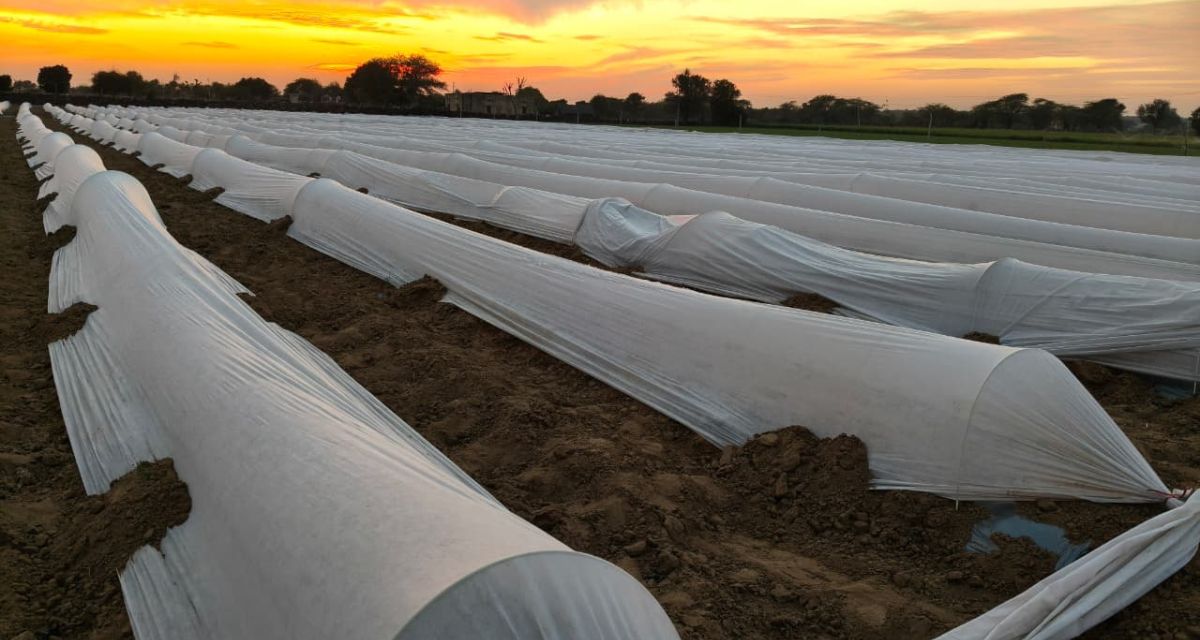 A view of chilli cultivation in a low tunnel in Jhumarlal Chaudhary's field in Gagadi village (Photo - Jethmal Jain)
Cautious revival
Some farmers, however, are experimenting with revival. Mahendra Chaudhary of Gagadi village resumed chilli cultivation on four-and-a-half bighas last year after a decade-long gap. His brother uses drip irrigation, mulching and low tunnels, and practices organic farming. In villages such as Rajasani, Tinwari, Binjhwadia, Rampura, Balrava and Bada Kotecha, farmers have built rainwater storage tanks and distribute water through drip systems rather than flood irrigation.
Water from tube wells is not used directly. It is first poured into the tanks to allow the nutrients to settle, and then the same water is distributed to the fields through drip irrigation. Asha Ram Gehlot, a trader in Mathania, said that he once handled up to 300 maunds of chilli. Today, volumes are too low to sustain profitable trade.
Rupesh Lava, Deputy Director of the Horticulture Department, believes that receiving the GI tag will benefit farmers. According to him, the department is encouraging farmers to adopt organic farming and drip irrigation, and farmers are gradually shifting towards this. He says that if proper technology and water management are adopted, Mathania chili cultivation can be revived.
Amidst this hope, opinions differ regarding the GI tag. Shravan Ram Bhadu, CEO of Tinwari Farmer Producer Company, says that other varieties of chili are being sold in the market under the name of his chili. According to him, the GI tag will prevent brand theft and provide legal protection to Mathania chili. He explains that traditional indigenous seeds have almost become extinct, but efforts are being made to revive cultivation using those seeds on a trial basis. Farmers are now abandoning flood irrigation and returning to drip irrigation and organic farming.
Tulchharam Sinwar of the Bharatiya Kisan Sangh believes that the GI tag will provide legal protection to Mathania chillies and enable them to fetch premium prices in the market
But not everyone is on the same page. Farmer Chandulal Khatri says a GI tag cannot bring water back to wells. Rampal Jat, National President of the Kisan Mahapanchayat, argued that branding is meaningless without stable production. First, he says, groundwater must be restored and disease-resistant local seeds redeveloped.
On the other hand, government officials believe that the situation is serious, but not completely insurmountable.
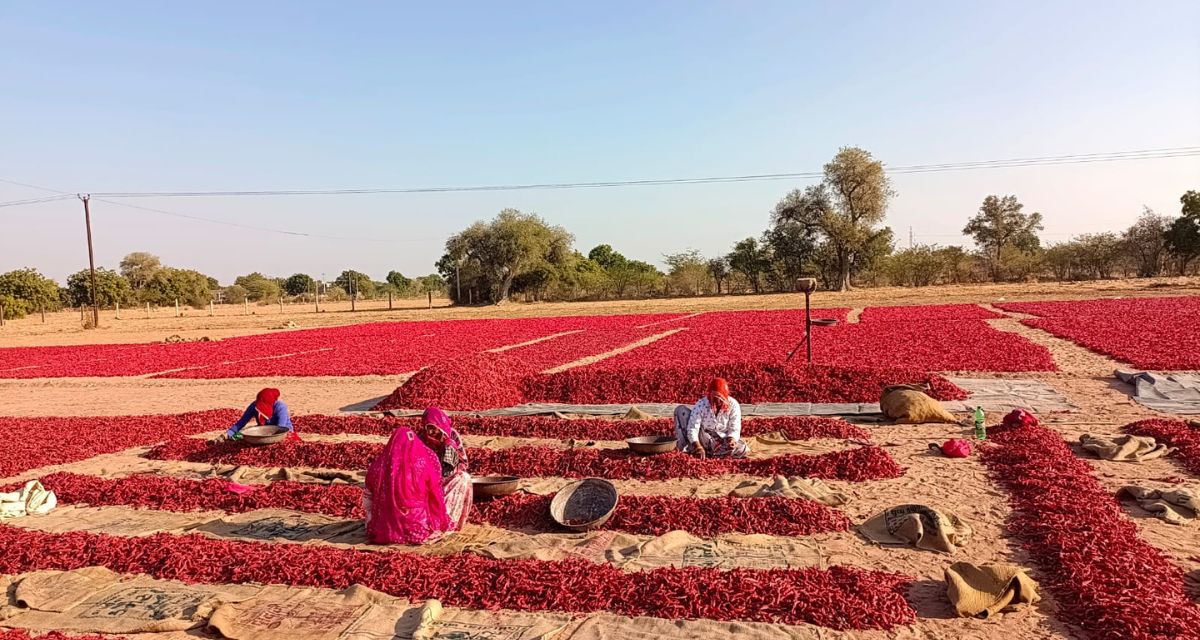
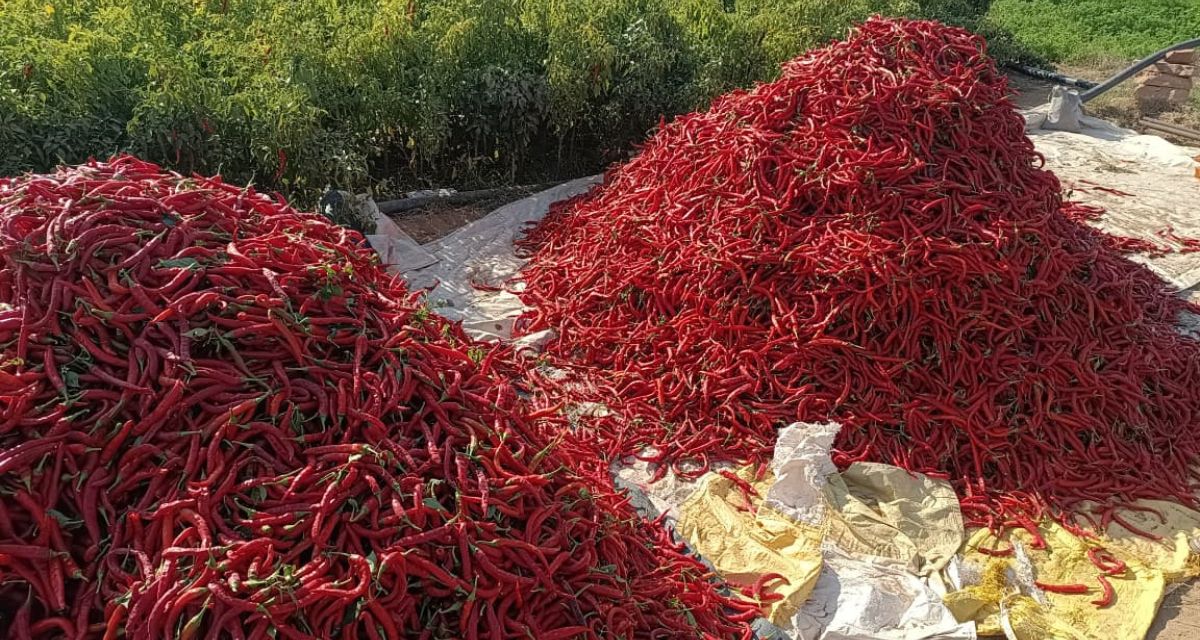 Piles of chilli after harvesting in a field (Photo - Jethmal Jain)
Efforts undertaken
Prahlad Singh Rathore, a senior groundwater scientist at the Groundwater Department in Jodhpur, said excessive extraction has far outpaced natural recharge. As a result, the entire Jodhpur district has fallen into the “dark zone”. Most tube wells have dried up, and the remaining water has turned saline, with high TDS levels and other contaminants. “This is a loss that cannot be compensated immediately,” he said, adding that sustained efforts are required.
Inspired by Prime Minister Narendra Modi’s Catch the Rain campaign, the state government launched the “From Workplace to Motherland” initiative a year ago, involving entrepreneurs and businesspersons working outside the state. Under the scheme, the aim is to build four recharge shaft structures in each gram panchayat. So far, around 16,500 recharge shafts have been constructed. Rathore said more people need to participate to accelerate water conservation and groundwater recharge efforts.
He added that the department is encouraging groundwater recharge, crop diversification and a shift to less water-intensive crops. In water-scarce regions such as western Rajasthan, he said, crops like wheat should be avoided, noting that producing one kilogram of wheat requires 500 to 1,000 litres of water.
Dr Vikas Pawadia, assistant professor at the Nagaur College of Agriculture and state adviser on GI tags, said a GI tag would provide Mathania chilli with global recognition and legal protection, which could encourage farmers to return to its cultivation.
Cover photo - Women taking care of dried red chilies in a field in Bada Kotecha village in the Mathania-Tinwari agricultural area of Jodhpur district (Photo - Jethmal Jain)
Would you like to Support us
101 Stories Around The Web
Explore All News