Under Kerala’s sun, cataract is striking earlier among outdoor workers
Under Kerala’s sun, cataract is striking earlier among outdoor workers
In Kerala, outdoor workers are being diagnosed with cataract earlier than expected, raising questions about ultraviolet exposure, coastal geography and gaps in eye care.
Alapuzzha, Kerala: In 2005, during a medical examination for a visa, Vavachan Cherathamthuruthil (45), a construction worker from Alappuzha, was told that something was wrong with his eyes. He did not know what. The doctor assured him it was nothing to worry about as he was not going to Oman for office work anyway.
Over the years, vision in his left eye weakened gradually. Nearly 15 years later, when he had almost lost sight in that eye, he finally learned what the problem had been all along: cataract. To regain his vision, he would need surgery.
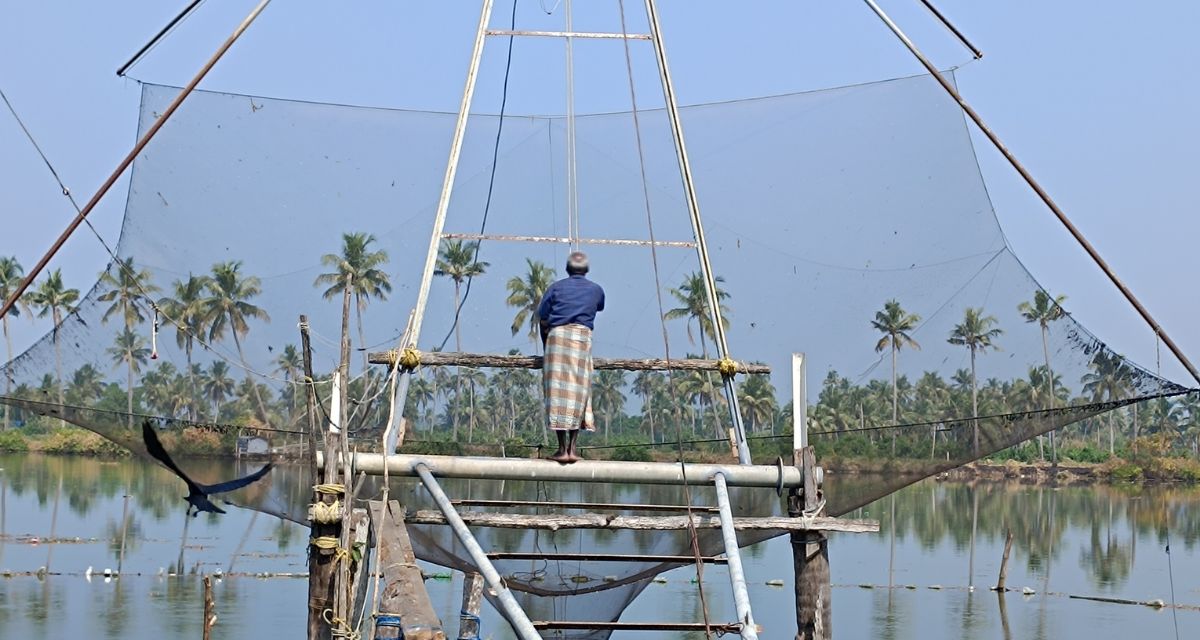 Vavachan Cherathamthuruthil working on his Chinese net (Photo - Nisha Matamp, 101Reporters)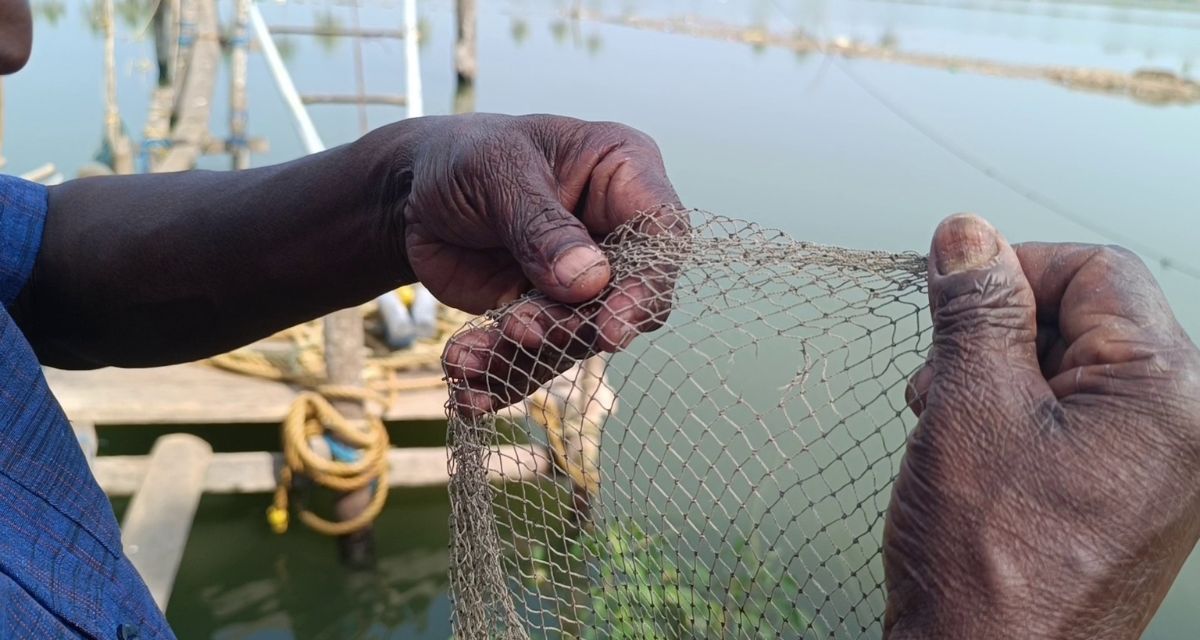
According to the National Programme for Control of Blindness and Visual Impairment survey conducted between 2015 and 2019, cataract accounts for 66.2% of blindness in India. Though widely understood as an age-related condition, epidemiological research has repeatedly pointed to prolonged exposure to ultraviolet radiation as a contributing factor.
The lens of the human eye absorbs ultraviolet radiation to protect the retina. Over time, prolonged exposure disrupts the lens proteins, causing them to clump together and cloud vision, a condition known as cataract.
“Unlike most cells in the body, the cells in the lens are not replaced,” explained Sumesh Soman, research coordinator at Sreedhareeyam Ayurveda Eye Hospital in Koothattukulam. “New cells keep layering over old ones. As the older cells degrade, cataract develops. This process usually takes decades, which is why cataract is considered age-related. But it can speed up or slow down depending on lifestyle, genetic factors, and exposure to radiation.”
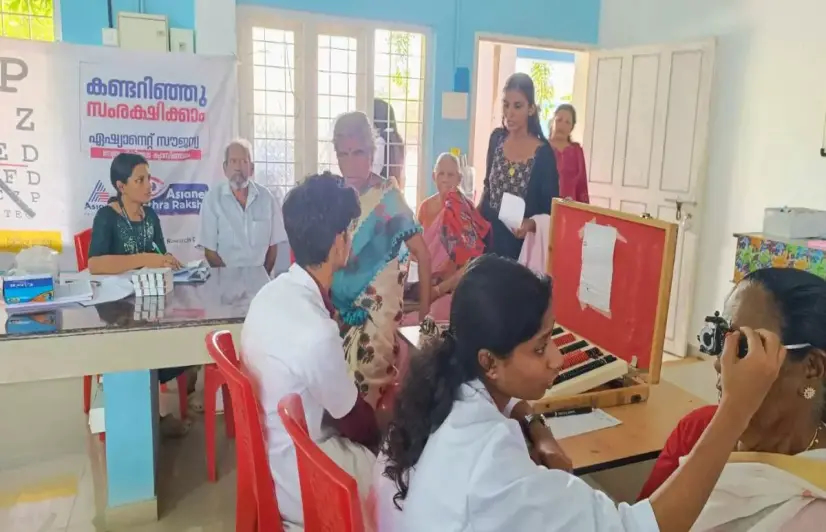
Patterns of early cataract are often visible in community eye camps. At one such camp organised by Little Flower Hospital in Angamaly, 12 of the 20 patients diagnosed with cataract reported long hours of daily sun exposure.
Ravikumar Mangalath was 44 when he was diagnosed. “It felt like a lightning strike,” he said. “Except I could only see it through my left eye.” Ravikumar, now 48, has worked as a security guard for years, standing outdoors from 7.30 am to 5.30 pm, through sun and rain.
“When I was a student posted to community eye camps in Alappuzha, the turnout was always high,” Dr Sanitha Sathyan recalled, who later conducted a study to understand pre-senile cataract prevalence in Kerala. “Usually, we see cataracts in patients above 60. But we often saw cataract in people under 50, without diabetes or trauma. Their sun exposure stood out.”
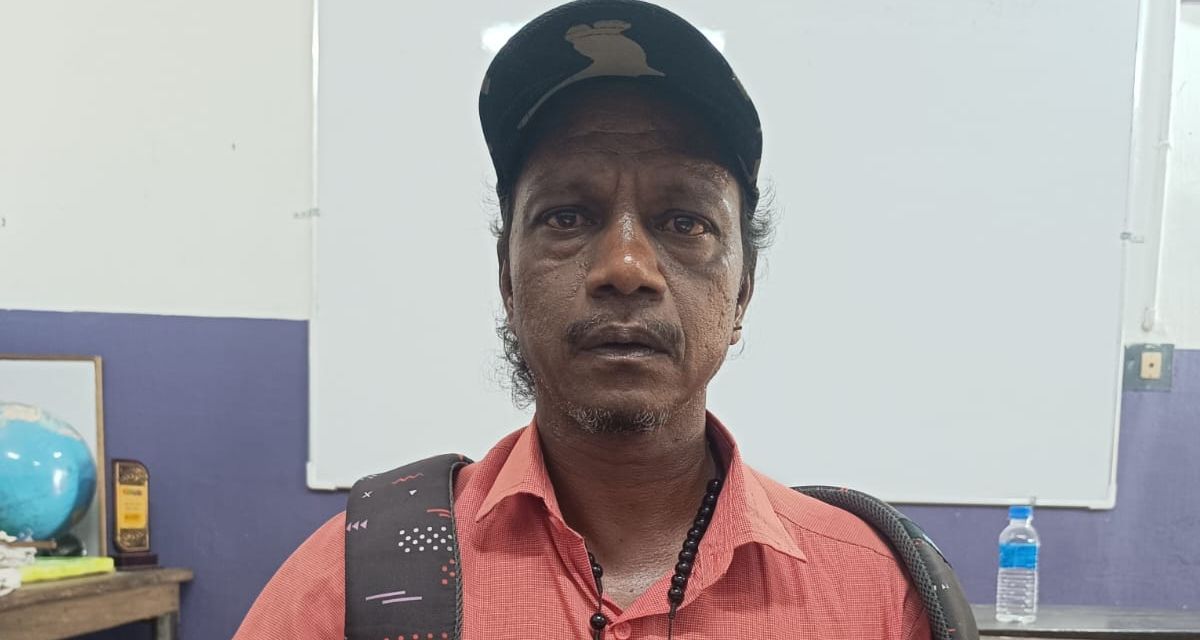 Ravikumar Mangalath, 48, waits at Angamaly eye camp to check the progress of his cataract (Photo - Nisha Matamp, 101Reporters)
What kind of UV reaches the ground
Ultraviolet radiation is classified into three types: UV-A, UV-B and UV-C. UV-C, the most harmful, is almost entirely absorbed by the stratospheric ozone layer.About 90-95% of UV-B is filtered out, while UV-A makes up most of the radiation that reaches the Earth’s surface.
“Even though UV-B forms a smaller proportion, it is far more biologically harmful,” said MG Manoj, a scientist at the Advanced Centre for Atmospheric Radar Research at Cochin University of Science and Technology. “Just 15 to 20 minutes of unprotected midday exposure can cause sunburn. UV-B also damages DNA and is linked to cataract formation.”
“When we analyse cataract cases,” said Soman, “people with long hours of sun exposure such as construction workers, fisherfolk, agricultural labourers…consistently show higher risk.”
Vavachan, now 65, has spent most of his life on construction sites in Kerala, later working briefly in Oman. He worked from 8 am to 5 pm, without hats or sunglasses. “I’ve lived under the sun all my life,” he said. “Is that why this happened?”
Rather than attributing cataract to a single cause, ophthalmologists describe it as the result of multiple interacting factors.
“Population-level studies show a link between UV exposure and cataract,” said Dr Sanitha Sathyan, ophthalmologist and editor of the Kerala Journal of Ophthalmology. “But for an individual patient, we look at several factors such as sun exposure, diabetes, hypertension, trauma. If other risk factors are absent, UV exposure may have played a major role. Still, we cannot say so with absolute certainty. To make a definitive claim, we would need extensive patient-level data and analysis across multiple variables.”
Kerala’s exposure
Kerala’s geographical location places it closer to the equator, where sunlight strikes more directly throughout the year. Cloud cover during the southwest monsoon limits UV exposure for several months, but clearer skies dominate much of the remaining year.
“Climate change has altered cloud patterns,” Dr Manoj said. “There are fewer sustained cloud systems and more broken or thin clouds. On partly cloudy days, UV levels can spike due to cloud-edge scattering, sometimes exceeding clear-sky levels.”
An analysis of Kerala’s ultraviolet index (UVI) between 2004 and 2022 by researcher Ninu Krishnan found that 79% of daily UVI values fell within the ‘very high’ or ‘extreme’ categories. Between 2005 and 2010, the proportion of days with high UVI increased sharply, even though year-to-year averages fluctuated.
The data does not show a smooth upward trend. Instead, it points to persistent high exposure, seasonal peaks, and short-lived spikes. These are the conditions that matter most for people who work outdoors for long hours, experts said.
A person’s geographical location shapes how much they are exposed to the harmful UV radiation. A 1995 study by ophthalmologist Jonathan C Javitt found that moving one degree closer to the equator increased the likelihood of cataract surgery by 3%.
“Landscapes affect UV penetration,” Manoj added. “Dense forests reduce exposure. Coastal areas increase it.”
Beaches reflect sunlight. Dry sand can bounce back up to 30% of incoming radiation. Sea surfaces scatter light off waves, increasing effective exposure. Coastal air contains aerosols that further diffuse UV from multiple directions. “People receive radiation from above and below,” Manoj explained.
This matters in Kerala’s coastal districts.
Mary Sebastian, assistant administrator at Little Flower Hospital, described a similar pattern. “In the 1990s, each camp saw 600-700 patients, with about 15% diagnosed with cataract. In coastal areas, that figure often went up to 30%.”
An Indian Council of Medical Research study comparing cataract patients in Gurugram, Guwahati and Prakasam district in Andhra Pradesh found that although lifetime sun exposure was highest in Gurgaon, measured UV levels were highest in Prakasam. Cataract prevalence followed UV levels rather than exposure duration alone.
Kerala’s cataract surgery targets have more than doubled — from about 98,000 in 2006-07 to over 2.1 lakh in 2024-25. Coastal districts such as Ernakulam, Thiruvananthapuram and Malappuram have consistently recorded the highest numbers.
Between 2020 and 2025, cataract surgeries rose by 28% in Ernakulam, 23% in Thiruvananthapuram and 12% in Malappuram.
Despite this, awareness of the UV-cataract link remains limited. The Kerala State Disaster Management Authority issues UV alerts, but they are rarely connected to eye health.
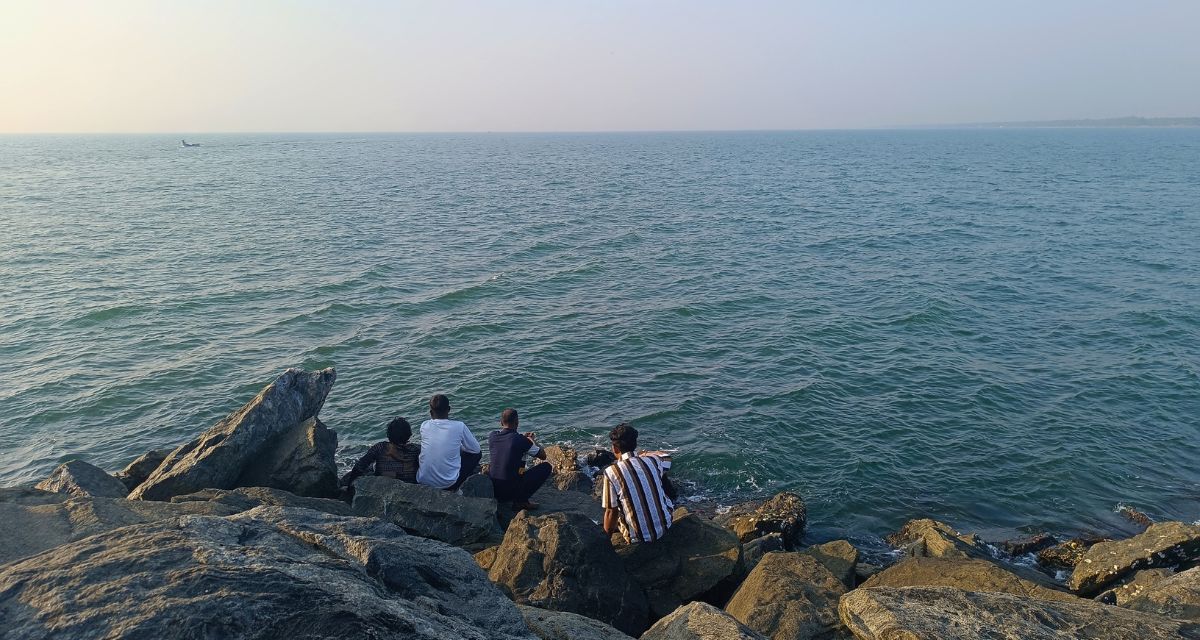 Fishermen sitting in the sun (Photo - Nisha Matamp, 101Reporters)
The cost of delay
A 2019 study estimated that poor eye health costs India 0.57% of its GDP, through lost employment, reduced productivity, caregiving burdens and premature mortality.
“I remember a fish vendor in her sixties,” Sanitha said. “She could barely read currency notes but had not told her family because she feared the cost. After surgery, her life changed.”
For Vavachan, cataract altered daily work. Unable to compete with younger migrant labourers, he now limits himself to small construction jobs in his village. He supplements his income by fishing with a Chinese net outside his coastal home. The net needs frequent mending, costing up to Rs 3,000 each time. “If my eyesight was better, I could fix it myself,” he said.
Augustine CJ, 69, a house painter from Alappuzha, has stopped travelling for work. “I cannot read bus boards,” he said. “Now we survive on my pension and my wife’s income.”
Meanwhile, Anju Baby, a project officer at Little Flower Hospital, told 101Reporters that “at eye camps, only about 30% of those diagnosed with cataract actually undergo surgery,”.
Surveys show that financial constraints, lack of caregivers, fear, and poor access remain major barriers.
Many patients below the poverty line wait specifically for free eye camps. “We now conduct at least four camps a week,” Mary Sebastian said. The load per camp has reduced because more institutions now organise eye camps, but the need remains high.”
When NSS students of a school in Alappuzha organised a weekday camp, 153 patients attended in three hours. Seventeen were diagnosed with cataract. Vavachan was among them.
Treating cataract, amid constraints
Kottayam Medical College, once the primary referral hospital for five districts, has faced repeated infrastructure failures. For over a year, its OCT eye scan machine remained non-functional. Patients were sent eight kilometres away for scans, only to return with photographs of results stored on mobile phones after the printer at Kottayam General Hospital stopped working.
Laser machines too were unavailable for long periods, forcing patients to travel to Ernakulam or Alappuzha. One new machine has recently been installed, but slots remain limited.
An ophthalmologist at the medical college said an additional OCT and laser machine would significantly reduce patient burden.
Despite cataract being a treatable condition, its consequences accumulate quietly, under the sun, over decades, before patients arrive at hospital doors. For many in Kerala’s coastal and outdoor-working communities, that arrival comes earlier than expected.
This project is supported by the Internews Earth Journalism Network with funding from the Swedish International Development Cooperation Agency (Sida) Cover photo - Eye camp happening at St. Raphael HSS, Alappuzha (Photo - Nisha Matamp, 101Reporters)
Would you like to Support us
101 Stories Around The Web
Explore All News