The Rajasthan village where a goddess guards the trees

The Rajasthan village where a goddess guards the trees
In Gola village of Ajmer district, a centuries-old belief in goddess Kalki has preserved a dense green forest and stable water levels, even as the surrounding region turns drier.
Ajmer, Rajasthan: “I grew up in Jethana village in Rajasthan’s Ajmer district, where water was never scarce,” said Geeta Gujjar (29), who married in 2001. “So when I married in Gola, everyone told me it was a dry village. But the first time they took me to the Kalka Temple, I was shocked…I had never seen such a dense, lush forest.”
Like her, many who come from her parents’ village are surprised to find a thick green forest in Gola, in the Pisanghan block.
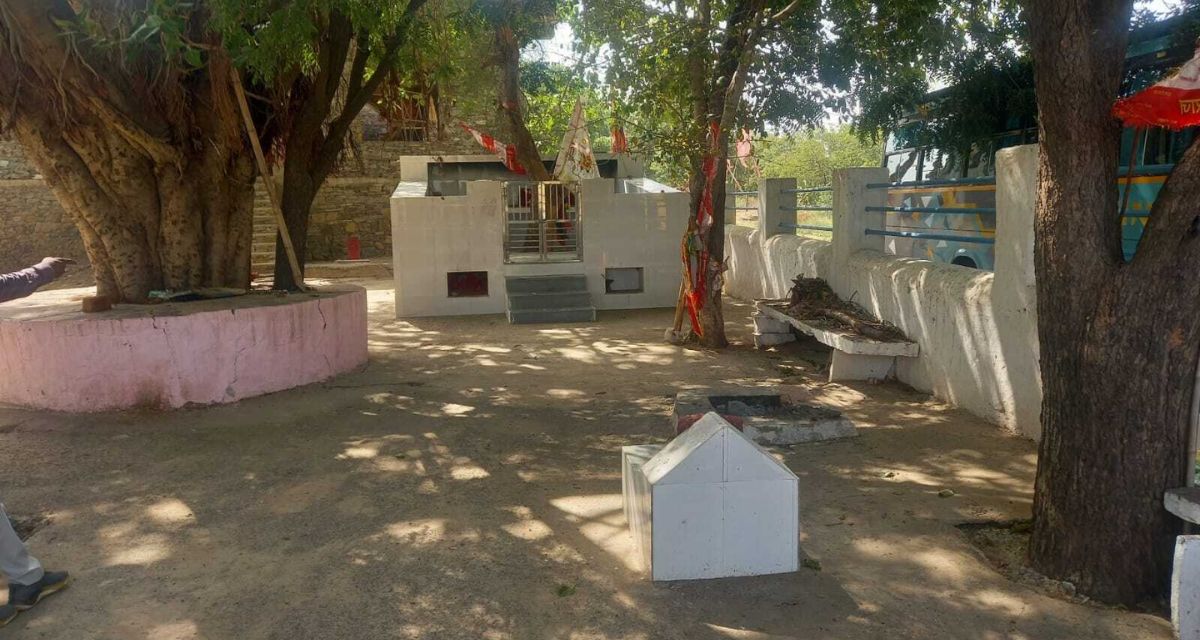 Temple in the Gola village which is surrounded by forest (Photo - Kahitiz Gaur, 101Reporters)
Located opposite the Aravalli ranges, Gola is a semi-arid village with hard, rocky soil beneath the surface, salty groundwater, and temperatures that swing from 42°C in summer to 5°C in winter.
Yet a 700-bigha (175-hectare) forest of Khejri (the state tree), Neem, Pipal and Babul thrives here, protected by a long-standing tradition of never carrying an axe into the forest. As one approaches, the air turns noticeably cooler and birdsong fills the area. In some stretches, the canopy is so dense that sunlight barely filters through. “The smell of neem leaves is enchanting. In peak summer, it feels like an oasis. I believe the Goddess herself looks after this place,” Gujjar added.
Data from the India Meteorological Department (IMD) shows wide variation in Ajmer’s peak temperatures and rainfall over the last decade. The highest July temperature in this period was recorded in 2012. Temperatures then dipped for a few years before rising again in 2018, staying above 40°C in 2018, 2019, and 2020.
A report by the Rajasthan Ground Water Department, Ground Water Level Scenario in Rajasthan, 2022, noted that Gola maintained its groundwater levels better than nearby villages that year.
The state irrigation department, which kept records of all 27 lakes and ponds in the district, issued a report on their water levels every year before the monsoon arrived. The department stated that even the level of Pushkar pond, a religious site, fell to 2 to 3 feet, while Gola pond in the forest of Gola village never went deeper than 5 feet, even in the hot summers.
Villagers trace this resilience to their long-held cultural practice. “When we were born, we were told this is the tradition our forefathers followed, so we follow it too,” said Himmat Singh Rathore. “Everyone knows the axe is not allowed. There is no written instruction but everyone obeys it.”
The belief stems from a local legend of deity Kalki, who is said to roam the forest. According to Rathore, she once grew angry when a villager carried an axe and left the land barren. “This is why our land is not good for cultivation,” he said. While the forest is not used for livelihood, it provides shade during harsh summers and helps recharge groundwater in the semi-arid region.
Protected by culture
Gola has about 20 hectares of pond area protected by an anicut system. “The pond is maintained by the Gram Panchayat and holds clean water. It does not dry up even in summers,” said Ramchandra Rar, Additional Chief Engineer of the Public Health Engineering department. Sarpanch Suman Kanwar (38) added, “Even the branches that dry out are collected but not burnt. No tree has been cut in the last 20 years since I came here after marriage.”
During the first full moon of the monsoon, the village celebrates Haryali Purnima, a thanksgiving festival for goddess Kalki. Women sing traditional songs in new clothes with veils, men wear fresh turbans and carry sticks, and artisans bring their crafts to sell. Children ride swings. The festival reaffirms the idea that greenery is sacred and is celebrated in the popular song Haryali ma rahti Kalka mata (The goddess resides in greenery).
The forest also sets Gola apart from its surroundings. While much of Pisanghan block has turned into a quartz and phosphorus mining area, Gola still shelters foxes, occasional leopards, and a large variety of birds. Villagers speak of the cuckoo’s calls bringing “flashes of happiness” in summer, and the monsoon peacocks that gather across the forest.
“Our elders told us that when our ancestors were roaming for a place to settle, they reached here tired after crossing the Aravallis,” said Durga Bai Kumawat (72). “The summers were harsh, so they prayed to Mata Kalki. She brought out this forest in such arid land. That is why our family settled here.”
There is no scientific study yet on this tradition, but its effects are visible. “This forest is our belief and our culture,” said Rathore. “Because of it, the groundwater is maintained and the anicut pond holds water through all twelve months.” Nearby ponds, Kesholav, Govindgarh, Dantra and even the Luni river, dry up in summer, villagers say, but the Gola pond does not.
Residents say the taboo around cutting wood has held strong for generations. “Even before LPG, when we used firewood, no one collected dead branches from the Kalka Mata forest,” said Manna Devi Meghwanshi. “My mother-in-law taught me this, and I am passing it to my daughter-in-law.”
Last monsoon, the villagers expanded the forest by planting Neem, Babul and Pipal on 120 bighas of adjoining government land. “We got the saplings from the forest department,” said Sarpanch Kanwar. After the rains, a three-member panchayat team checks which saplings have taken root.
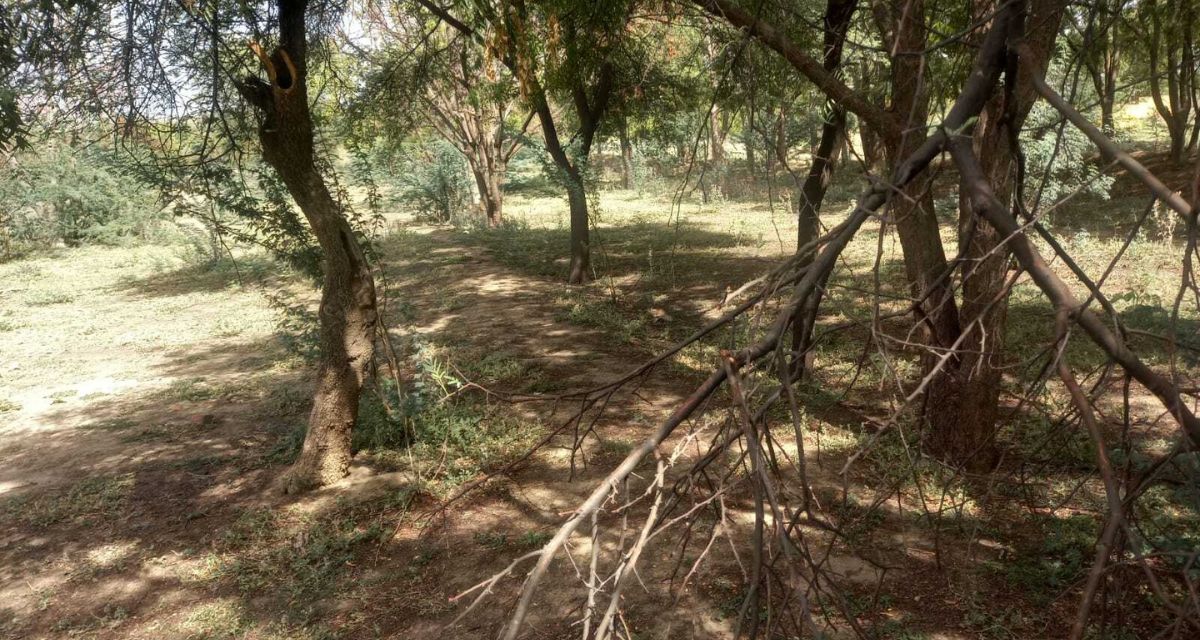 The forest around the temple, it is a dense green forest with stable water levels (Photo - Kshitiz Gaur, 101Reporters)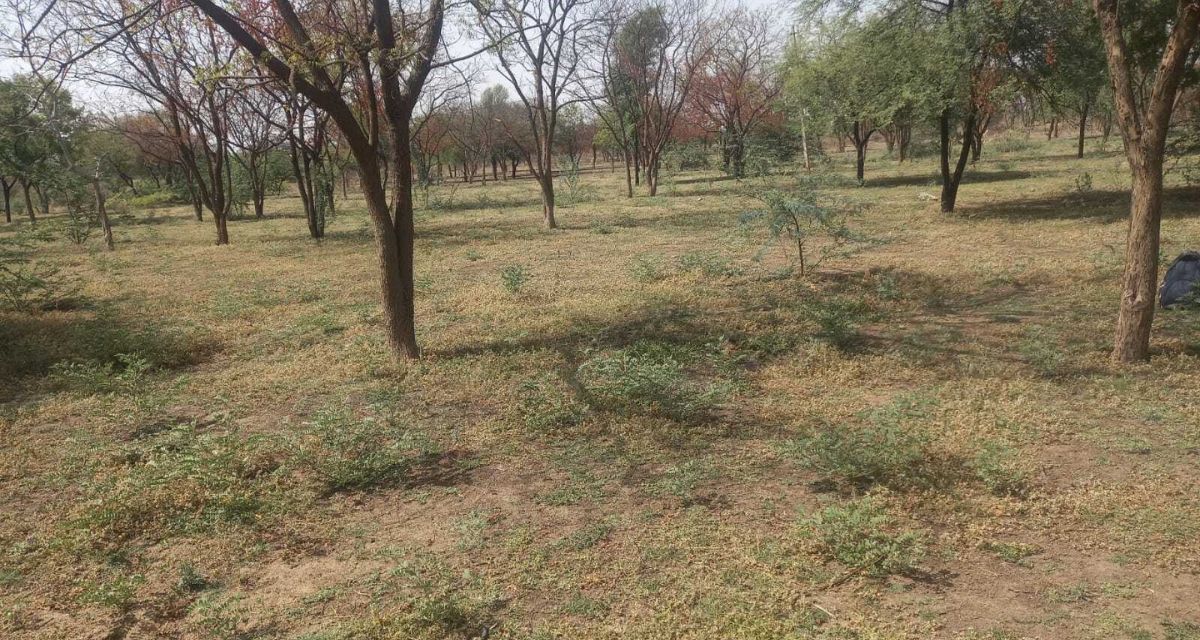
Thriving ecosystem
Professor Praveen Mathur, former Dean of Environment Studies at Maharashi Dayanand Saraswati University, who has studied bird migration in arid zones, visited Gola in 2021. “It was June, and the temperature inside the forest was 2-4 degrees lower,” he said. “There were native birds like the Indian peafowl, red-vented bulbul, Indian robin, and rose-ringed parakeet nesting there… species that are rare even in Ajmer. Villagers have managed to preserve this forest purely through tradition.”
On the main road to Pisanghan, wood dealer Ramdhar Jangid sells coal and legally sourced wood. “I have never taken wood from the Kalki Mata forest,” he said. “It is forbidden. She is our deity from generations.”
Officials posted in the area say Gola stands out. “When I joined the block, I was astonished to see the forest,” said Shyam Lal Chachwa, Assistant Development Officer, Zila Parishad. “We planted more trees with villagers’ help. They are eager participants.” Assistant Engineer Tejpal Gujjar added, “In my previous posting in Silora block, people were not happy with plantation drives. This place is different.”
Nearby villages are beginning to draw inspiration. “These traditions protect the pond and the forest,” said Kamla Devi, Sarpanch of Lamana. “We want to start similar practices in our village.”
Rajasthan is often pictured as a place where women walk kilometres with pots of water, a land defined by heatwaves, droughts and desert stretches. But patches like Gola show another reality, green belts sustained not by natural abundance, but by cultural traditions of environmental care. These practices, villagers say, do more than protect forests: they help slow the pace of climate stress.
This project is supported by the Internews Earth Journalism Network with funding from the Swedish International Development Cooperation Agency (Sida)
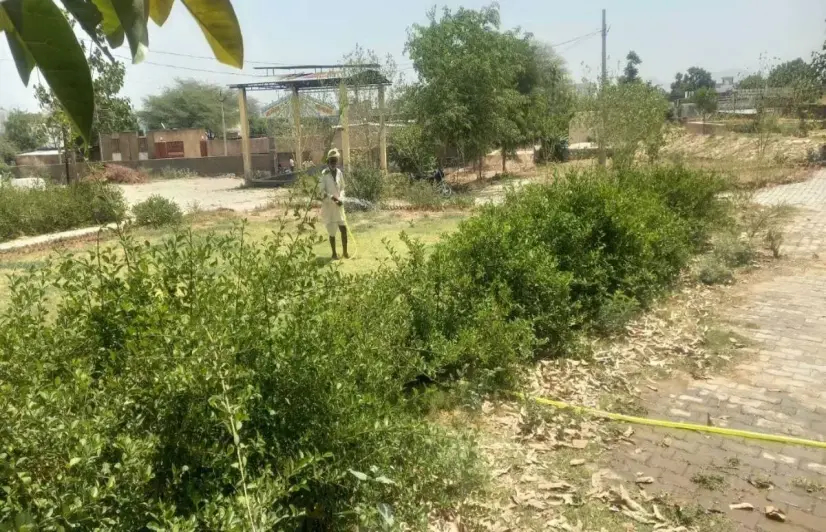
Cover photo - Way towards the Gola village forest (Photo - Kshitiz Gaur, 101Reporters)
Would you like to Support us
101 Stories Around The Web
Explore All News