In Rajasthan’s Badopal, a wetland created by floods divides a village


In Rajasthan’s Badopal, a wetland created by floods divides a village
Hanumangarh, Rajasthan: “We have no quarrel with the birds,” said Khiraj Sihag, 60, a resident of Badopal in Rajasthan’s Hanumangarh district, where nearly six decades ago floodwater from the seasonal Ghaggar river was diverted into low-lying land, creating 18 large water bodies. The water bodies now support fish, aquatic vegetation, and resident and migratory birds.
“But if you want to keep the birds, you need water too. We don't want Ghaggar's water, nor do we want to see the birds,” he told 101Reporters.
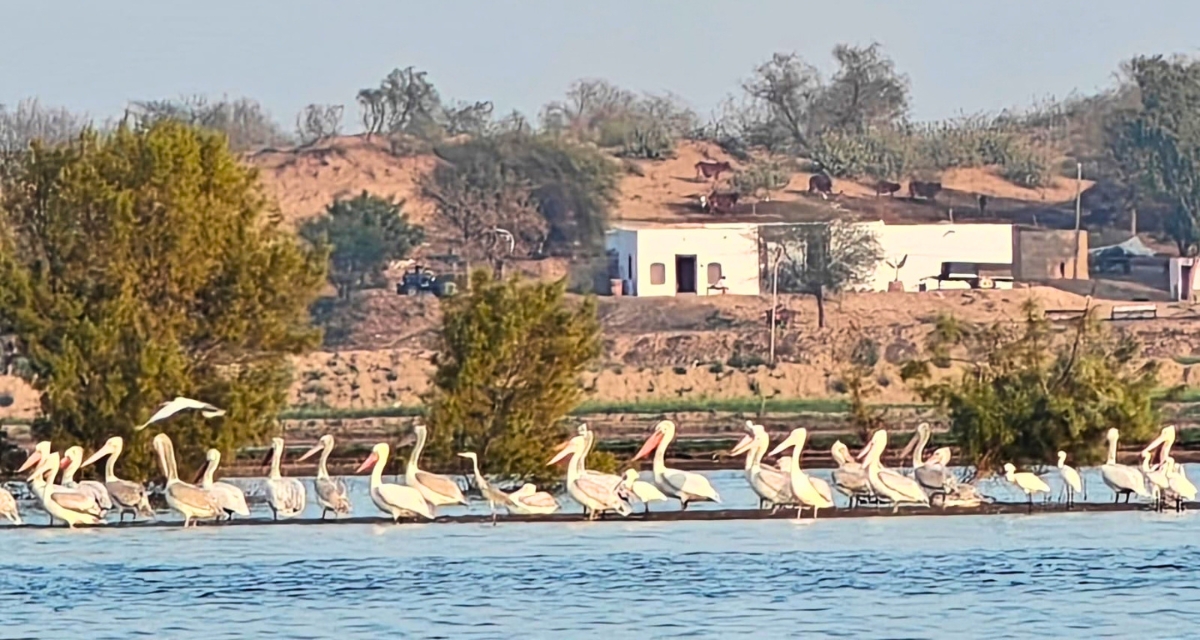 Birds frolicking in the water spread across Badopal (Photo - Rajat Soni, 101Reporters)
For Sihag, the water means sem, or waterlogging. He and his four brothers own about 100 bighas of khatedari land in Badopal, much of which, he said, lay under several feet of water for almost 30 years after water accumulated in the low-lying areas and raised the groundwater level. The water has since receded, but he said about half their land is affected again when excess water from the Ghaggar reaches the area.
His wariness now has a new focus. In 2024, the Rajasthan Forest Department began the process of marking 2,062.255 hectares of Irrigation Department land in Badopal Barani as “deemed forest”, in line with the Supreme Court’s directions. The term covers land treated as forest under forest-conservation law even if it was never formally notified as forest, and the status can restrict non-forest use. According to the Forest Department, the proposed area includes the same low-lying depressions where Ghaggar water accumulates and birds arrive. The Irrigation Department has objected in writing, saying the status could hinder flood-control work.
An accident that became an ecosystem
Seen from a distance, the water bodies around Badopal hardly look like part of a desert. Birds live here all year. In winter, thousands of migratory birds gather alongside local ones, while fish and aquatic plants thrive in the water. A short distance away are sand dunes, desert scrub, fields and villages.
None of it was planned. The Ghaggar is a seasonal river that rises in the Shivalik hills near Chandigarh and reaches Hanumangarh through Punjab and Haryana. Nearly six decades ago, its monsoon floods spread across the region. To control them, the Ghaggar Diversion Channel, which locals call the “Semnala”, was built. About 15 cuts in it released excess water into the low, sandy ground nearby. Year after year, the water spread and 18 large water bodies formed.
Fish, aquatic plants and small organisms arrived with the water. Local birds settled, followed by migratory species from Siberia, Europe, China and even Australia. Greater Flamingo, Northern Shoveler, Garganey, Knob-billed Duck, Black-winged Stilt, Ruff, Common Coot and Demoiselle Crane have all been recorded here.
A study of the wetland found four distinct ecosystems in one place: desert vegetation with small dunes, human settlements, farmland and wetland. It also identified farming expansion and livestock pressure as threats and called for greater community awareness and participation in protecting the area.
Bholu Abrar Khan, 71, spent about 40 years at Bharatpur’s Keoladeo Ghana National Park before retiring as a Range Forest Officer. He said that during a departmental survey of the Badopal area some years ago, he saw “lakhs” of birds.
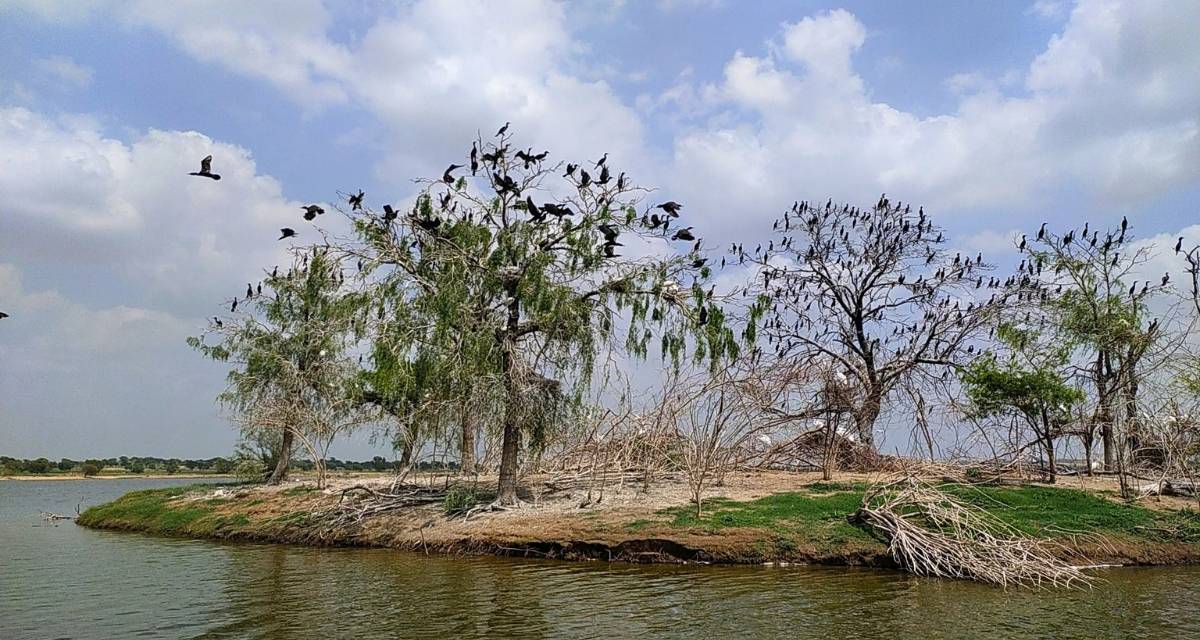 Birds perched on trees on an island surrounded by water in Badopal (Photo - Amarpal Singh Verma, 101Reporters)
A sanctuary that never was
The Rajasthan government’s 2013-14 budget announced that Badopal would become a bird conservation area or sanctuary. A plan was drawn up for about 60,000 hectares, later reduced to about 5,000. The proposal was cancelled about a decade ago, with the government saying that enough land was not available for such a large sanctuary.
Local residents, however, attributed the decision to political pressure. Environmental activist Anil Bishnoi said all the proposed land was government-owned and that the government could have gone ahead with the plan. Influential people who were illegally cultivating the land, he alleged, opposed the sanctuary and used their influence to stop it.
Meanwhile, the wetland’s water has dwindled. Except on three or four occasions in the past 10-15 years, the Ghaggar has not carried its old volume. Lower rainfall in its catchment, increased water-holding arrangements at Ottu Headworks in Haryana, and the shrinking of its traditional flow area under farms and settlements have reduced the water reaching Rajasthan. When it does arrive, some still reaches the depressions through the Semnala. Not all 18 fill, but locals say many retain water and the birds return.
For Rameshwar Jalap, 71, a former sarpanch of Badopal, the water was once a promise. He remembers 1968, when the channel’s water first arrived. Drinking water was then several kilometres away and the groundwater was highly saline. Villagers hoped the river would end the desert’s thirst.
Some farmers refused to give up land for the depressions, saying they would seek no compensation if the water damaged their fields. But the water did not drain. It stopped at a layer of gypsum below the surface, Jalap said, and from around 1977 the water table rose and sem set in. Gypsum, mineral and salt crusts appeared on the surface, leaving thousands of bighas barren.
“Out of our family’s 50 bighas of land, 10 bighas were acquired for the depression and we got land elsewhere in exchange, but the remaining 40 bighas in the village also went under water,” Jalap said. “We were left with nowhere to go.”
Sihag recalls the 1990s as the worst period. By his account, the entire village was submerged, about 10,000 bighas were affected, and hundreds of houses, temples, hospitals, schools and the grain market were flooded. People rebuilt on higher ground.
“We don’t want those conditions again.”
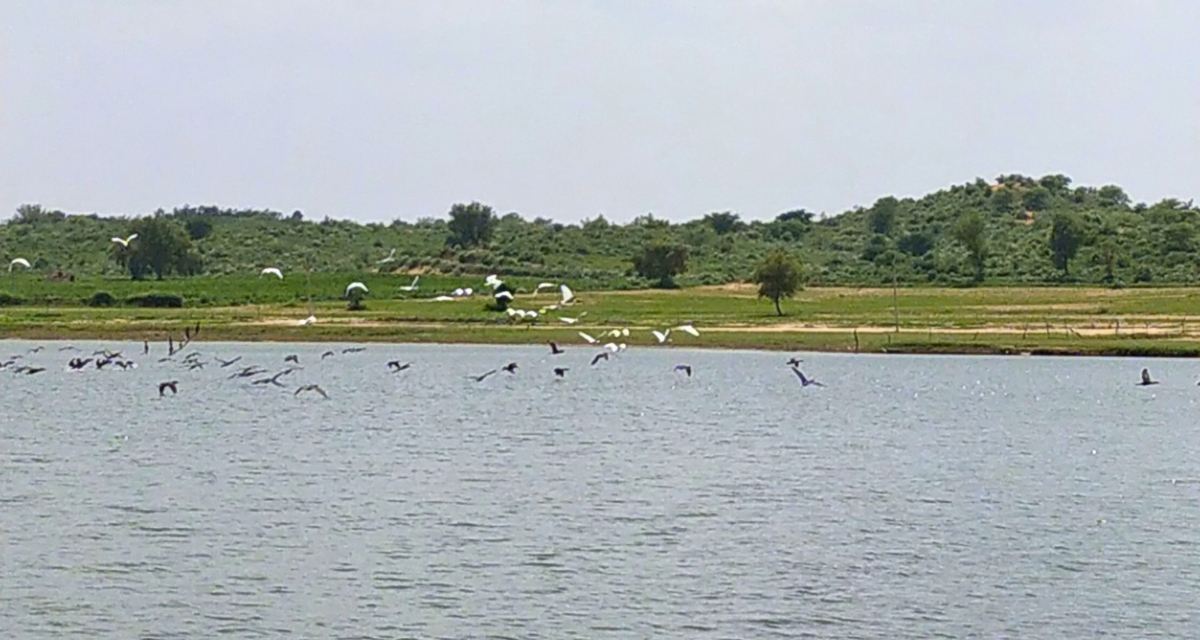 Birds frolicking in the water spread across Badopal (Photo - Amarpal Singh Verma, 101Reporters)
 The state on both sides of the water
Government records show the same tension. According to information the state gave the Assembly, 5,085 hectares across 68 chaks in the Pilibanga constituency are affected by sem. The state built drains, pump houses and other drainage infrastructure to tackle the problem. A pilot project worth Rs 460.66 lakh was sanctioned in 2000. Pumping began in 2003. A drain from Bhairusari via Jakhrawali to Badopal followed in 2005-06, and a pump was installed at Jhuriyawali in 2006.
Since 2019, four pumps with a combined capacity of 60 cusecs each at Badopal have sent sem water through a pipeline into the Ghaggar’s Depression No. 06.
In other words, the state pumps waterlogged water out of farms and into the depressions it is now proposing to protect. Fishing contracts have also been awarded in the same area. Sihag sees a contradiction. The government explored a bird sanctuary in the wetland created by this water, he says, while spending crores to pump the water out and awarding fishing rights in the same area.
“Even the government itself doesn't know what it wants to do.”
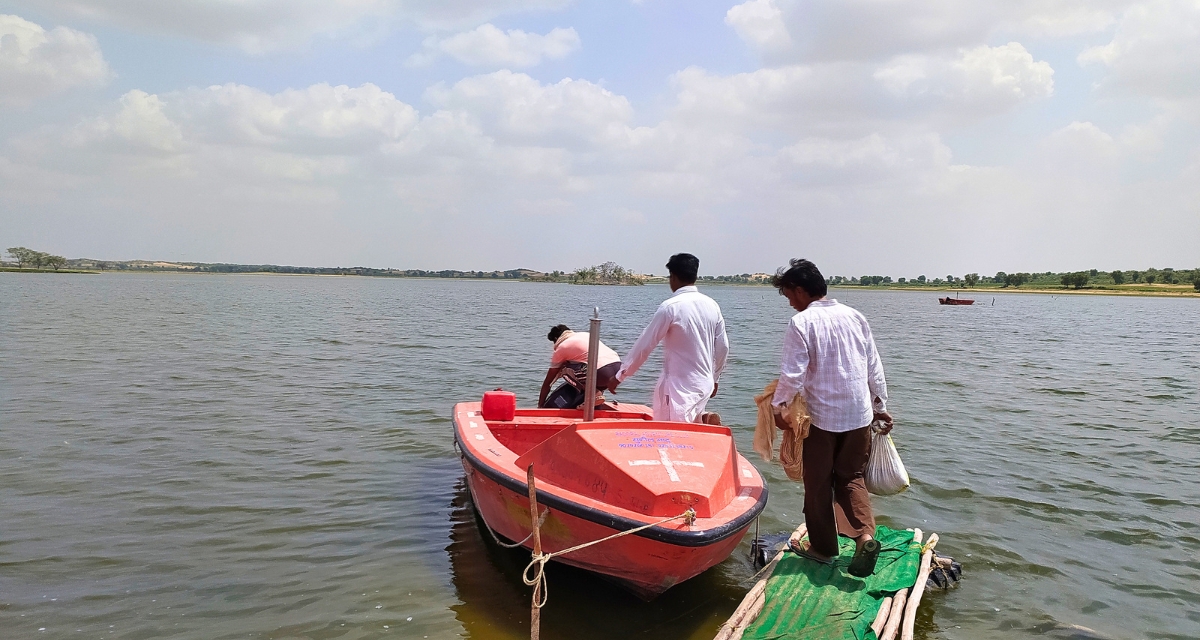 People travelling by motorboat on the lakes in Badopal (Photo - Amarpal Singh Verma, 101Reporters)
Whose land is it?
The proposal sits on land with a contested history. Harchand Singh Sidhu, 87, a former Pilibanga MLA, said about 8,000 bighas were acquired for flood control around 1967 — 7,000 in the Suratgarh area and 1,000 in Rawatsar.
Farmers were given land elsewhere, he said, but the acquired land was not recorded in the Water Resources Department’s name for a long time. Cultivation resumed, and he claims thousands of farmers now cultivate it illegally, harming bird conservation. He said he met the department’s Chief Engineer about two and a half years ago and was promised action, but nothing concrete has followed.
Villagers, however, describe a different picture. Surendra Meghwal disagreed that most people farm the acquired land and says a few may sow crops when the water dries. Sanjay Jakhar, 24, said it is common. Of his grandfather’s 42 bighas, 12 were acquired for a depression, and the family received land in a nearby village. When the acquired land dries, they plant on it, as do most others whose land was taken, he said.
Anil Bishnoi, an environmental activist from Lakhasar, said the land is government land and the opposition comes from influential people who have farmed it for years.
What the objectors say
Gagandeep Jandu, Assistant Conservator of Forests in Hanumangarh, said the process began in 2024 under the Supreme Court’s directions. Khasra-wise details were released and objections invited. Villagers have opposed the proposal and are repeatedly submitting objections to the administration, he said. The Irrigation Department’s Ghaggar Flood Control Division has also objected in writing, citing legal and practical obstacles to flood-control work.
Dharmendra Mochi, another former Pilibanga MLA, opposed the proposal.
“The Forest Department can build whatever it wants on its own land,” he said, “but we will not allow it on Irrigation Department land because it will affect flood control, and farmers will also face difficulty in reaching their fields.” He said he recently took the demand to the Forest Minister and the Head of Forest in Jaipur. Meghwal asked what happened to people’s movement given the private land around the site.
Sihag feared the designation will reach beyond government land. Asked whether he would give up his private land if the state sought it for bird conservation, he said: “We will not give our land under any circumstances.”
The area is rain-fed, he said, and land rates are low. “What will we get? We get no benefit from the birds. It is only loss, loss and more loss.” Swami wants the Ghaggar’s water kept out altogether and diverted towards Jaisalmer. “If a deemed forest is created, we will be ruined,” he said.
The other village
Not everyone in Badopal sees only loss. Sunil Bhadu, 44, started the Badopal Adventure Club to make villagers aware of the wetland, attract tourists and build local facilities. “This wetland in our village is in itself a unique ecological area and a unique gift of nature,” he said.
He said thousands of birds of more than 250 species winter and breed here, and many have settled permanently. Three years ago, he began boating trips. Winter visitors now come from across the country, and homestays are under consideration. He pictures a nature circuit linking Badopal with Hanumangarh’s 1,700-year-old Bhatner Fort, the Bhadrakali Temple and Kalibangan, a centre of a civilisation older than Harappa.
Rajat Swami, 23, films the lakes and birds daily for social media. “When tourists come from far away after watching my videos, it gives me great happiness.”
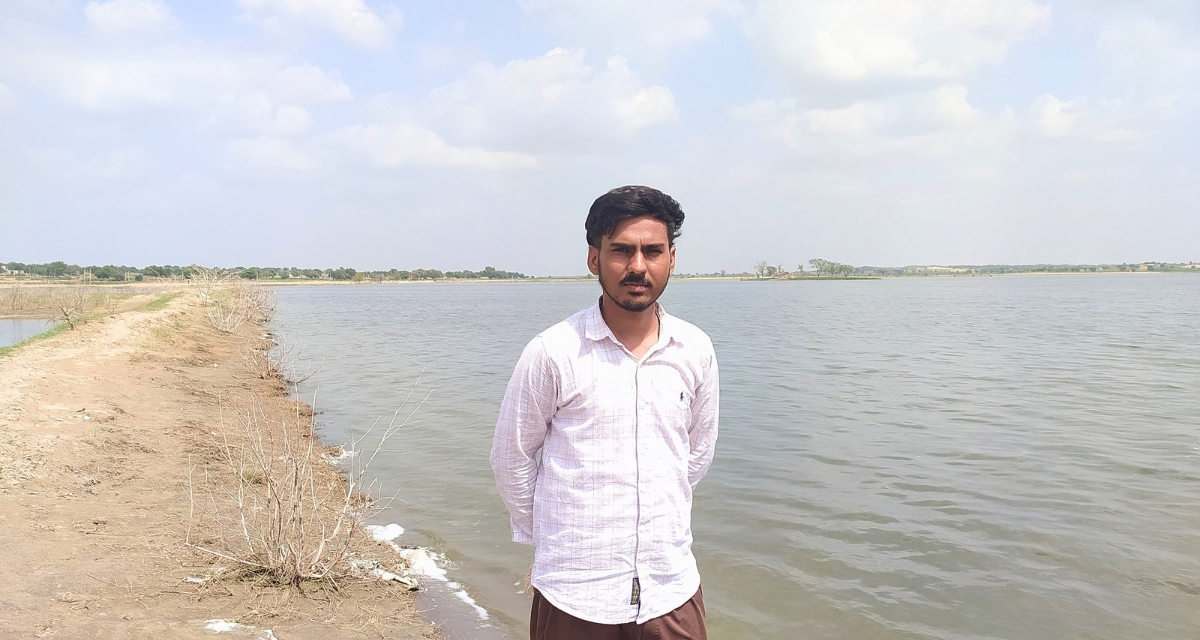 Social media influencer Rajat Soni standing on the banks of the lake in Badopal (Photo - Amarpal Singh Verma, 101Reporters)
Bhadu knows he is outnumbered. He puts support for the idea at about 20% in a village of roughly 5,000 people. His own 50 bighas have yielded no crop in 40 years except in 2022. “There is a disaster in the village; instead of grieving over it, we should look for opportunity in it. How long will we keep waiting?”
This story was produced under the Biodiversity Reporting Fellowship, supported by Earth Journalism Network.
Cover Image - Birds frolicking in the water at dusk in Badopal (Photo - Rajat Soni, 101Reporters)
Would you like to Support us
101 Stories Around The Web
Explore All News