How Coastal Erosion Is Changing Women’s Lives in Odisha’s Baliapal

How Coastal Erosion Is Changing Women’s Lives in Odisha’s Baliapal
Odisha, Balasore: “My brother and his friends used to play cricket there. Now there is the sea. The school where I studied is now under the river.” For Subasini Giri, the disappearance of her school is a reminder of how much the landscape around her has changed. The playground where children once gathered and the school where she spent her childhood have been swallowed by the Subarnarekha River.
She lives in the Baliapal block of Odisha's Balasore district, where coastal erosion has forced families to leave their homes and agricultural land. The river has eaten into villages, while the sea has advanced towards settlements from the other side. For women, the loss extends beyond homes and farmland. It includes land inherited from their parents or received at marriage, trees that provided an income, markets where they met friends and places associated with their childhood.
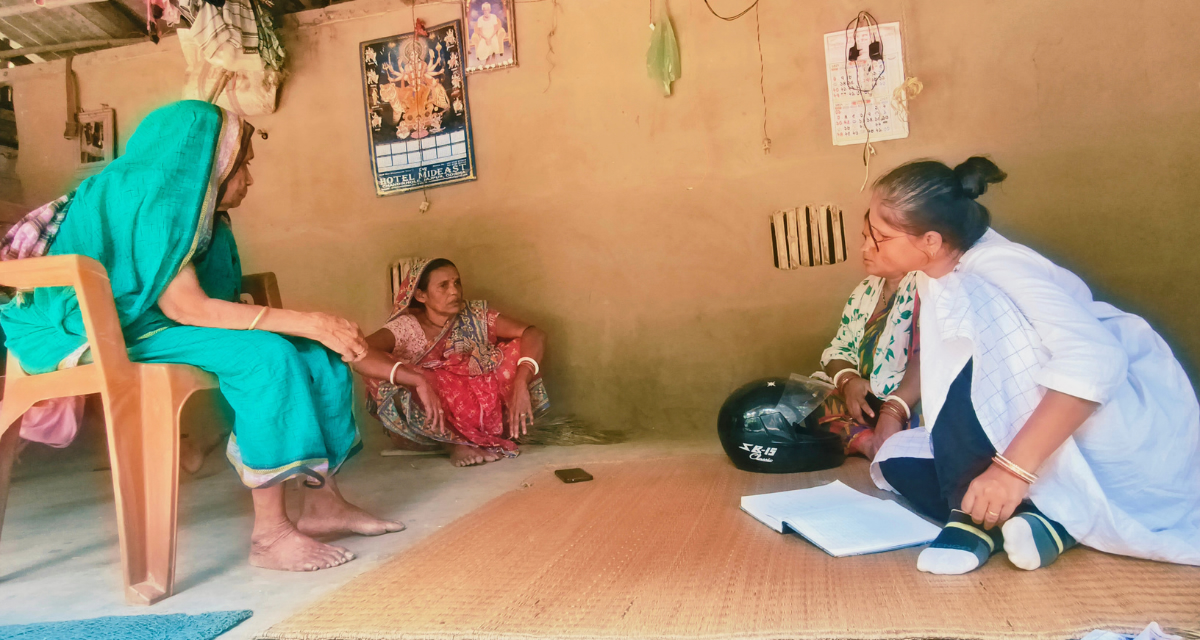 Subhasini Giri (middle) explains about her school loss and land loss and remembers her childhood memory (Photo - Prativa Ghosh, 101Reporters)
Brahmamani Barik, 80, remembers when her family owned 2 acres and 80 decimals of land. There was a house, three ponds and orchards of mango and coconut trees. The family also cultivated potatoes, onions, chillies, cucumbers, turmeric and paddy.“We never faced any difficulty in making ends meet,” she says.
About 25 years ago, the river washed away their land, house, ponds and orchards. “We fled for our lives and left everything behind. The government did not provide any assistance to families displaced by the river at that time,” she says.
Today, the family has no agricultural land. Her son works as a barber in nearby villages. Brahmamani, however, has preserved the land deed for the property that disappeared beneath the river. The family continues to pay land revenue on it.
“The document is still kept safely in a box,” she says. “My grandchildren need land certificates for their education. We still use these documents.” Her son, Sanatan Barik, says several families continue to use land documents for property swallowed by the river when applying for residential certificates.
“Even though the river has taken our land, the land deed remains our identity. Without it, how could we prove to the government that we belong here?” he asks. Records obtained through a Right to Information application from the Baliapal tehsildar's office show that Chamukh has lost an estimated 1,826.25 acres to the river. Four neighbouring villages – Bainchuan, Harinakuili, Dhamatput and Satguhalia – have lost another 444.71 acres.
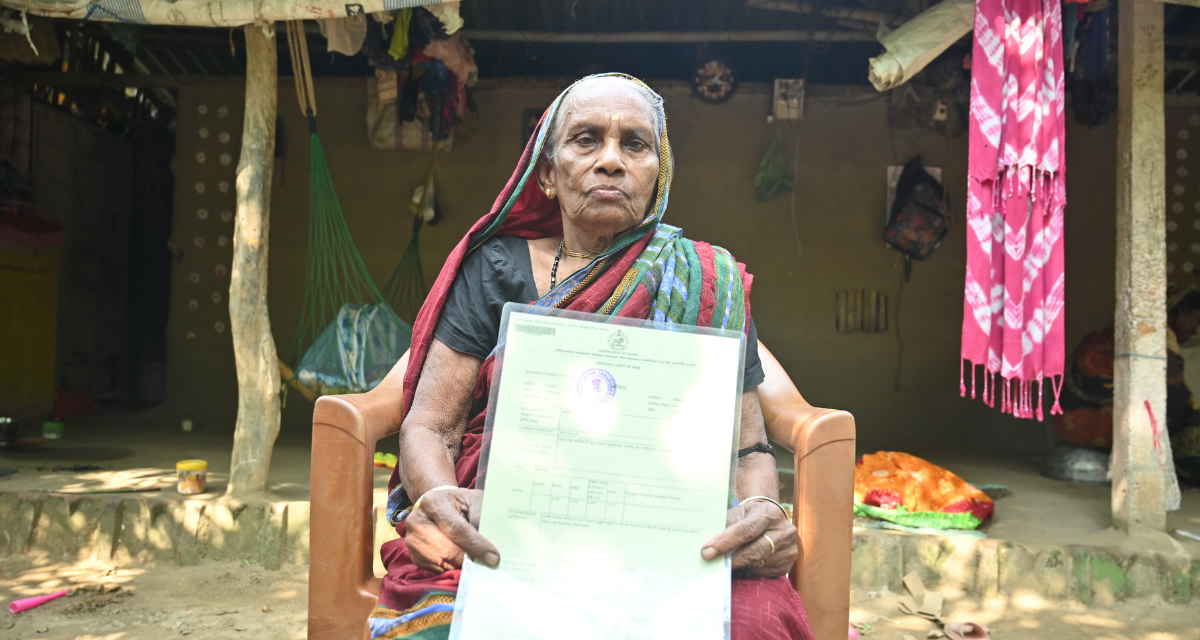 Brahmani Barik shows her land records (Photo - Prativa Ghosh, 101Reporters)
Losing an inheritance
For women in the villages, land was not only a source of agricultural income. It was also part of the property they received from their families when they married. Sandhya Giri's father gave her two acres of land when she got married. The river has since swallowed it. “When a daughter got married, families would give her a piece of land. My father gave me two acres. The river took that away too. Now, when we marry off our daughters, we have to depend on relatives. The marriages are managed with whatever they can give us,” she says.
Sandhya's family lost six acres to the river and eventually left the old Kankadapal village, where her family had lived for generations. The settlement, nearly 80 years old, now lies beneath the Subarnarekha. Her family moved to its present location 26 years ago, along with around 25 other families who had also been displaced. They initially hoped to make a living through fishing.
But the sea, which was about three kilometres away at the time, gradually moved closer. Sandhya says her family has shifted its house twice more because of the sea, after moving it nearly three times because of river erosion.
The family also experienced flooding during cyclones. During Cyclone Phailin, seawater entered their house, forcing them to seek shelter. When Cyclone Yaas struck in 2021, seawater entered the house again. Her son, Santosh, who had worked for nearly 18 years at an imitation jewellery company in Mumbai, eventually left his job and returned home.
“We live with the constant fear that the sea will swallow our home. Sometimes we think of leaving, but where will we go? We no longer have the financial means to take the entire family somewhere else and build another house,” she says. Sandhya is not the only woman to have lost land received at marriage. Mausami Giri says her father also gave her two acres, which have since been swallowed by the river.
For these women, the loss has meant giving up property that could have provided an independent source of income and security.
Land also played a role in marriage arrangements in the area. Rebati Giri, 82, says some families gave land to daughters when they married, while others transferred land to the bride's family as part of marriage arrangements.
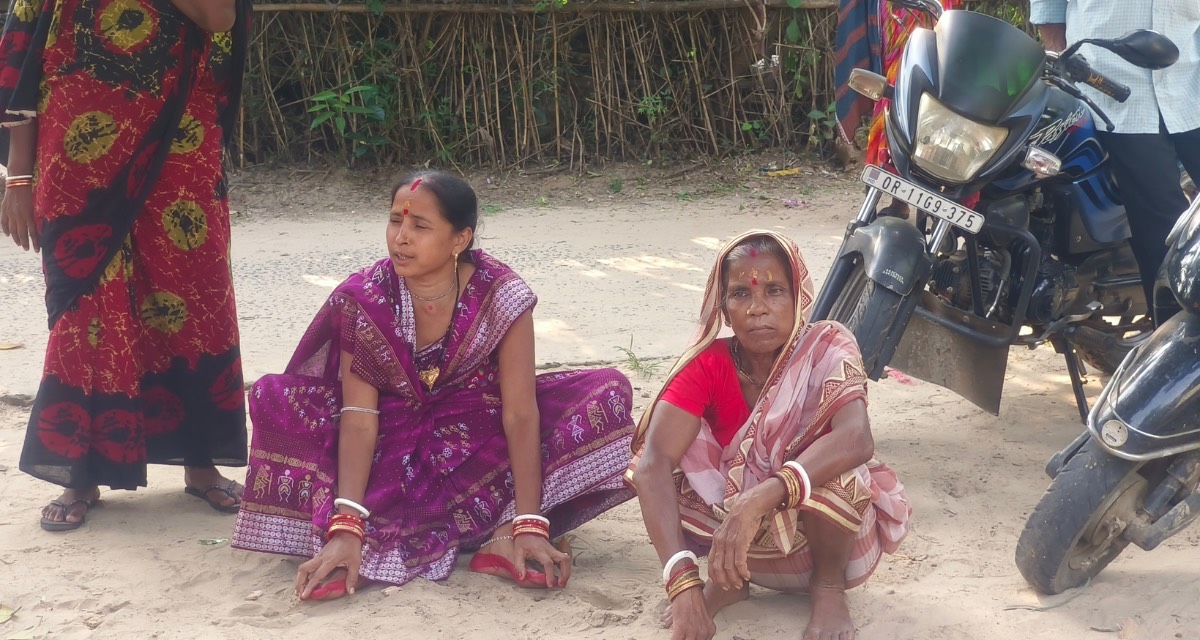 Women explain their land loss and ancestral property (Photo - Prativa Ghosh, 101Reporters)
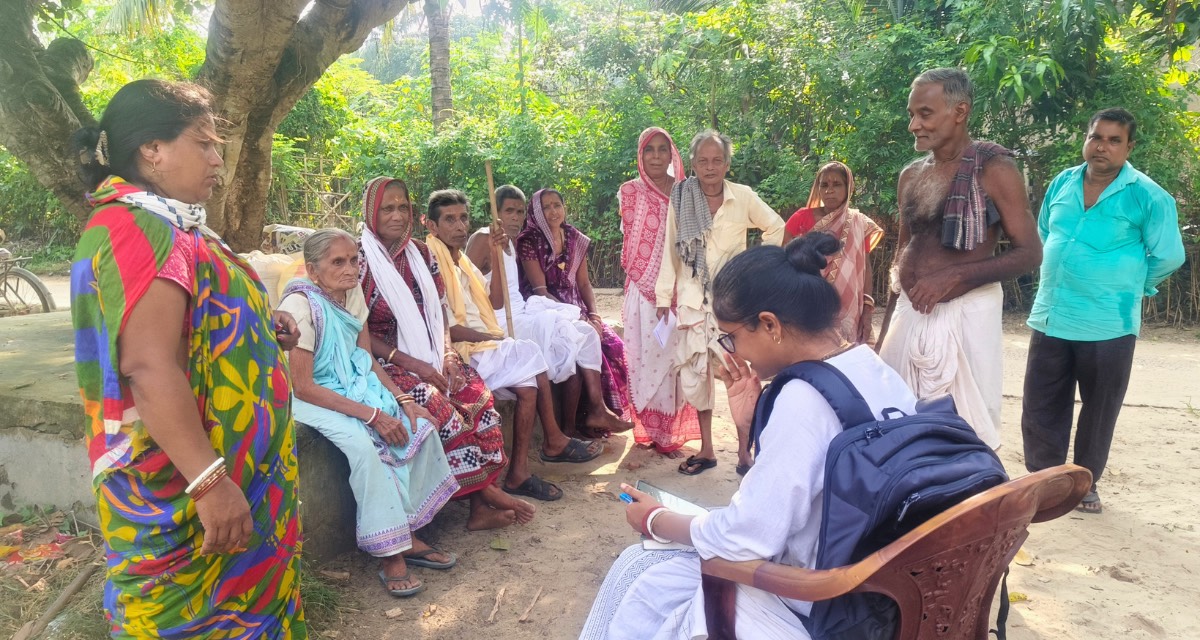
She recalls that Upendra Hajra, who once owned around 200 acres, gave land to his daughters at their weddings. Much of his property has since been swallowed by the river. His son Sourav Hajra says nearly 70 acres have been lost. The disappearance of such land has affected families across generations. Property that once provided an income and could be passed on to children is no longer available.
For Krushna Giri, land was central to the security her family had hoped to provide her.
She was 15 when she moved to the village as a bride. Her father had chosen the place, believing she would not have to struggle for food or a livelihood. The village was known for its paddy, betel leaves and fish. Families had agricultural land, coconut trees and other sources of income. “Even today, if someone has just one mana of land, they can earn enough to live without having to ask others for help. But to live on this earth, you need at least a piece of land. Every morning, our first worry is whether our home will still be here tomorrow,” she says.
The loss of homes and familiar places
The erosion has also taken away places that formed part of women's everyday lives.
Bhagabati Giri remembers the weekly market at Ambachua, near Kalipada, where she and other women went to buy household provisions.
“Those days, we depended entirely on the Ambachua market for our household needs. Every Monday and Friday, we would cycle there with friends to buy cooking oil, salt, rice, pulses and clothes. The market was not just a place to shop. It was where we met friends and relatives, socialised and did business. We would buy mixture, sit together over tea and pakodas, and return home with enough provisions to last five days,” she recalls.
The market no longer exists. The river has swallowed her family's house, agricultural land and the coconut, mango and jackfruit trees that once stood around it. “Even if someone steals everything you own, you still have your ancestral home. You have four walls to shelter you and a roof over your head. But when the river swallows your land, you lose everything. The place where your house once stood is now underwater," she says.
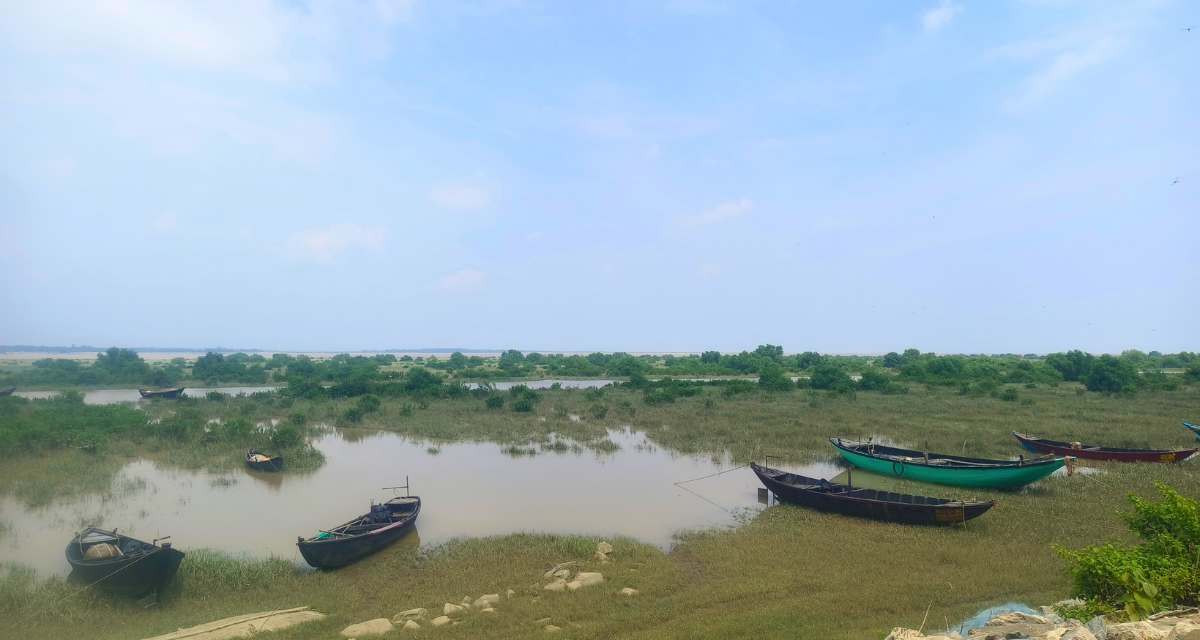 Once upon a time, villagers were settled here, and now it's a catchment area where floodwater comes to this place (Photo - Prativa Ghosh, 101Reporters)
Giri and other affected families now live in houses built inside a casuarina plantation on government land. They moved there as the river advanced, rather than through a formal rehabilitation programme. She says Gadadhar Giri, the area's then MLA, had encouraged families to move into the plantation and build houses there, promising to look into their rehabilitation.
“Because of him, we gathered the courage to build houses on government land. But even after all these years, nobody has made proper arrangements for our rehabilitation,” she says.
According to Giri, families received relief materials such as rice and flattened rice, or chuda, but no compensation for the land lost to erosion.
The loss of land has also changed how families live together. Subhadra De, 75, remembers when her family lived as a joint household, with a common cattle shed, ponds, coconut groves, mango and jackfruit trees and betel vineyards.
“Earlier, we lived as joint families. We had land, and everyone stayed together. We had a common cattle shed, ponds, coconut groves, mango and jackfruit trees, and betel vineyards. Everything was in one place. After the river took our land, there was hardly any space left for us to live together,” she says.
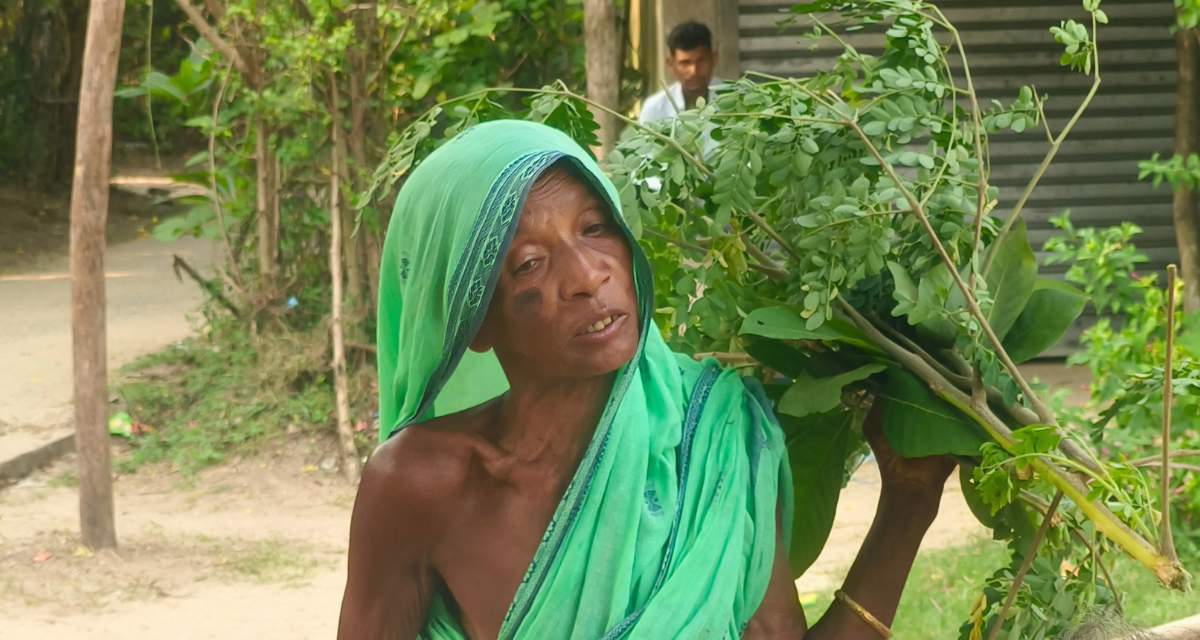 Subhadra Mohanty explains about her land loss (Photo - Prativa Ghosh, 101Reporters)
The family eventually moved to a casuarina plantation at the edge of the village. With little land left, relatives have fenced off separate portions and built their own houses.
“Now everyone has fenced off a small piece of land for themselves. We grow betel vines and groundnuts there. There is no land left where the whole family can live together
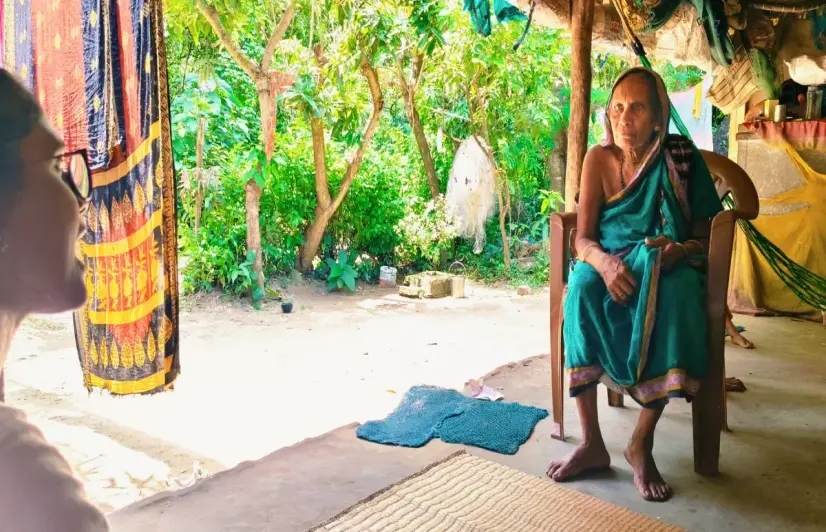
Cover Image - Brahmanami Barik explains about her land loss and how she keeps her land records (Photo - Prativa Ghosh, 101Reporters)
Would you like to Support us
101 Stories Around The Web
Explore All NewsAbout the Reporter
Write For 101Reporters
Would you like to Support us
Follow Us On