Highway project leaves Kashmir residents in fear of landslides

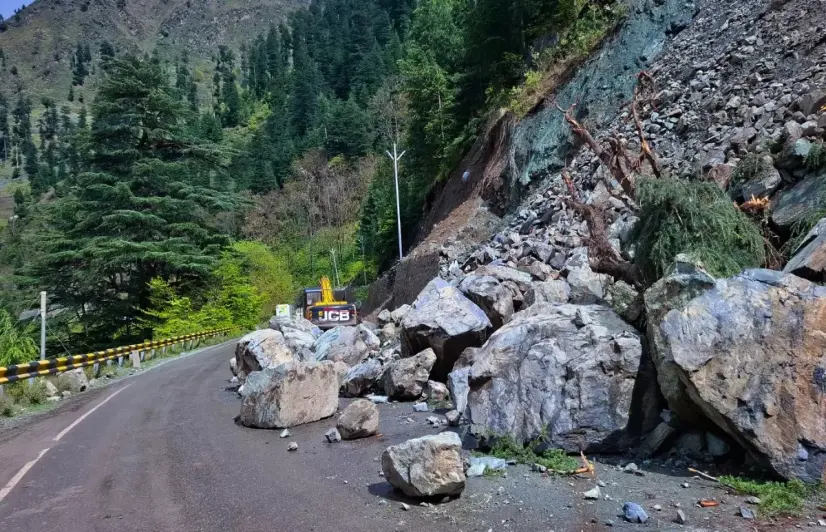
Highway project leaves Kashmir residents in fear of landslides
By Umar Farooq Zargar and Ilhak Tantary.
Baramulla, Jammu and Kashmir: Javied Ahmad Khan's house in Mohra, a village along the Baramulla-Uri National Highway in Jammu and Kashmir, has been coming apart since March 2025. That month, road widening work began directly below his home. Workers cut into the hillside but left the slope unfinished. When they returned a year later, they built a stone bund for protection but completed only half of it. By then, the 10-15 feet of earth that once separated his foundation from the road's edge had disappeared, due to the erosion from rainfall. The base of his house, built from stones and cement, is now exposed and hollow on the roadside. Two rooms have been abandoned. When it rains, his family — he has six children — moves outside.
“Whenever it rains, we cannot sleep,” Khan said. He earns Rs 500-600 a day as a Sumo driver and is still repaying a Rs 5 lakh bank loan taken to build the house. He approached the contractor, who told him that even if the house collapsed, it was not his concern. He then went to the Sub‑Divisional Magistrate (SDM) of Uri, who referred him to the tehsil office in Boniyar. The tehsil confirmed the house was in a dangerous condition and forwarded the case to the Border Roads Organisation (BRO). There was no response.
The Border Roads Organisation is a government agency under the Ministry of Defence responsible for building and maintaining roads in India’s border areas, including strategic highways in Jammu and Kashmir.
Khan has since filed a case in the Boniyar court, and his demand has shifted, from asking that the bund be completed, to asking for compensation. "Where will I go with my wife and six children?" he said. "Who will repay my loan if my house collapses?"
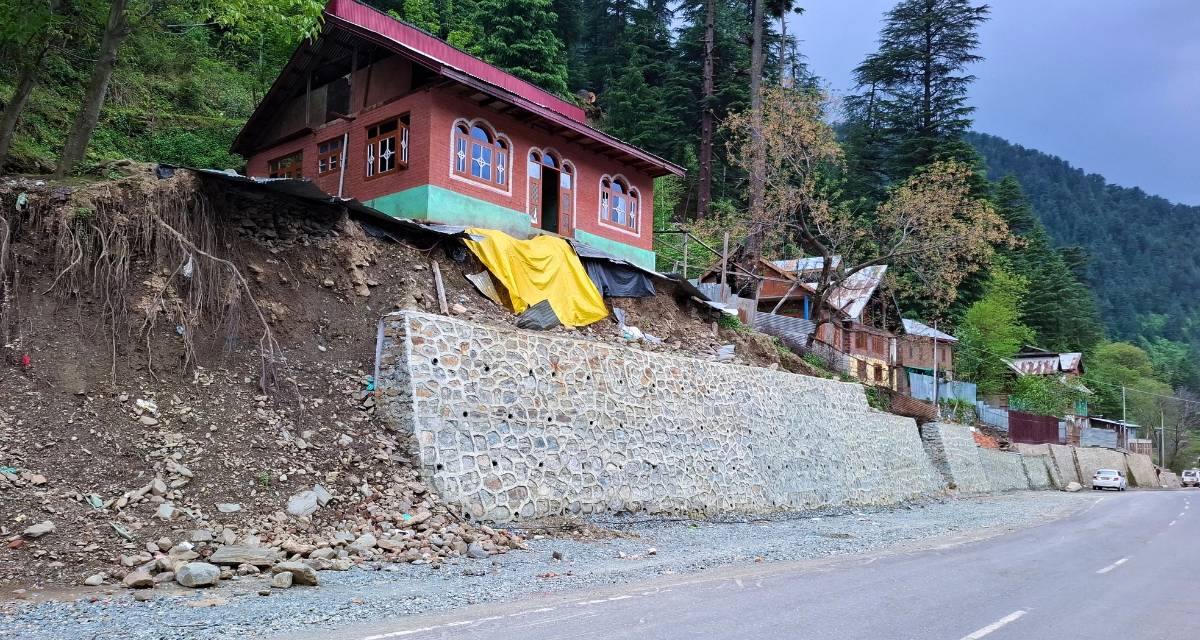 The house of Javied Ahmad Khan in Mohra, Uri, left structurally vulnerable after road cutting and incomplete bund construction ( Photo - Umer Farooq Zargar, 101Reporters )
Geologically unstable
The Baramulla-Uri stretch of NH-1 passes through some of the most geologically unstable terrain in the Kashmir Himalayas. Villages like Kamalkote, Mohra, Garkote, and Lagama sit on slopes that have been failing for decades. A hazard-zonation study of the NH-1 Baramulla-Uri corridor found that more than 22 percent of the study area falls within high or very high landslide hazard zones.
Dr Khursheed Ahmad Parray, Head of the Geology Department at Government Degree College Sopore, said the region's vulnerability is both natural and compounded by human activity. Many parts of Kashmir consist of fragile sedimentary and weathered rock formations that become highly unstable during rainfall. "Rainfall saturates sediments, increases pore pressure, and weakens slope stability, affecting both natural formations and surface structures," he said. Road widening, hill cutting, mining, and traffic vibrations, he added, accelerate slope instability further. He also flagged seismic risk: the Kashmir Valley has historically witnessed a major earthquake roughly once a century, and any such event could trigger massive landslides and flooding across this corridor.
Rainfall data supports the concern. According to IMD district-wise data for Jammu and Kashmir, Baramulla received 72 mm of rainfall in July 2025 against a normal of 57.3 mm — a 26 percent positive departure, classified as excess. The highway has recorded documented closures going back to at least 2014, when heavy rainfall triggered landslides near Mohra and NS Bridge, forcing authorities to suspend traffic on the Srinagar-Muzaffarabad road.
In 2020, hundreds of vehicles were stranded after fresh landslides blocked the Uri stretch. In 2021, a massive landslide at Laghama again blocked the road, with officials acknowledging it had already been closed "several times" that season.In 2022, a landslide near Red Bridge suspended all vehicular movement.
The pattern intensified after widening work began. In March 2026, a massive landslide blocked the Uri-Baramulla section of NH-1, with commuters explicitly linking it to ongoing slope-cutting.
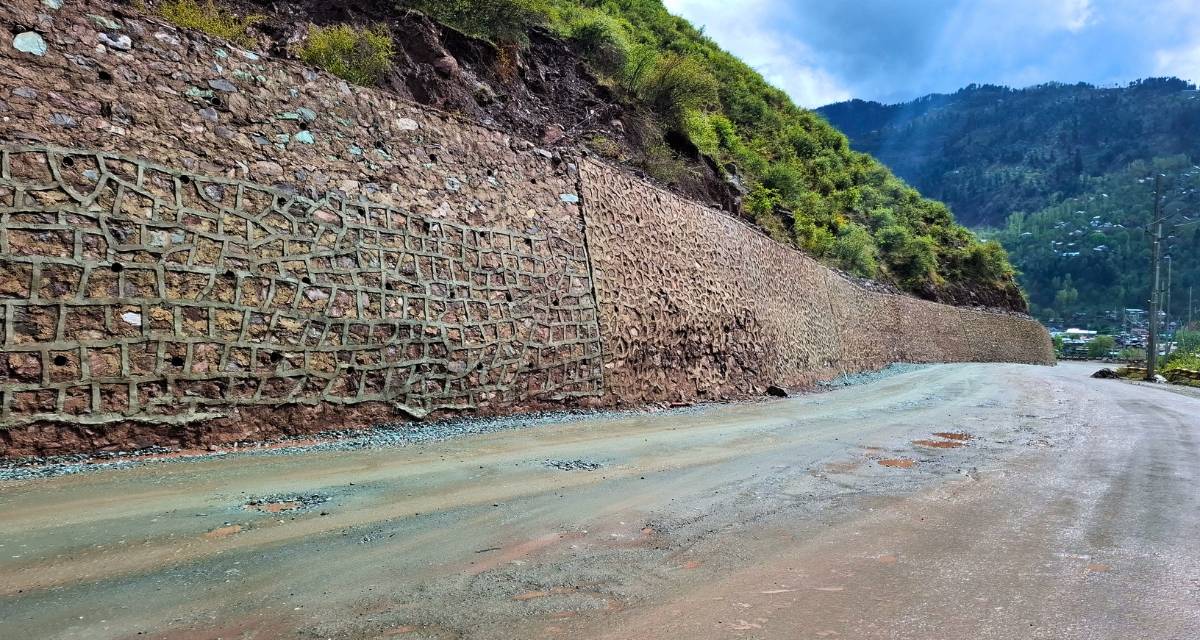 Stone and cement bunds constructed along the Baramulla–Uri stretch of NH-1 as part of road widening and landslide mitigation efforts ( Photo - Umer Farooq Zargar, 101Reporters )
In May 2026, heavy landslides near Laghama shut the highway again, forcing a traffic diversion after large rocks and debris fell onto the road — reported to be the third such incident in 20 days.
Inadequate repair work
To address the risk, the BRO, under Project Beacon, has been constructing cement bunds and retaining walls at landslide-prone spots including Mohra, Laghama, and Garkote. The work is part of the Srinagar-Baramulla-Uri highway upgrade, announced by the Ministry of Road Transport and Highways, with a sanctioned outlay of Rs823.45 crore. The project began in September 2024. According to Dr Parray, cement bunds are designed to support weak hillsides by holding back loose soil and rocks, reducing erosion, and stopping debris from sliding onto the highway during rain or slope instability.
In theory. In practice, residents say the structures are failing.
Raja Javed, former Sarpanch of Boniyar block, said the protection walls do not survive even light rain. "I am myself a witness — whenever it rains, the retaining walls fall down," he said. He alleged that older, sturdier walls were demolished and their material reused in the new construction. "Earlier, the road and walls were quite strong. Now they have destroyed those walls and used that material in constructing new retaining walls." He described the drainage as entirely inadequate. "We thought a proper drainage system would be constructed, but this project seems a complete failure. The money spent on this work is being wasted."
Altaf Ahmad Wani, 32, a resident of Garkote, said his cousin was injured when his vehicle was caught in a landslide in the last week of March 2026. He said retaining walls in the area were collapsing without any apparent external trigger. "After rainfall, water accumulates and directly hits the retaining walls instead of flowing through drains," he said. The stretch between Mohra and Lagama — roughly five kilometres — has seen 20-25 houses and 30-40 shops removed for road widening, he noted, but the risk has not reduced.
One resident, who did not wish to be named, alleged that substandard materials were being used in construction. "Instead of proper material, dust is being used — 80 percent soil and only 20 percent sand," they said. This could not be independently verified. The BRO and the contractor did not respond to repeated queries.
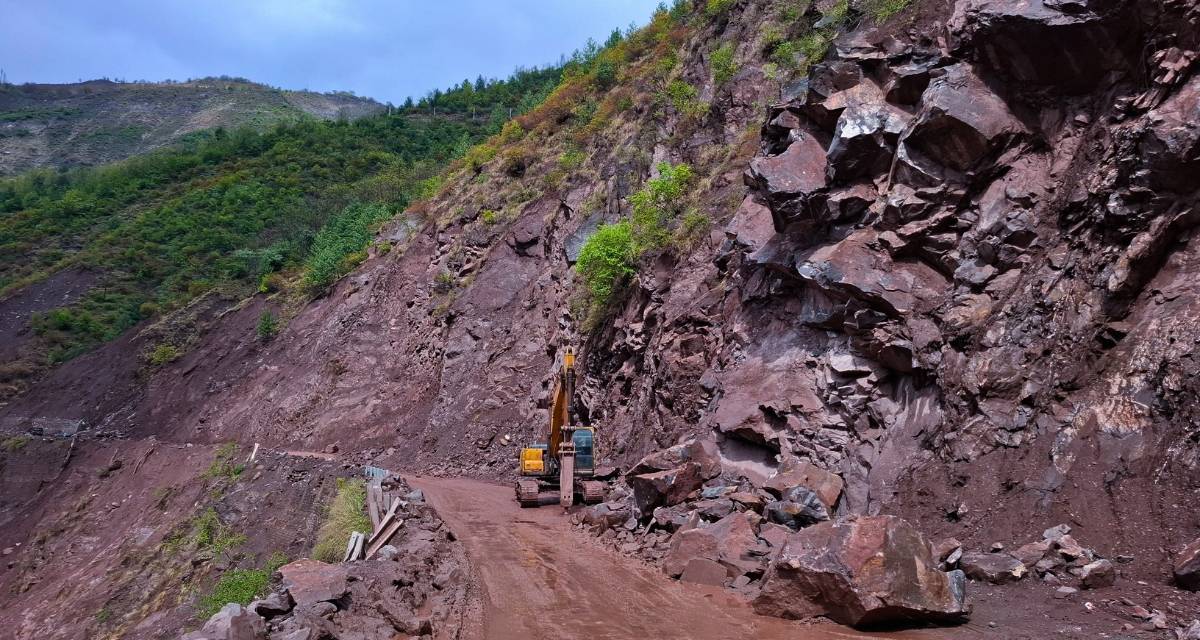 Debris and damaged road stretch along the Uri–Baramulla National Highway (NH-1) near Nand Singh Bridge in Uri market, Baramulla. The road, which connects Srinagar to the Line of Control (LoC), is frequently disrupted by landslides ( Photo - Umer Farooq Zargar, 101Reporters )
The widening project has also involved significant forest clearance. According to official data tabled in the J&K Assembly, 740 trees were affected or felled and 20.93 hectares of forest land diverted for the project. Some reports cite a higher figure of 1,700 trees along the broader Srinagar-Baramulla-Uri corridor, but this could not be independently verified. Dr Parray said the loss is consequential: trees act as natural anchors and help stabilise slopes, and large-scale cutting during road construction directly increases landslide vulnerability.
Mohammad Akram, 40, from Kamalkote, said a vehicle carrying passengers was struck by falling stones near his village. Everyone survived, but the episode illustrated what he called a broader neglect of off-highway areas. "The work is focused only on the highway. Areas like ours are ignored," he said. As a daily wage worker, road closures affect his income directly. "In 2018, a landslide blocked our road for two days. Only after repeated calls did officials respond. Do we deserve this?"
Preparedness mechanisms
Rehana, In-charge of Disaster Management in Baramulla, acknowledged that Boniyar is officially recognised as a landslide-prone area and that Baramulla is among the most hazard-prone districts in Jammu and Kashmir. She said areas around Mohra and NS Bridge are among the more vulnerable stretches of the highway. She also said that there is currently no dedicated early warning system in place for these locations.
She outlined existing preparedness measures: GIS mapping and remote sensing for hazard zonation, field surveys by the Geological Survey of India, Tehsil-level Disaster Management Committees, and machinery such as JCBs kept ready at key locations during the rainy and winter seasons. Aapda Mitras — trained local volunteers — are being deployed as first responders, alongside school drills and community awareness programmes.
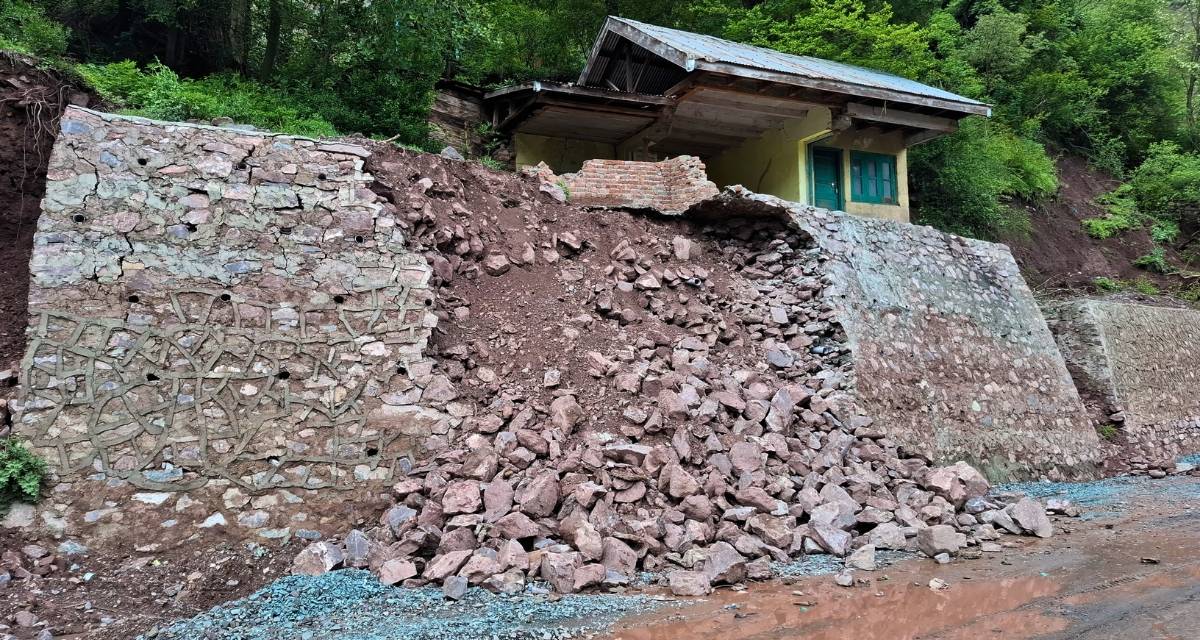 A damaged cement bundle along NH-1 in Uri, Baramulla, after recent rains. Locals allege poor-quality materials have led to repeated collapse ( Photo - Umer Farooq Zargar, 101Reporters )
But she also acknowledged the structural limits of the current approach. "Cement bunds and retaining walls provide short-term relief, but they are not always effective in the long run, especially if drainage systems behind them are not properly maintained," she said. The department, she added, is increasingly focusing on bioengineering solutions, including deep-rooted vegetation to stabilise slopes naturally.
Dr Parray said that techniques such as rock bolting and geotextiles — synthetic fabrics that reinforce and drain soil — can offer better long-term stability on landslide-prone Himalayan highways but require higher upfront investment and consistent maintenance. Concrete-only solutions, he cautioned, are insufficient in fragile Himalayan terrain where steep slopes, unstable geology, deforestation, and intense rainfall interact. "Without proper drainage, even reinforced retaining walls can fail because water saturation destabilises the slope behind them." Sustainable approaches — deep-rooted vegetation, restricted excavation, bioengineering — are more appropriate for the region's geology, he said.
This story was produced as a part of 101Reporters Climate Change Reporting Grant.
Cover Image - Large boulders from repeated landslides block the Uri–Baramulla stretch of NH-1, a key road connecting Baramulla town to the border town of Uri, often halting traffic for hours ( Photo - Umer Farooq Zargar, 101Reporters )
Would you like to Support us
101 Stories Around The Web
Explore All News