From industrial park to waste facility: Why Siddapur villagers are protesting

From industrial park to waste facility: Why Siddapur villagers are protesting
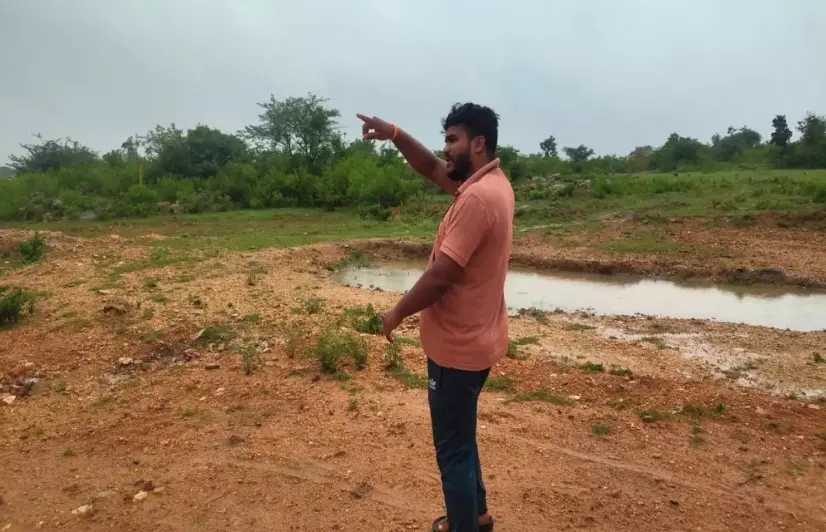
Hyderabad, Telangana: On the southern edge of Hyderabad, a few kilometres from Rajiv Gandhi International Airport, Dalit Patnam Suresh (28) sits in his unfinished, single-storey brick house. The walls are unpainted and the bricks remain exposed.
His father, Patnam Balaiah, once owned four acres of land. Today, he is landless and works as an agricultural labourer to support his family.
In 1980, the state allotted more than 330 acres of land in Siddapur village to landless families. Suresh said his family cultivated their share for decades before the Bharat Rashtra Samithi’s Telangana government acquired it in 2020, along with land belonging to several other families, for the development of an Industrial Park.
The families say that they agreed to give up the land with the understanding that an Industrial Park would be developed there.
But that plan has since changed. The land is now part of a proposed Solid Waste Management facility under the Siddapur Eco-Town, approved by the Congress-led Telangana government on July 2, 2026.
Residents claim that they were never consulted about the change in the land's intended use.
Change in land use
The change in the land's proposed use unfolded over several years. An April 24, 2021 order issued by the Land Acquisition Officer and Revenue Divisional Officer, Shadnagar, confirms that the Telangana State Industrial Infrastructure Corporation (TSIIC) had initiated proceedings to acquire around 330 acres of assigned land in Siddapur for the development of an Industrial Park. A response to a Right to Information application filed with the Telangana Revenue Department the same year also confirmed that the government had acquired land in the village.
Residents say they continued to expect an Industrial Park to come up on the acquired land. After the Congress government came to power in December 2023, road construction at the site continued, reinforcing that expectation, said Kothur Mandal Congress president Y Shekar Reddy.
The situation began to change in 2026. Residents first heard that Siddapur could be used for waste management in May, when Deputy Chief Minister Bhatti Vikramarka mentioned Bandaraviryala and Siddapur as sites for waste management and circular economy projects at the Swachh Bharat Mission Urban 2.0 conference in New Delhi on May 19 and May 20, 2026.
Sarpanch Bas Naik said the village was never officially informed that land acquired for an Industrial Park would instead be used for a solid waste-processing facility. “We only found out from newspaper reports. But, when villagers approached officials about the reports, they were initially told that no such facility was planned,” he said.
Shekar Reddy said local leaders had also heard about plans for a Solid Waste Management facility in the weeks before the government formally approved the project. When they approached TSIIC officials, he said, they were told that the government planned to locate the facility in Siddapur.
Meanwhile, Vikramarka’s statement at the waste management event had led to protests in Siddapur and neighbouring villages. Following the stir, on June 10, Shadnagar MLA Veerlapally Shankar held a press conference and said that no dumping yard would be established in the area, describing earlier reports as misunderstandings or misinformation.
However, on July 2, the Telangana government approved new Solid Waste Management facilities at the planned Siddapur Eco-Town through an order issued by the Metropolitan Area & Urban Development Department.
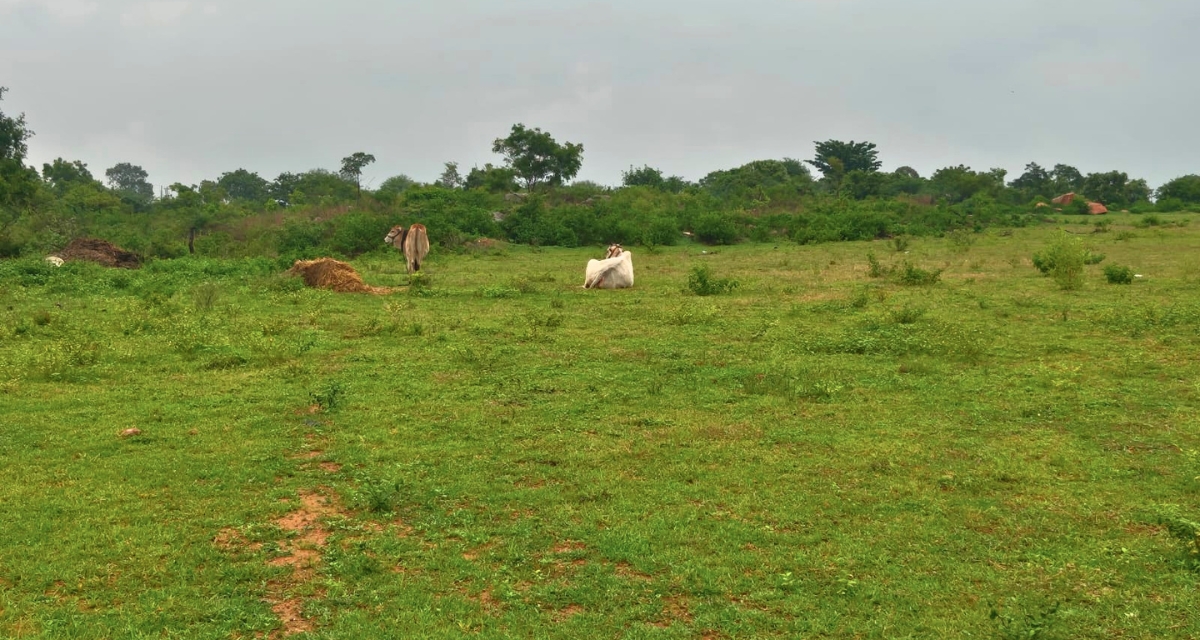 The Siddapur site where cows are grazing (Photo - Durga Prasad Sunku, 101Reporters)
Vice-Sarpanch Dubbala Yadaiah said the Congress government announced the facility without giving prior notice to the Gram Panchayat, he said came suddenly and surprised residents. “We were shocked and wondered how this could happen after the assurances we had received,” Shekar Reddy said.
Documents examined for this report substantiate some of the residents' claims. The April 2021 acquisition order confirms that around 330 acres of assigned land in Siddapur were acquired for an Industrial Park.
However, the documents reviewed for this report do not establish whether the Gram Panchayat or affected landholders were formally consulted before the proposed use of the land was changed.
Residents’ concern
Residents fear that pollution from the proposed Solid Waste Management facility could affect agriculture and other allied activities in Siddapur and neighbouring villages.
Siddapur lies at an elevation of around 580 metres above mean sea level and is an important rainwater recharge zone, according to Amme Raghavender of the Save Siddapur movement. Surface runoff from the proposed site flows through several drainage routes towards nearby water bodies. Three routes eventually drain towards Himayat Sagar lake in Ranga Reddy district, while another drains towards the Dindi River. One route passes through Palmakul Cheruvu, the largest storage tank upstream in the Esi River system, before eventually reaching the Himayat Sagar reservoir, an important source of drinking water for Hyderabad.
The Esi River eventually joins the Musi River, connecting the drainage system around Siddapur to the wider Musi basin.
Residents and environmental activists fear that waste or leachate from the proposed facility could contaminate surface or groundwater and affect the water bodies used to irrigate agricultural land in the area.
"The land's slope actually directs water towards the lakes. It seems like officials misled the government. The plan may not work well here," said Narender Reddy, a former ward member.
The concerns also extend to the government's Musi River Rejuvenation Project, which aims to restore and clean a 55-km stretch of the river from Gandipet to Gowrelli. Residents fear that contamination of water bodies connected to the Musi system could undermine these efforts.
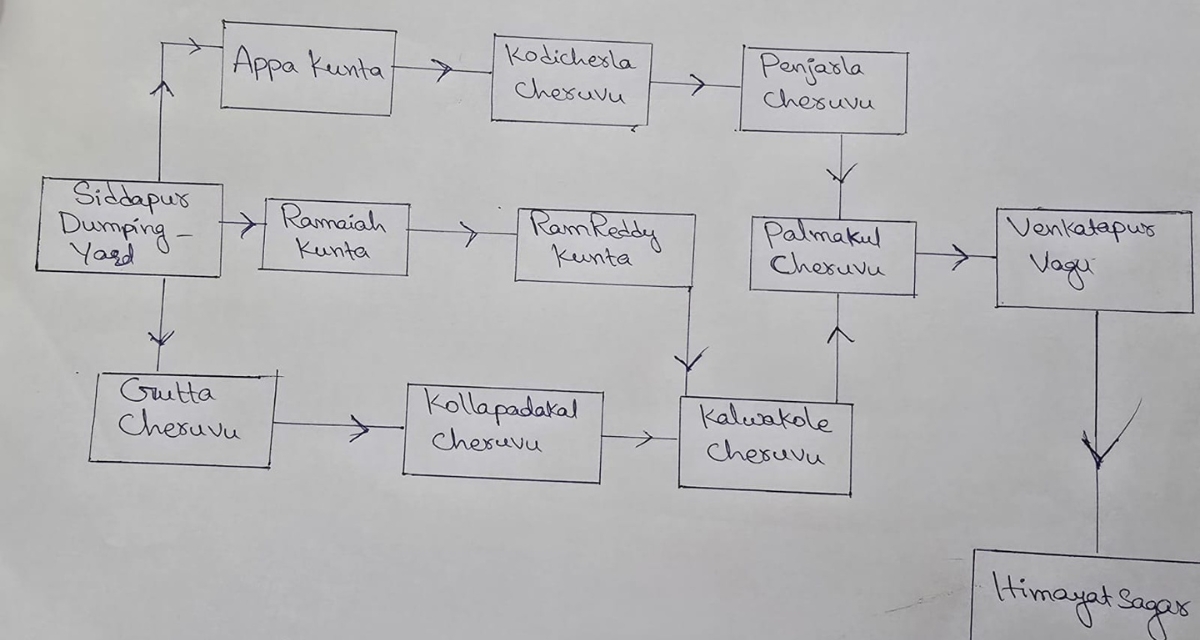 The Chain of lakes (Photo - Durga Prasad Sunku, 101Reporters)
Residents distinguish this concern from the proposed industrial park, another development project that has raised concerns about the loss of agricultural land. They say the industrial park is confined to a specific area, while the waste management facility could affect the wider water system on which surrounding agricultural land depends. According to residents, the industrial park does not affect the water sources used for irrigation in the same way.
Around 3,000 acres are cultivated in Siddapur, according to residents. Farmers grow paddy, red gram, cotton, chillies, vegetables and flowers, which are sold in markets in Shamshabad, Gudimalkapur and Bowenpally in Hyderabad.
Vadde Balaiah, a former MPTC member, said the area supplies agricultural produce to Hyderabad. "From Siddapur village alone, 20 tonnes of food and vegetables are sent to Hyderabad. If you count all the affected villages, the total is about 15,000 tonnes," he said.
Residents also estimate that the affected region, including parts of Kothur, Keshampet, Farooqnagar, Nandigama and Maheshwaram mandals, produces more than 70,000 litres of milk a day. Siddapur alone, they estimate, produces around 5,000 litres.
Environmental pressure
Residents say that the proposed facility would add to the environmental pressures Siddapur is already facing.
Granite-crushing operations in the area involve deep mining, residents say, and they allege that these activities have affected local water sources and damaged borewell motors. They fear that excavation and waste disposal at the proposed facility could further affect groundwater and other water sources.
Residents have also raised concerns about air pollution, citing the Municipal Solid Waste Processing and Disposal facility at Jawaharnagar in Hyderabad. At the facility, dry, non-biodegradable waste is processed into Refuse-Derived Fuel (RDF), which is used as fuel in waste-to-energy plants to generate electricity.
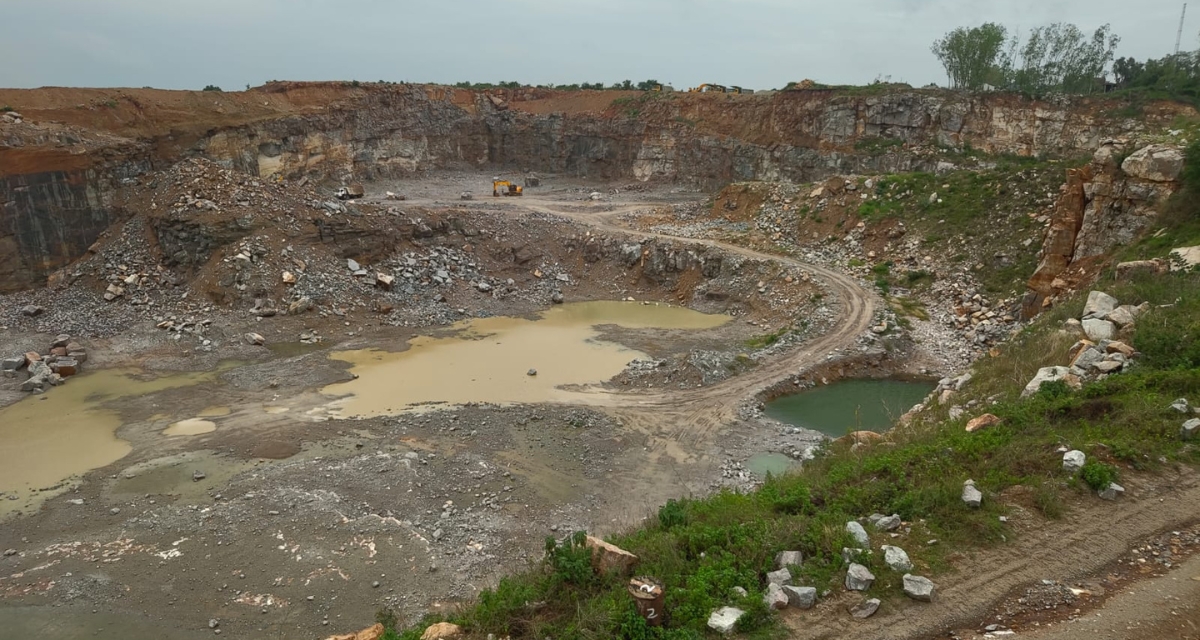 The Granite quarry (Photo - Durga Prasad Sunku, 101Reporters)
Residents fear that if a similar process is used at the proposed facility, burning RDF could contribute to air pollution. They are particularly concerned about pollutants such as particulate matter and carbon monoxide. The actual emissions, however, would depend on the technology and operating conditions of the proposed facility.
Jawaharnagar has become a reference point for residents' concerns about waste management. They say people living around the landfill have reported skin problems and other illnesses that they attribute to air and water pollution. Residents fear that Siddapur and around 20 neighbouring villages could face similar problems if the facility is established.
Studies around Jawaharnagar have found that poor municipal waste management can allow leachate to seep into groundwater aquifers, increasing Total Dissolved Solids and concentrations of metals such as lead, cadmium and chromium.
Residents also worry that an open waste facility could attract birds and increase the risk of bird strikes involving aircraft.
Opposition to continue
They say that they will continue to oppose the proposed facility and are prepared to take legal action if talks with the government do not produce results.
According to Amme Raghavender of the Save Siddapur movement the proposed facility is a joint project with Kitakyushu, Japan. The Kitakyushu Eco-Town is a model designed to help cities transition from heavy industry to greener businesses. It is based on industrial symbiosis, in which waste generated by one factory is used as a raw material by another.
For example, facilities under the model process wood and plastic waste into building materials and convert plastic bottles into pellets or new containers.
Raghaveder said that the Kitakyushu system depends on extensive segregation of waste, while Hyderabad and surrounding areas continue to struggle with basic waste segregation.
“Their system needs waste to be sorted into 800 categories, but here only two types are sorted, and even that is not done well in Hyderabad and surrounding neighbourhoods,” he said.
Presenting their concerns to the authorities, on July 22, 2026, Ranga Reddy District Collector C Narayana Reddy met leaders of the Save Siddapur Joint Action Committee (JAC), which comprises around 30 women's rights groups, community leaders and several political parties, with the exception of the ruling Congress.
Following the meeting, the Collector promised to send a detailed report to the state government after consulting other senior officials.
Siddapur and several other villages — including YM Thanda, Kodicherla, Kodicherla Thanda, Imulnarava and Penjarla in Kothur mandal; Polkoni Gattu, Bhairkhanpalle and Sherikunda Badhrayapally in Keshampet mandal; and Kollapadkal in Maheshwaram mandal — have rejected the proposed Solid Waste Management facility. Residents say these villages passed Gram Sabha resolutions opposing the facility.
They demand that the land be used for the original purpose it was acquired for.
Cover Image - Patnam Suresh showing his land (Photo - Durga Prasad Sunku, 101Reporters)
Would you like to Support us
101 Stories Around The Web
Explore All News