Double trouble: Assam’s maize farmers hit by pests and erratic weather

Double trouble: Assam’s maize farmers hit by pests and erratic weather
As maize cultivation expands across Assam, climate shifts and rising pest attacks are eroding yields and farmer confidence.
Kamrup, Assam: On a pleasant sunny day in the first week of April, Bangalpara, a village in Assam's Kamrup district, was busy harvesting maize. The village sits around 35 kilometres from Assam's capital, Dispur.
The west bank of the Hajo Suti River, flowing gently through Bangalpara, had turned yellow — freshly harvested corn kernels spread across large plastic sheets, drying in the sun. Overlooking the riverbank were vast swathes of ripened maize plants, waiting their turn.
Maize, or maakoi, is the main crop grown in Bangalpara. The village has around 550 residents, and all 100-odd households are engaged in farming.
"Around 2,000 bighas (268 hectares) of land in Bangalpara are under cultivation. Of that, we grow maize on 90 per cent of the land, and paddy on the remaining 10 per cent," said Kutubuddin Ahmed, 48, the gaon bura or village head of Bangalpara.
Abdul Rashid, 81, the village's oldest farmer, interjected: "We are traditionally dhan (paddy) growing people. Maize was introduced as a commercial crop in Bangalpara in 2017. Slowly, it replaced dhan. Now the farmers are mostly growing maize," the octogenarian told The 101 Reporters.
The pride in Rashid's face quickly gives way to despondency. "We are poor people. We have to keep working till we die. No matter how hard we work, botor (the weather) and puk (pests) destroy half the crops we grow," he added.
All the farmers of Bangalpara share Rashid's dejection.
Yet the farm work never stopped. On that April day, the whole village, including children, worked in sync with two maize threshing machines separating corn kernels from cobs on the bank of the Hajo Suti River. The machines produced a constant buzzing that made everyone speak louder.
Men fed the machines ear by ear. Women and children collected the kernels, cobs and husks, sorting them into separate zones.
"We sell corn kernels and use cobs and husk for animal feed and fuel," said Arjina Khatun, 27, a woman farmer.
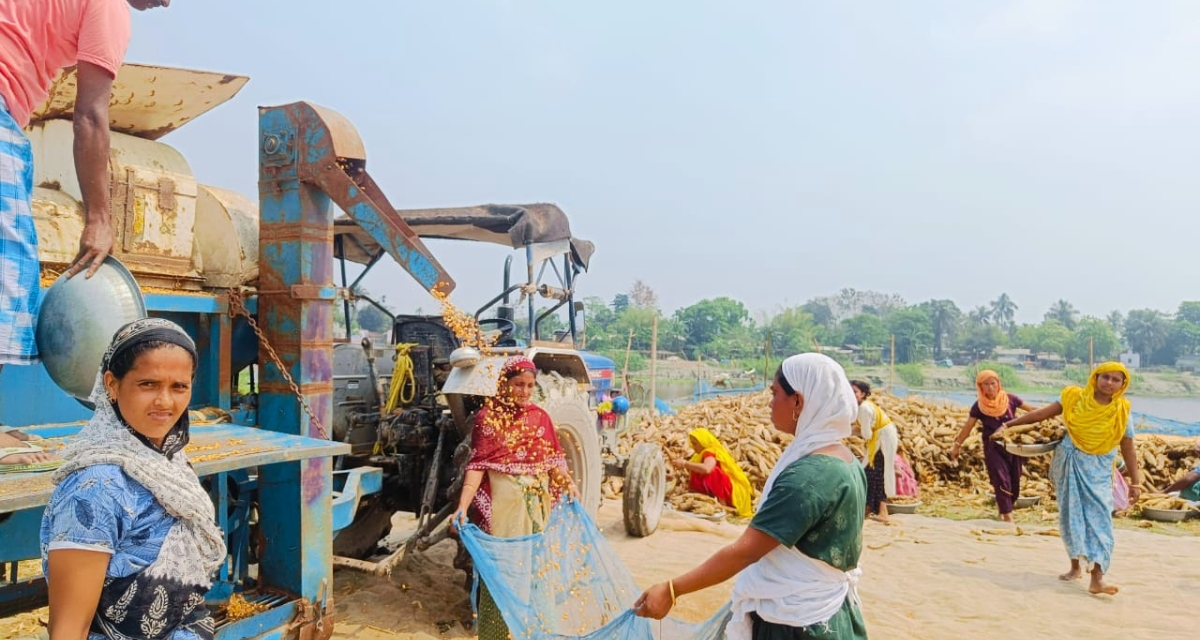 A maize threshing machine separates corn kernels from cobs on the bank of the Hajo Suti River in Bangalpara village (Photo - Maitreyee Boruah, 101Reporters)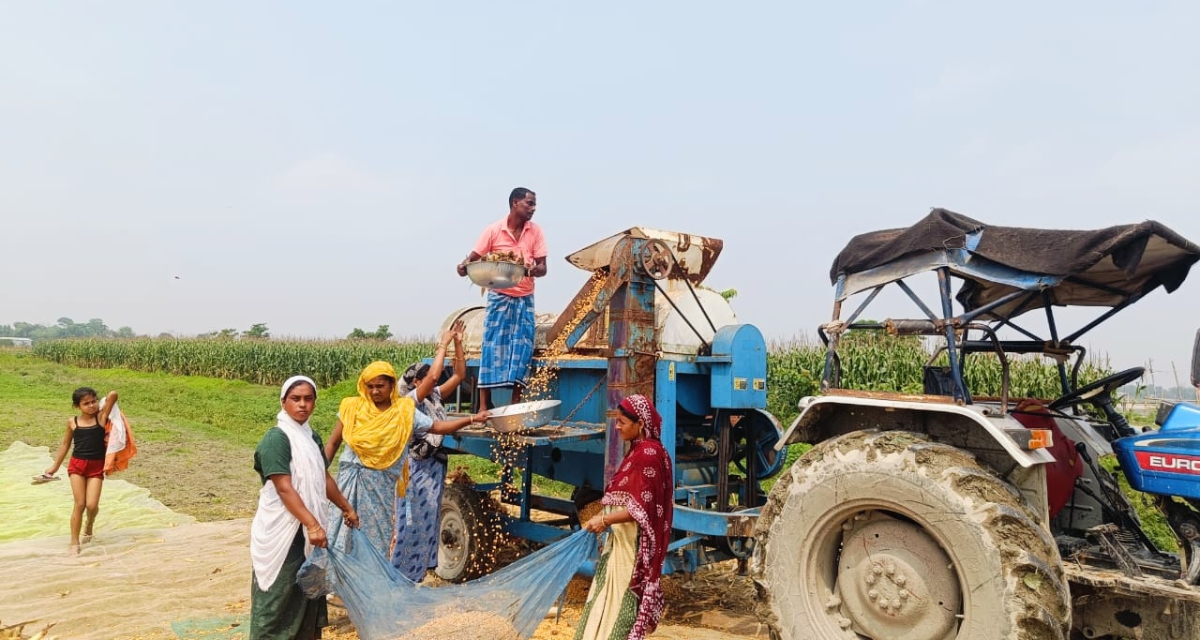
The pest problem
Shahidul Islam, 28, another maize grower from Bangalpara, laid the blame squarely on pests. "The pests are our biggest enemies. They destroyed half our maize crop, which we had sown in the last kharif season, around May 2025," he said.
Denim Bora, Agricultural Development Officer (ADO) of Hajo revenue circle, under which Bangalpara falls, confirmed the farmers' fears.
"Pest attacks on maize crops have increased over the years across Assam. The state is highly vulnerable to climate change events. Unseasonal rainfall, temperature fluctuations, and extreme weather events such as floods, droughts, and cyclones significantly affect maize production. Warmer, more humid conditions favour pests such as the fall armyworm, accelerating their reproduction and intensifying crop damage," said Bora.
"Some of the pests attacking maize across Assam are the maize stem borer (Chilo partellus), fall armyworm (Spodoptera frugiperda), maize shoot fly (Atherigona spp.), and corn aphid (Rhopalosiphum maidis)," he added.
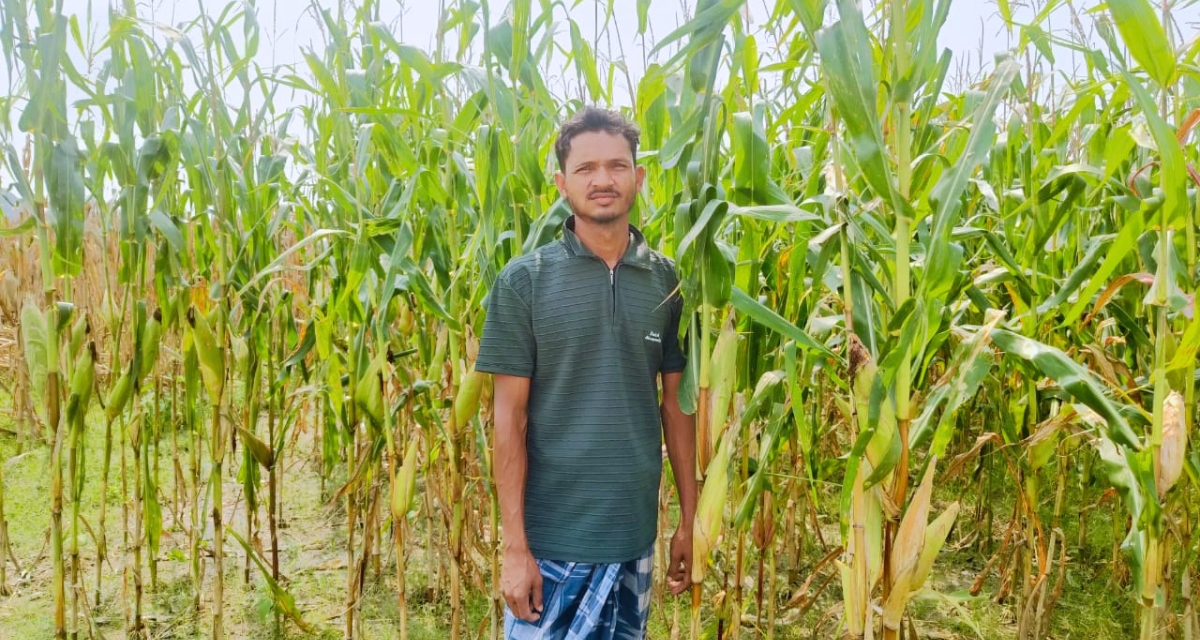 Shahidul Islam, 28, from Bangalpara village, blames pests for destroying half of his maize crop last season, he poses in front of his maize crop waiting to be harvested (Photo - Maitreyee Boruah, 101Reporters)
From paddy to ‘golden grain’
Earlier, maize was grown in small patches across Assam for household consumption. In 2016-17, the Indian Council of Agricultural Research (ICAR) and Indian Institute of Maize Research (IIMR), Ludhiana, in collaboration with Assam Agricultural University (AAU), Gossaigaon, launched a series of demonstrations and training programmes to promote maize as a commercial crop in the northeastern state.
The traditional paddy growers of Assam — rice is the state's staple food — began experimenting with maize on a commercial scale. The results were striking. Maize cultivation surged from 31,000 hectares in 2016–17 to 1.04 lakh hectares in 2023-24, with productivity rising 39 per cent to 5.14 tonnes per hectare.
Along with Kamrup, Barpeta, Bongaigaon, Nagaon, Darrang, and Udalguri emerged as the 11 major maize-producing districts of Assam.
"Maize truly proved to be 'the golden grain' for Assam. The crop sparked a rural revolution, reshaping the agricultural map of the state and providing livelihoods to thousands," said Ramesh Kumar, principal scientist (plant breeding) at IIMR Ludhiana, over the phone.
"To expand maize cultivation across 12 districts of the state, ICAR-IIMR joined hands with the World Bank, the Government of Assam, and the Assam Agribusiness and Rural Transformation (APART). More than 3,200 farmers received field-level technical training covering seed selection, modern cultivation practices, pest management, storage, and market linkages," Kumar added.
Maize is grown twice in Assam, in the Kharif (monsoon) and Rabi (winter) seasons, explained Bora.
"The Kharif maize crop is used as animal fodder and fuel. The Rabi crop is for human consumption," he added.
Farmers across villages in Kamrup district, Ramdia, Simina, Tapabari, Bangalpara, and Borgaon, told 101 Reporters they had shifted from paddy to maize because the yield and profits were both higher.
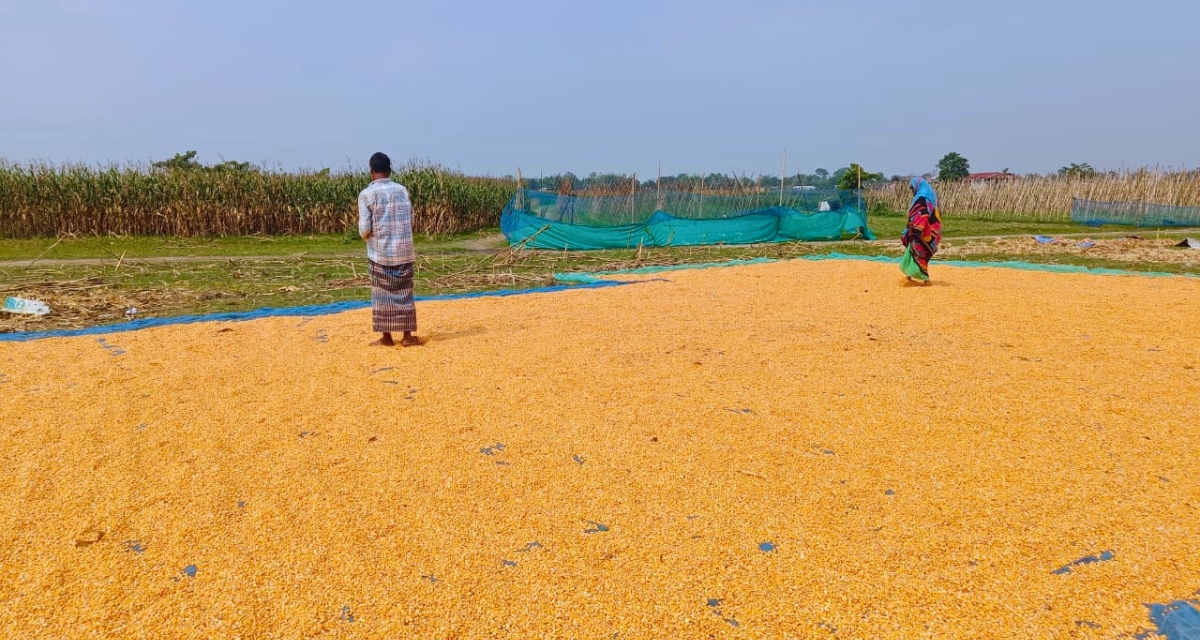 Freshly harvested corn kernels are spread out on a large plastic sheet to dry in the sun in Bangalpara, a village in Assam's Kamrup district, on a sunny April day (Photo - Maitreyee Boruah, 101Reporters)
"In Assam, the average yield of maize is seven to 10 quintals per bigha, going up to 16 quintals per bigha. Rice yields three to six quintals per bigha, up to 10 at best. Farmers are getting Rs 1,500-1,700 per quintal for maize, against Rs 1,200-1,400 for rice," said Muzaffar Ali, 31, who runs a farmer producer company under APART and the Assam State Agricultural Marketing Board in Kamrup district.
A farmer producer company pools farmers together to sell produce collectively and negotiate better prices.
Behind the numbers, however, lies a grimmer reality.
"Pest and fungal attacks and diseases have always been there. In the last four to five years, they have intensified. Crop loss is now visible. But the full extent is yet to be quantified," said Ali, who is also a farmer himself.
The farmers of Bangalpara said they did not know the names of the pests. "We call them puk — insects or insect-like creatures. They crawl through our fields. Some even look harmless, like a butterfly. They mostly attack at night and destroy our crops," said Rashid.
Eliza Khatun, 41, a woman farmer from the village, noted that the attacks had worsened since the Covid-19 pandemic.
"We are already fighting floods and erratic rainfall. Now, in the last five to six years, pest attacks have increased, which was not the case when the village first adopted maize as its main crop."
Climate stress
Floods hit Bangalpara every year between May and August, and again between September and October. Kamrup is among the most flood-prone districts in Assam. During the rains, the Brahmaputra and its tributaries, Pagaladiya, Puthimari, and Noona, swell above danger levels, inundating villages.
In 2025, 22 districts of Assam, including Kamrup, were affected by floods, destroying around 12,610 hectares of cropland. In 2024, one of the worst years in recent memory, floods swept in three waves, with the Assam Flood Memorandum 2024 recording damage across all 35 districts.
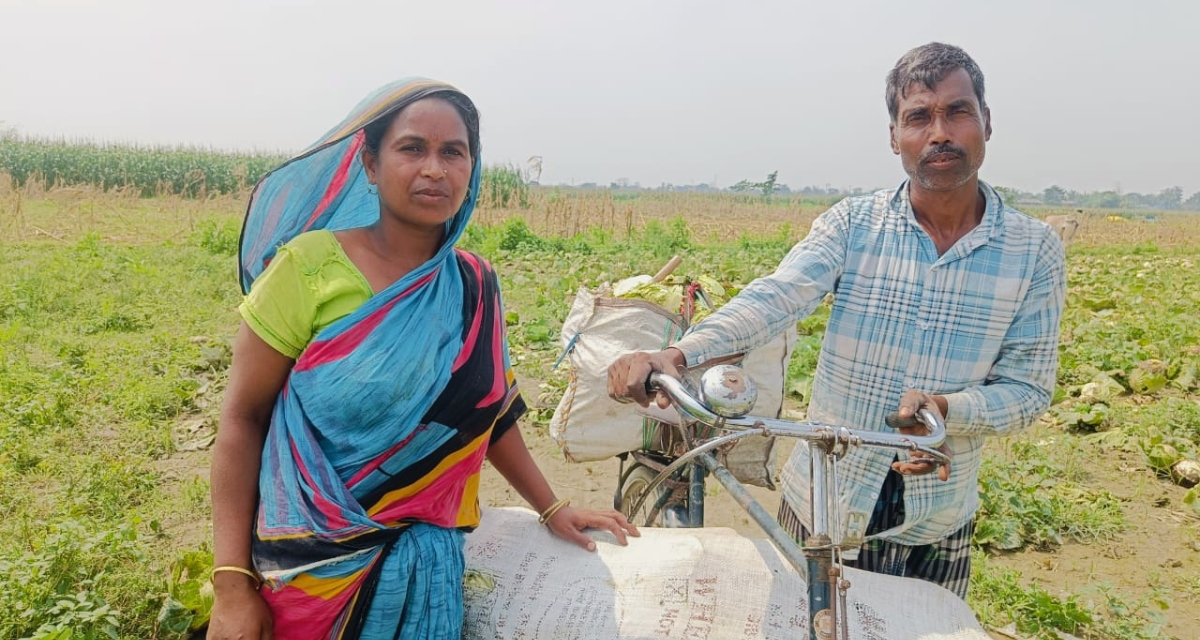
Heavy, unseasonal rains in March this year compounded the misery. "The rains in March destroyed a lot of our maize, tomato and cabbage crops. Continuous rains made it nearly impossible to harvest in time," said Khatun. She and her husband, Tomaz Ali, 51, could barely salvage half their cabbage crop before it began rotting in the fields.
"After the rains, the pest population will only increase," she warned.
Rising risks
So when maize was sown again in Bangalpara in mid-September 2025, Islam sharply cut back on acreage. "Instead of 16 bighas, I planted maize on just seven. This is to limit losses from pests and erratic weather," he said.
"Prices have also dropped. This season we are getting Rs 1,700 per quintal, down from Rs 2,100 last year," he added.
Most other farmers in the village followed suit.
Kumar, principal scientist at IIMR Ludhiana, acknowledged pests as a serious concern. "It is mainly the fall armyworm, an invasive species, that has been attacking crops. But we have trained farmers to combat it, through deep ploughing before planting, which exposes the soil to sunlight and birds, reducing existing pests; through the use of neem cake; keeping field bunds clean; planting flowers; sowing on time and uniformly. We also recommend rotating chemicals between sprays, since pests develop resistance to repeated use of the same one," he said.
Ali, who runs the farmer producer company in Kamrup, said not all of the training translates to the ground. "Most farmers here are not formally trained, but they are experienced — they have hands-on knowledge. Even so, it is not easy to fight pests when they attack in swarms. And unseasonal rains and floods keep pushing back both sowing and harvesting, leaving crops more vulnerable to stunted growth, pest attack, or rotting," he said.
Research confirms that pest populations thrive in conditions of erratic rainfall and elevated humidity.
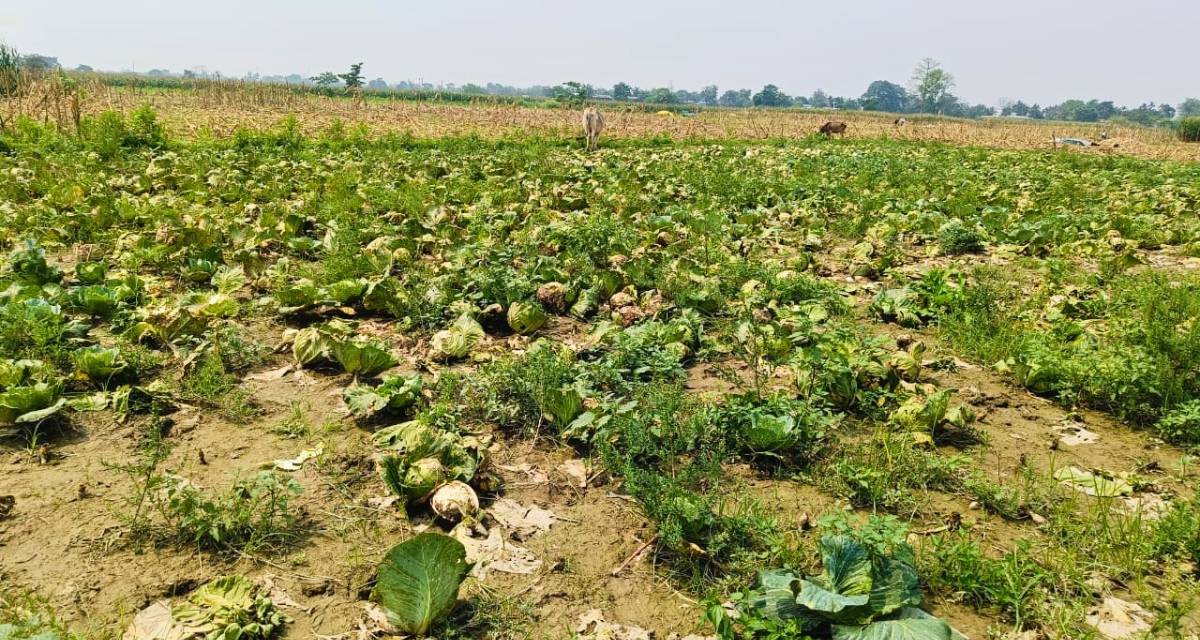 Excessive rains cause cabbage to rot as seen on the farm land of Bangalpara village in Assam (Photo - Maitreyee Boruah, 101Reporters)
Dr Rahul Mahanta, director of the Centre for Clouds and Climate Change Research at Cotton University, Guwahati, told 101 Reporters that rainfall patterns have shifted significantly over the past three to four decades. "The core monsoon zone has moved from the east to the west. The western region is getting wetter while the eastern region grows drier each year — likely a consequence of climate change. A stationary wave has formed over eastern India, suppressing rainfall. This decreasing trend is likely to continue until the end of the century," he said.
Mahanta explained that rising temperatures increase the atmosphere's moisture-holding capacity, as described by the Clausius-Clapeyron relation — but the mechanism to lift that moisture to higher altitudes for rainfall has weakened.
"At times, conditions become briefly suitable for rainfall, and we get an extreme burst for a day or so, followed by a dry spell of 20 to 25 days. Previously, rainfall was persistent — two to five centimetres a day over extended periods, with dry intervals of just three to five days. These shifts have fundamentally altered the flood cycle," he added.
Guwahati-based agricultural scientist Juri Talukdar pointed out that pests were not targeting maize alone. "In 2023, nearly 28,000 hectares of paddy fields across Assam were destroyed due to pest infestation. Prolonged periods of warm temperatures are the primary driver of these massive attacks," she said.
According to climate projections released by Azim Premji University, Bengaluru, in 2025, mean annual temperatures in some districts of Assam may rise by up to 0.83 degrees Celsius by 2040, while monsoon rainfall may decline by as much as 15 per cent over the same period.
Nazirul Islam, 55, a farm labourer from the neighbouring Gandheli Tari village, said the first signs of pest infestation were wilting and stunted growth.
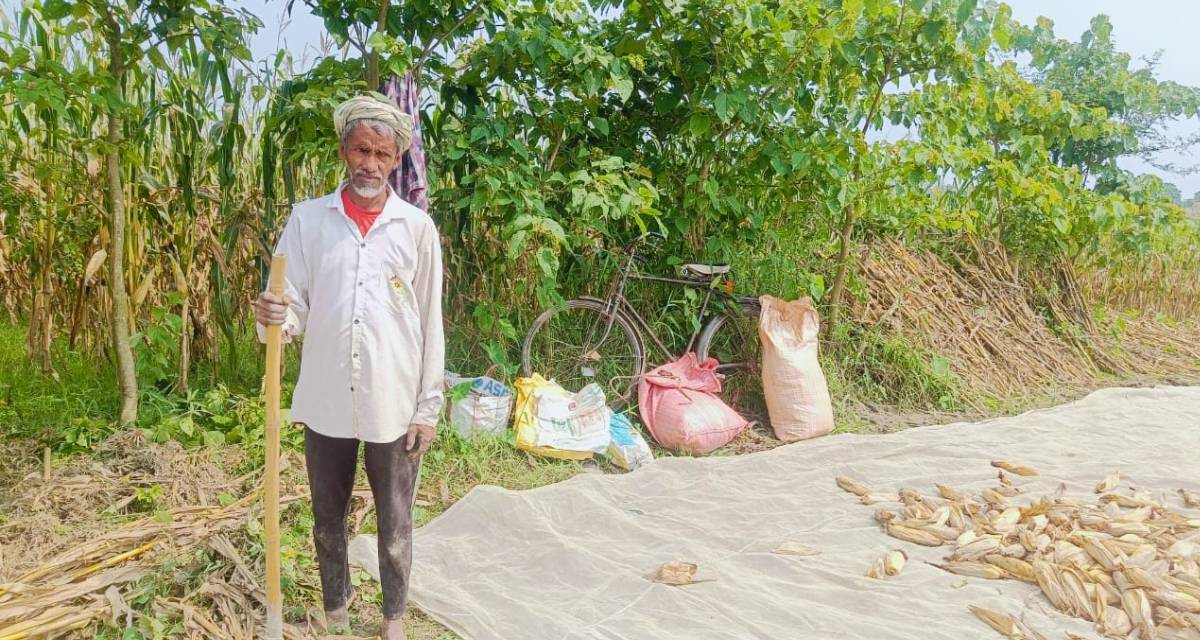
"Puk buror baibey paat bur xori jai" (plants shed their leaves because of pest attacks). "Puk buror baibey maakoi bur bhal koi nalagey" (the pests eat the cobs and kernels)," he explained, while harvesting maize in Bangalpara.
Islam lost his own agricultural land to floods a decade ago. "Now I work as a farm labourer across different villages. I earn Rs 400-700 a day, depending on the season and the work," he said.
This story was produced as a part of 101Reporters Climate Change Reporting Grant.
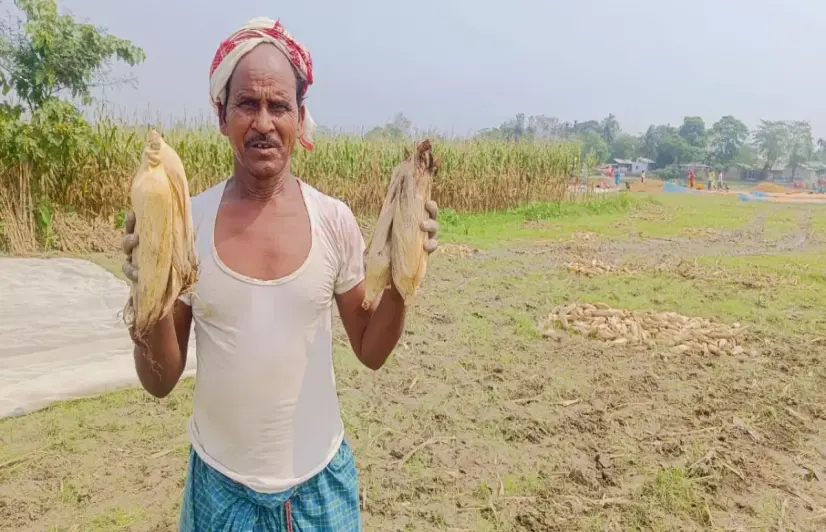
Cover Image - Gayasuddin, a farmer, holds corn produce from his farmland in his hands (Photo - Maitreyee Boruah, 101Reporters)
Would you like to Support us
101 Stories Around The Web
Explore All News