Childhood swept away by the Ganges

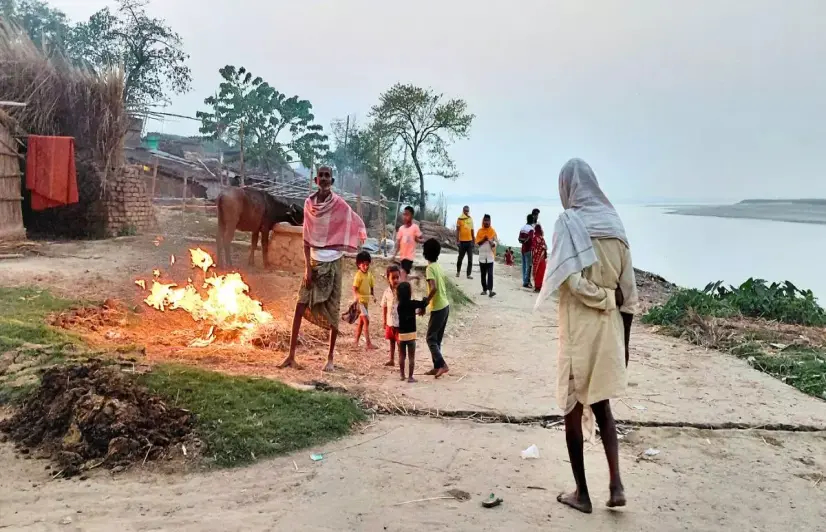
Childhood swept away by the Ganges
In Bihar’s erosion belt in Bhojpur district, displacement is pushing girls into early marriage
Patna, Bihar: “Ganga Mai ab hamni ke chhati par aa tikal badi.”
“Mother Ganga is now knocking on our chest,” said Sunaina Devi of Badhara block of Bihar’s Bhojpur district, standing beside the tarpaulin shelter where her family now lives after river erosion forced them from their village.
Devi is among many residents of the district whose lives have been upended by the shifting course of the Ganges. Across villages such as Piparpati and Balua, families displaced by river erosion now live under temporary shelters pitched along embankments.
In these settlements, insecurity and poverty are pushing parents toward decisions they once resisted: marrying their daughters early.
“When the house itself is gone, where will we run with a young daughter?”, Devi told 101Reporters. “Sleeping a young girl under a tarpaulin is like inviting danger. That is why we got her married.”
Residents across the erosion-hit belt say the fear of losing their homes, and the inability to ensure safety for adolescent daughters in temporary shelters, is leading to a rise in early marriages.
What is unfolding in Badhara is not an isolated phenomenon. A 2021 evidence brief by the United Nations Population Fund noted that environmental crises often disrupt livelihoods and displace families, with early marriage sometimes emerging as a coping strategy as households try to manage the loss of assets and income.
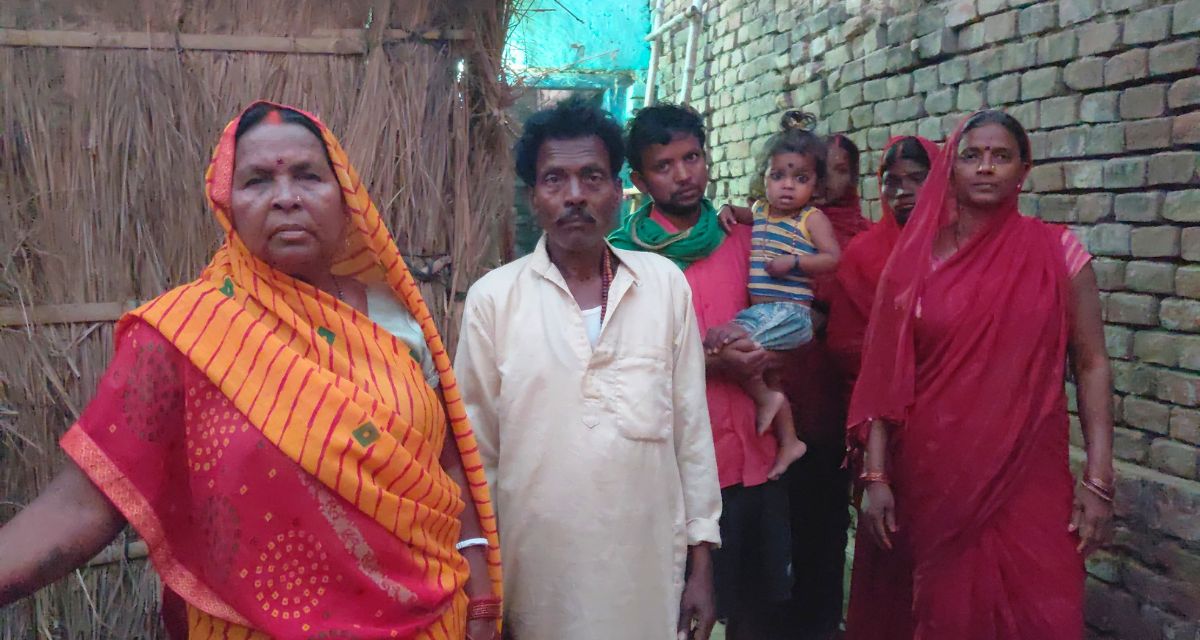 Displaced families in Badhara facing social insecurity (Photo - Himanshu Praveen, 101Reporters)
Displaced families
Among those living along the embankment in Badhara is Kajal (name changed), who passed her matriculation examination two years ago.
Her father, Ramji Singh, once owned more than 300 bighas of farmland along the river. Over the past decade, he says, erosion gradually consumed his fields.
“My daughter was very bright and passed matriculation,” he said in Bhojpuri. “I wanted her to study further. But when the Ganges swallowed our land, everything changed.”
As the farmland disappeared, so did the little money that the family would earn through agriculture. Although their house was not entirely destroyed, Singh told 101Reporters that the fear of further erosion forced them to leave their village.
Today the family lives under a tarpaulin on a raised embankment. To support the household, Singh now works as a daily-wage labourer in nearby villages. Keeping an adolescent daughter in such precarious conditions felt unsafe, he said.
“If something happened, whom would I answer to?” he said. “So with a heavy heart, I arranged her marriage.” Kajal, sitting beside him, said. “I really wanted to study,” she said. “But now it’s all over.”
To arrange the wedding, Singh borrowed Rs 50,000 from local moneylenders at 5% monthly interest.
“When there is no roof over our head, where can I invest money?” he said. “Getting my daughter married into a house with a proper roof is the only security I can give her.”
The marriage has been arranged with a man from a neighbouring district who has a permanent house. Singh said he had never met the groom’s family before agreeing to the match. The wedding is scheduled for June.
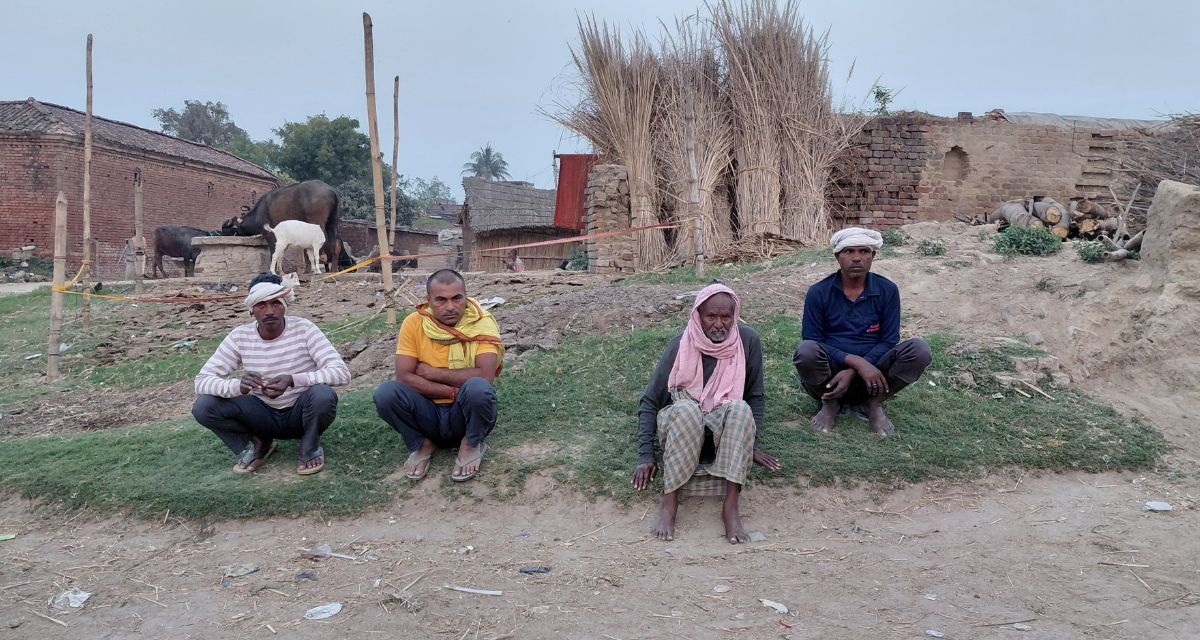 Displaced family facing climate led insecurity in the village (Photo - Himanshu Praveen, 101Reporters)
Decisions for survival
Prabha Devi, who now depends on fishing to feed her family, said that the erosion left them with little choice.
“Machhri maar ke pet bhartani ja,” she said. “We somehow survive by catching fish. There is no grain in the house.”
Her family also decided to marry their daughter early. “We thought it was better to marry her so that she at least gets two meals a day,” she said.
Experts said that the crisis unfolding in Badhara reflects a broader pattern of erosion along the Ganges.
Sanjay Kumar, head of the geography department at Maharaja College in Arrah, said that silt accumulation in the river has made it shallower, increasing the speed and unpredictability of its flow.
“The character of the river has changed,” he said.
According to Kumar, thousands of acres of fertile farmland in Badhara and Shahpur blocks have been lost to erosion over the past decade. In villages such as Jawania and Neknam Tola, hundreds of houses have collapsed.
“When the economic base disappears, the first impact is often on girls’ education,” Kumar said. “Families begin to see early marriage as a way of securing their daughters’ future.”
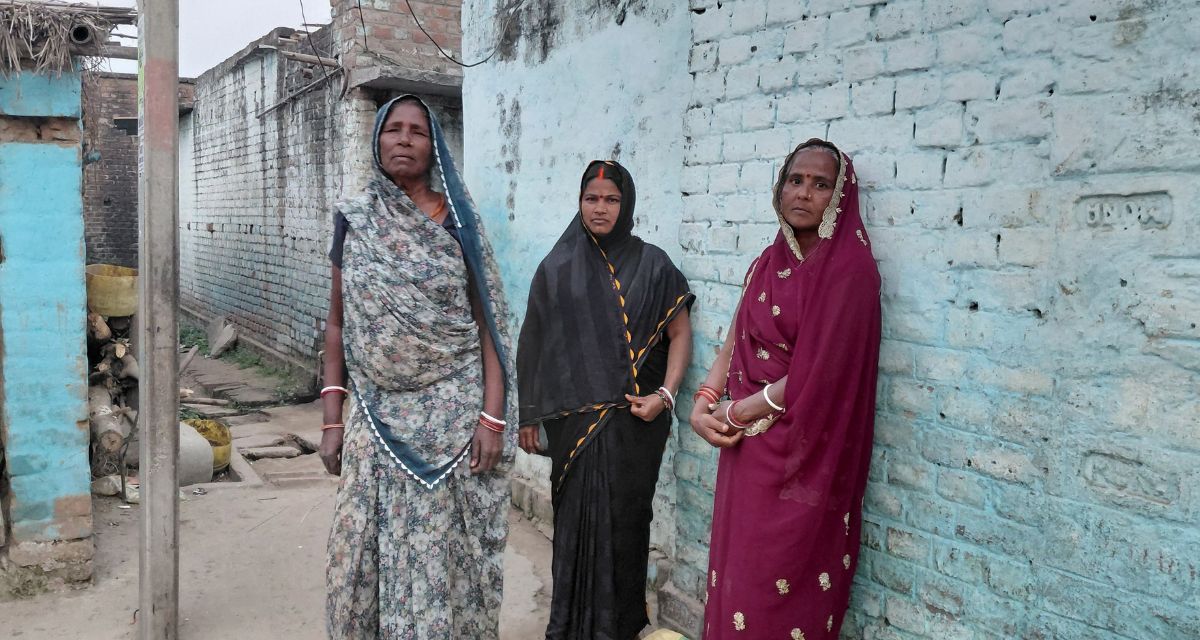 Displaced women in erosion hit Badhara district (Photo - Himanshu Praveen, 101Reporters)
Schools see the impact
Teachers in the region said the consequences are already visible in classrooms. Rakesh Singh, principal of Balua High School, said the number of married students has increased in recent years. “Every year, around 5% of the girls applying for classes 11 and 12 are already married,” he said, estimating that roughly 10 girls in each batch fall into that category.
He said the trend has intensified over the past four to five years, particularly in villages affected by erosion and displacement.
In some cases, Singh added, girls are found to be married even during Class 9 registration. Many parents, he said, hesitate to send daughters to school from temporary settlements because the routes are isolated and unsafe.
Government data suggested that child marriage remains common in the region.
According to the National Family Health Survey-5 (2019-21), 34.7% of girls in Bhojpur district are married before the age of 18. The state average for Bihar is 40.8%.
Although the rate has declined from 46.1% recorded in NFHS-4, activists said displacement caused by river erosion is creating new pressures on vulnerable families.
Social activist Raghuveer Singh said that he has seen several such cases in recent years.
“In the past five years, I have seen around 30 marriages in erosion-affected settlements that were directly linked to displacement,” he said.
Gaps in monitoring
Officials said that they act when they receive information about child marriages.
Ravishankar Verma of the district’s Additional District Child Protection Unit said the administration coordinates with block officials when such cases are reported.
“Whenever we receive information about child marriage, we inform the BDO of the respective block,” he said. “The BDO serves as the Child Marriage Prohibition Officer.”
But local officials acknowledge gaps in monitoring. Mohit Bhardwaj, the block development officer of Badhara, said that the administration often depends on external information to identify cases.
“When journalists or citizens inform us, we investigate,” he said.
He also acknowledged that the block administration does not have a dedicated data cell or monitoring mechanism to track child marriages in displaced settlements.
Local panchayat representatives say the erosion crisis has created deep insecurity among families.
Rahul Pandey, the mukhiya of Balua panchayat, said residents have repeatedly raised concerns about the lack of rehabilitation for erosion-affected communities.
He added that in some cases families attempt to bypass child marriage laws by altering age details in identity documents.
According to Pandey, some local cyber centres allegedly change birth dates in Aadhaar records for Rs 300 to Rs 500, allowing underage girls to appear legally eligible for marriage.
To report a child marriage, call Childline 1098 or Police Helpline 100. This report was filed under Population First’s Laadli Media Fellowship 2026.
Cover photo - Childhood and survival amidst the ruins (Photo - Himanshu Praveen, 101Reporters)
Would you like to Support us
101 Stories Around The Web
Explore All News