Assam’s tribal women keep indigenous food traditions alive, but at a cost


Assam’s tribal women keep indigenous food traditions alive, but at a cost
Guwahati, Assam: In the bustling sobji bozaar (vegetable market) at Beltola locality of Assam’s Guwahati, Purtima Bodo (46) greeted every customer with a smile even as the scorching July sun beat down on her. Wiping the sweat from her face with a gamosa – the traditional Assamese cotton cloth – she would call out repeatedly: “Aji mur tat kaji nemu aasey” (I have kaji nemu for sale).
Bodo, who belongs to Assam’s indigenous Bodo tribal community, grows the kaji nemu, an indigenous seedless variety of lemon with a Geographical Indicator tag, in her garden. Her farm is in Hatimura village in Assam’s Goalpara district, 115 kilometres from Guwahati. The produce she sells, she told 101Reporters, is as fresh as it gets – she picked it just the previous afternoon.
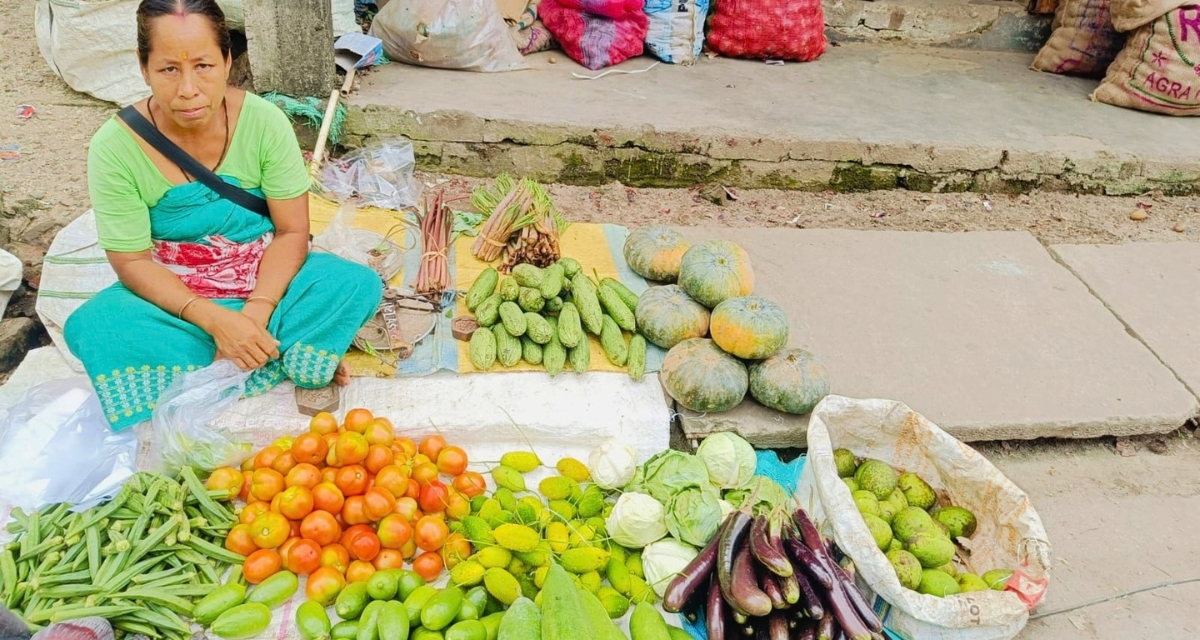
The open-air vegetable market in Beltola operates on Thursdays and Sundays, when farmers from rural settlements in Assam and neighbouring Meghalaya bring a range of indigenous foods to Guwahati. Tribal women vendors like Bodo are an important link between these rural food systems and the city.
They bring xak (wild greens) such as dhekia (fiddlehead fern), manimuni (asiatic pennywort), masundari (fish mint) and bhedai lota (skunk vine), as well as traditional rice varieties such as bao-dhan (deep-water red rice), aromatic joha and sticky bora rice, along with tubers, roots and khorisa (fermented bamboo shoots).
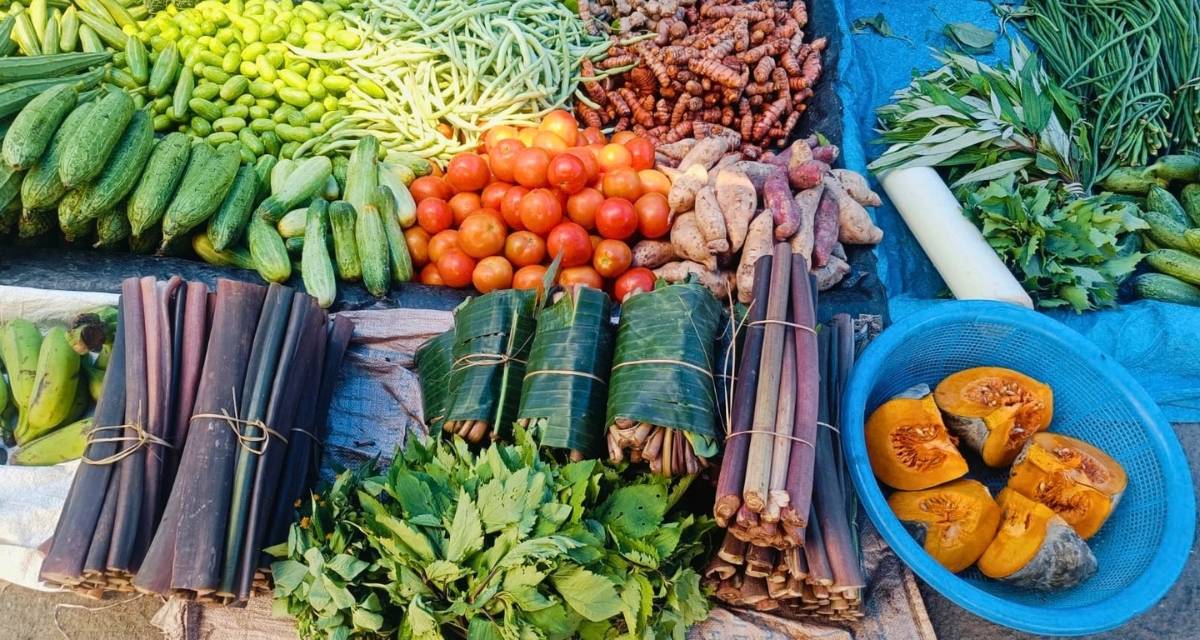 The colourful assortment of indigenous food including kosur thari (colocassia stems), mitha aloo (sweet potatoes), and varieties of xak (leafy green vegetables) for sale at a vegetable market in Guwahati (Photo - Maitreyee Boruah, 101Reporters)
But many of these varieties are increasingly difficult to find in mainstream markets. Farmers often grow them in small quantities rather than commercially, said Pramila Rongpi (40), a vendor from Naziraghat, 30 kilometres from Guwahati.
“These varieties are hard to find even in supermarkets as most farmers have opted for high-yielding hybrid rice varieties for profit,” said Rongpi, who belongs to Assam’s Karbi ethnic community. Like Bodo, she has been vending vegetables, rice varieties and other eatables in Guwahati for 10 years.
“These indigenous women traders are the custodians of our region’s ‘living heritage’ – the indigenous food systems. They act as a link between the forest and the urban plate… preserving a gene pool that is naturally resistant to pests and droughts,” said Kamal Kumar Tanti, director of the Centre for Environment and Climate Action Foundation (CECAF) in Guwahati.
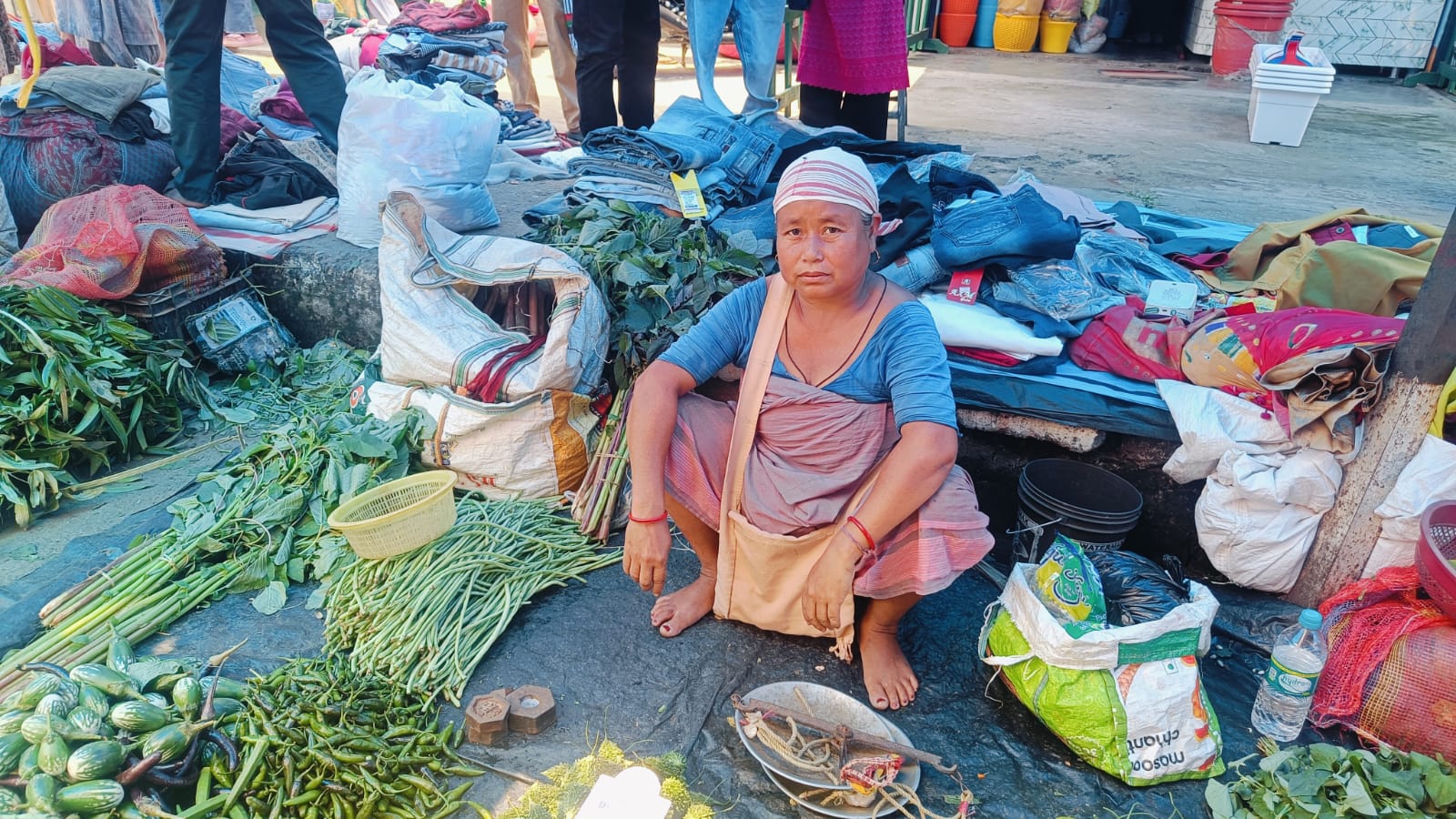 Pramila Rongpi, 40, is a vegetable vendor. She is from Naziraghat, a village 30 kilometres from Guwahati in Assam (Photo - Maitreyee Boruah, 101Reporters)
Under climate pressure
But the food systems they help preserve are themselves becoming increasingly vulnerable to a changing climate.
Munmi Phukon, a scientist at the Assam Rice Research Institute, Assam Agricultural University, Titabor, told 101Reporters that rising temperatures, erratic rainfall and extreme weather events, including floods and droughts, were affecting locally available indigenous food sources across Assam.
“This is due to climate change. There is a reason why a particular food variety is unique to a place. It all depends on rainfall, sunrise, humidity, soil moisture and soil content, among others,” she said.
“Like kaji nemu, which is unique to Assam; earlier, its flowers bloomed abundantly during winters. Now the winter season has shortened, and so the flowering and final harvest.” According to climate projections released by Azim Premji University, Bengaluru, in 2025, mean annual temperatures in some districts of Assam may rise by up to 0.83 degrees Celsius by 2040, while monsoon rainfall may decline by as much as 15% over the same period.
In the Brahmaputra valley, inconsistent rainfall and rising temperatures are also affecting the life cycles of wild foods, experts said.
“Certain species of wild mushrooms and wild greens are emerging late or in small numbers. Urban development around Guwahati has led to the destruction of ‘common lands’ and wetlands where these women usually collected food from the wild,” said Tanti. “Foraging of wild berries and medicinal plants has become difficult due to monoculture plantations in forest areas.”
Keeping the market alive
However, these indigenous food products continue to be in demand despite some urban youth moving towards a less traditional food palette. In Guwahati, for instance, tholua (ethnic Assamese) cuisine remains popular, with many eateries serving traditional Assamese dishes.
“Continuing demand encourages women to continue to produce and helps in maintaining the traditional ‘bari’ system (homestead farming) and sustainable foraging system,” said Tanti.
“In the hilly regions of Assam and Meghalaya, rural folks continue to practise traditional shifting cultivation in all its diversity. Otherwise, most of the land would have been converted to rubber and palm oil plantations.”
Atul Lahkar, a chef who popularised indigenous Assamese food, told 101Reporters that he regularly bought ingredients from tribal women vendors at vegetable markets in Guwahati.
“Without them, urban people would have lost the taste of the finest indigenous food habits,” Lahkar said.
He cited masor tenga (tangy fish curry), cooked with thekera (garcinia), and khar, an alkaline product made from banana ash and usually cooked with unripe papaya.
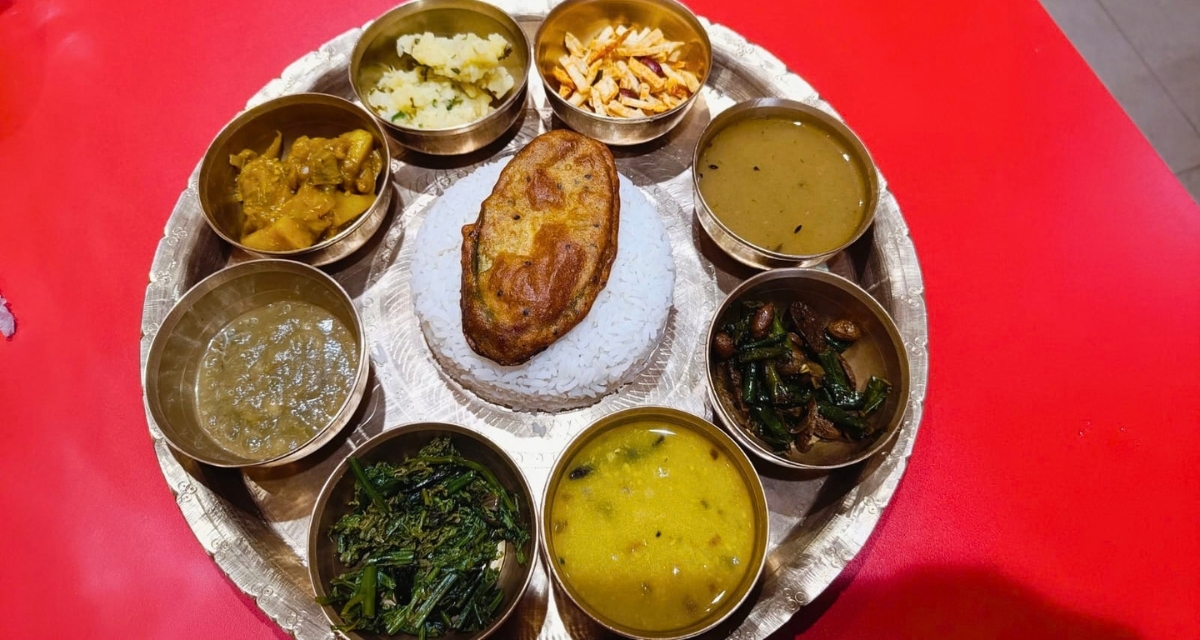 A typical Assamese thali (food plate) with rice, dal, xak, aloo pitika, and other favourite dishes served on a kahor kahi (bell metal plate) (Photo - Maitreyee Boruah, 101Reporters)
The cost of bringing tradition to the city
But preserving the taste of Assamese culture comes at a cost. The women travel long distances carrying vegetables and other traditional foods, including homemade tapioca chips from Meghalaya’s East Khasi Hills and freshwater snails handpicked from streams, marshes and paddy fields.
Garo tribal women from Nagrabil in the East Khasi Hills, for instance, travel in groups, walking first, then taking two-wheelers and finally hiring a four-wheeler to reach Guwahati. Though the village is about 50 kilometres away, the journey takes around three hours because of the hilly terrain.
“As I travel through hilly terrain, I have to wait a long time to board public transport. It takes me three hours (one way) to reach Beltola in Guwahati,” said Romeo Sangma (35), a vendor.
The long journey brings exhaustion and body aches.
“We are not only vendors. We are also farmers and homemakers. We do a lot of work, and there is hardly any rest for us. My body aches a lot,” said Robina Marak (30), a mother of three from Nagrabil.
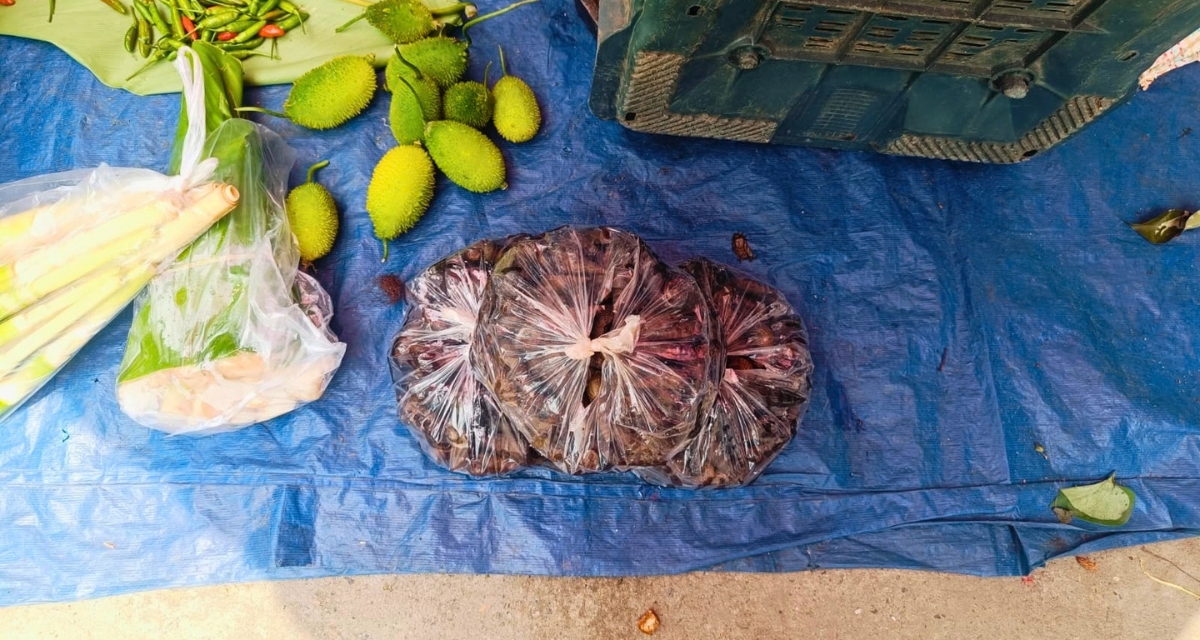 The snails sold by Robina Marak are packed together in a plastic bag (Photo - Maitreyee Boruah, 101Reporters)
Bodo told 101Reporters that to reach Beltola before 7 am and find a good spot for her products, she has to start her journey at 2 am from Hatimura village. Around five to six women from neighbouring villages travel with her to make the trip cost-efficient. Per head, daily food and travel costs Rs 300 to Rs 400 and they earn around Rs 1000 to Rs 2000 per day.
“My household is run from my earnings. My husband is unwell, and my son is looking for work after finishing his school education,” said Bodo.
The Guwahati Municipal Corporation collects a daily fee of Rs 100 to Rs 250 from the vendors. “The corporation people collect money from us daily without fail, but when it comes to providing us with basic needs like a shade, they don’t listen to us,” Sangma said.
For these women, the work of keeping indigenous foods in cultivation, on city markets and on urban plates continues alongside the daily struggle to earn a living – with little support for the basic conditions in which they do it.
This story was produced under the Biodiversity Reporting Fellowship, supported by Earth Journalism Network.
Cover Image - Tribal women vendors sit in a row on a footpath at the Beltola vegetable market in Guwahati (Photo - Maitreyee Boruah, 101Reporters)
Would you like to Support us
101 Stories Around The Web
Explore All News