As heatwaves intensify, autistic children and their families struggle to cope
_(1).webp)

As heatwaves intensify, autistic children and their families struggle to cope
Patna, Bihar: Every day, Neha Kumari worries that the journey to her son's therapy could make him sick.
The 29-year-old moved from Bokaro in Jharkhand to Patna after her four-and-a-half-year-old son, Aman, was diagnosed with autism about 18 months ago. With no specialised autism centre in her hometown, she rented a room about 25 minutes away from a therapy centre in Patna so he could continue treatment.
But as temperatures continue to soar, the daily commute has become another source of anxiety.
"Due to excessive heat, it becomes very difficult for me to bring my child to the therapy centre. There is always a fear of heatstroke," she said.
The heat has also kept Aman indoors. Without his usual time at the park, he becomes increasingly hyperactive at home, making it harder for Neha to manage his routine.
Neha's experience reflects a challenge confronting many families of autistic children during heatwaves. Parents say extreme heat is disrupting therapy, worsening behavioural challenges and making everyday caregiving more difficult. Experts say autistic children are particularly vulnerable because many struggle to recognise and communicate internal bodily signals such as thirst or overheating, yet India has no heatwave guidance tailored to their needs.
Challenges for autistic children
Psychologists say autistic children can be especially vulnerable during heatwaves because many struggle with interoception, the ability to recognise and respond to internal body signals such as thirst, hunger, fatigue, overheating or the need to rest. As temperatures rise, they may not realise they are dehydrated or physically distressed until their symptoms become severe.
Heat can also intensify sensory sensitivities. High temperatures, humidity, sweating and changes in clothing can trigger sensory overload, making it harder for children to regulate their emotions. Experts say this may lead to anxiety, hyperactivity, meltdowns or aggressive behaviour, particularly among children who are unable to communicate their discomfort verbally.
"Heat affects autistic children differently because many struggle with interoception, the ability to recognise internal body signals such as thirst, hunger, fatigue, overheating, or the need to rest," said Dr Rajlakshmi Kandawamy, director of Authentic Autism Solutions. "During a heatwave, these signals can become harder to interpret, making it difficult for children to realise they are dehydrated or exhausted. As a result, they may experience heightened sensory overload, emotional dysregulation, anxiety, meltdowns or extreme restlessness."
Reshaping everyday life
For many families, the effects of a heatwave extend well beyond the journey to therapy.
Mamuni Kumari, a police constable from Bihar, has taken two months' leave from her posting in West Champaran to stay in Patna while her five-year-old son, Sanskar, undergoes therapy.
As Sanskar is non-verbal, she often struggles to understand what is causing his distress.
"There are days he cries and acts stubbornly, but we fail to understand what the problem is," she said. "The power cuts during extreme heat make the child uncomfortable, and he starts crying, making it difficult to calm him down."
The nights are equally difficult for some families.
Julie Kumari, who moved from Bihar's Mokama to Pune after her two-and-a-half-year-old son was diagnosed with autism, said high temperatures and frequent power cuts have disrupted his sleep despite having a cooler at home.
"He is very hyperactive and anxious at night," she said. "As a result, I cannot sleep at night. I try to finish all my household chores and sleep between 11 am and 3 pm, but I still feel tired a lot."
Dr Rajlakshmi Kandawamy said heat-related sleep disruption and heightened sensory stress can create a cycle in which children become more irritable while caregivers face increasing exhaustion and sleep deprivation.
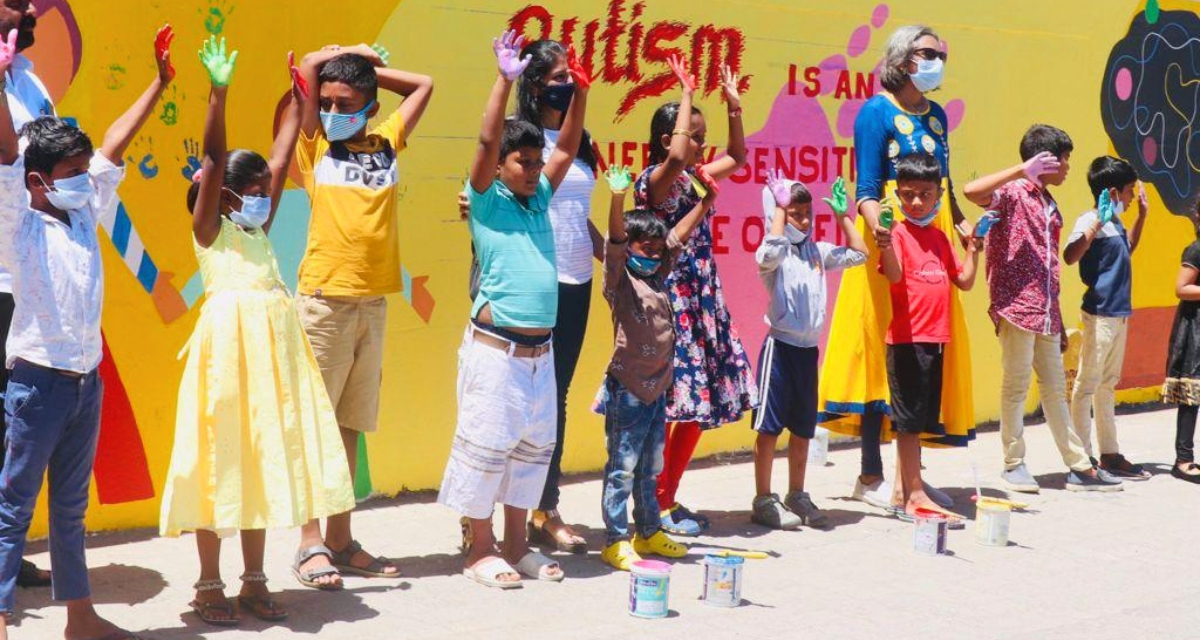 Children doing wall art to create awareness about our energy based solution in autism ( Photo - Dr Rajlakshmi Kandawamy, 101Reporters )
Adaptation
The effects of extreme heat are also changing how therapy centres work.
Nehaluddin Asad, founder of Medminds Autism & Down Syndrome Therapy Center in Patna, said therapists often have to modify sessions during heatwaves as children arrive more restless and emotionally dysregulated than usual.
"We often see children being hyperactive during extreme heat, so we change the therapy plans," he said. Instead of moving directly to speech or learning sessions, therapists spend more time on calming exercises such as ramping sessions and ball-pressure therapy to help children regulate their emotions before beginning other activities.
But these adaptations are largely based on experience rather than official guidance.
Nehaluddin said therapy centres do not fall under the education system and are therefore not covered by government heatwave protocols. "Despite increasingly frequent heatwaves, India has no autism-specific heatwave advisory," he said.
Experts say the absence of disability-inclusive heat action plans means therapists and families are left to develop their own strategies to keep autistic children safe during periods of extreme heat.
The cost of coping
For many families, adapting to heatwaves also comes at a financial cost.
After moving from Bokaro to Patna for her son's treatment, Neha rented an affordable room nearly 25 minutes from the therapy centre to keep expenses manageable. But the longer commute has made travelling in extreme heat more difficult. At home, the family relies only on a fan, which she says often offers little relief during periods of intense heat.
The burden is unevenly distributed. While some families can rely on air-conditioners, private transport or homes with uninterrupted electricity, others must cope with long commutes, frequent power cuts and limited access to cooling. For caregivers, each heatwave brings additional emotional, physical and financial strain. This is particularly true for families who have already relocated or travel long distances to access specialised therapy.
Despite increasingly frequent heatwaves, experts say support for autistic children remains largely absent from India's heat action planning. Beyond general advisories on hydration and avoiding the afternoon sun, there are no autism-specific protocols to help families, therapy centres or caregivers manage the heightened risks associated with extreme heat.
This story was produced as a part of 101Reporters Climate Change Reporting Grant.
Cover Image - Wall art to promote inclusivity - done on a govt school wall near the center
Would you like to Support us
101 Stories Around The Web
Explore All News