Lost in translation: The limitations of teaching in mother-tongue in Odisha

Lost in translation: The limitations of teaching in mother-tongue in Odisha
While multilingual education improves early participation, gaps in materials, training and transition leave tribal students struggling as classrooms shift to Odia.
Mayurbhanj, Odisha: It’s a warm April morning in a small school tucked among tall sal trees in Mayurbhanj district. Inside, about 30 young children sit cross-legged on a faded red mat, their voices already filling the room.
Their teacher, Sasmita Sing Banara, holds up a picture of a peacock. "This bird dances when it sees dark rain clouds. What do we call it?"
"Mara!" the children call out in Ho, their mother tongue.
"Good! Now — what about in Odia?"
"Mayuro!" they chime, switching languages as easily as breathing.
These children are learning in the language spoken at home, around the fire, in the fields and then, gently, being walked into new languages without leaving their own behind. "The language is ours. The children are ours. It feels good to teach like this," Banara told 101Reporters.
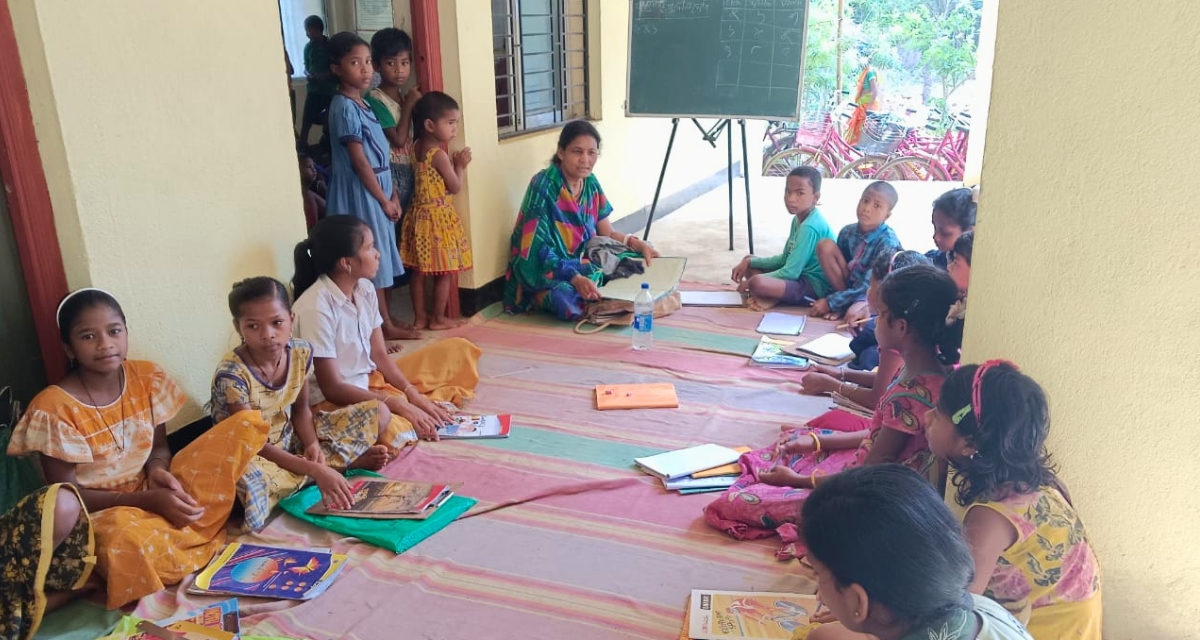 Sasmita teaches the primary students in mother tongue (Photo - Prativa Ghosh, 101Reporters)
Built around children's language
Such classes are conducted regularly at Rani Pokhari Government UG High School in Kaptipada block. Of the school's 263 students, around 90% belong to the Ho community and most speak Ho, Santali or Mundari at home. Conventional teaching in Odia often leaves these children disengaged. "When lessons are only in Odia, many children remain silent, hesitate to respond, or lose interest," said MLE volunteer teacher Simal Hembram.
Efforts to teach in Ho here began through Sikshasandhan, a non-profit that introduced multilingual practices around 2006. The school was later brought under Odisha's official mother-tongue based MLE programme around 2012-’13. Instead of relying only on textbooks, teachers use placards, pictures, sticks and bangles to teach alphabets and counting. "Reading in our language is fun. When teachers explain in our language, it becomes much easier," said Namita Hembram, a Class 5 student at Adapal Government High School.
According to district education officials, 635 schools in Mayurbhanj are currently listed under the MLE programme, around 400 using Santali, 100 Ho, and 135 Mundari. But listing and functioning are different things. On the ground, implementation varies widely due to gaps in teachers, materials and support. In Ramchandrapur panchayat, where 98% of students belong to Scheduled Tribe communities, only two of seven primary schools are designated MLE schools, and the programme is not consistently functional in both.
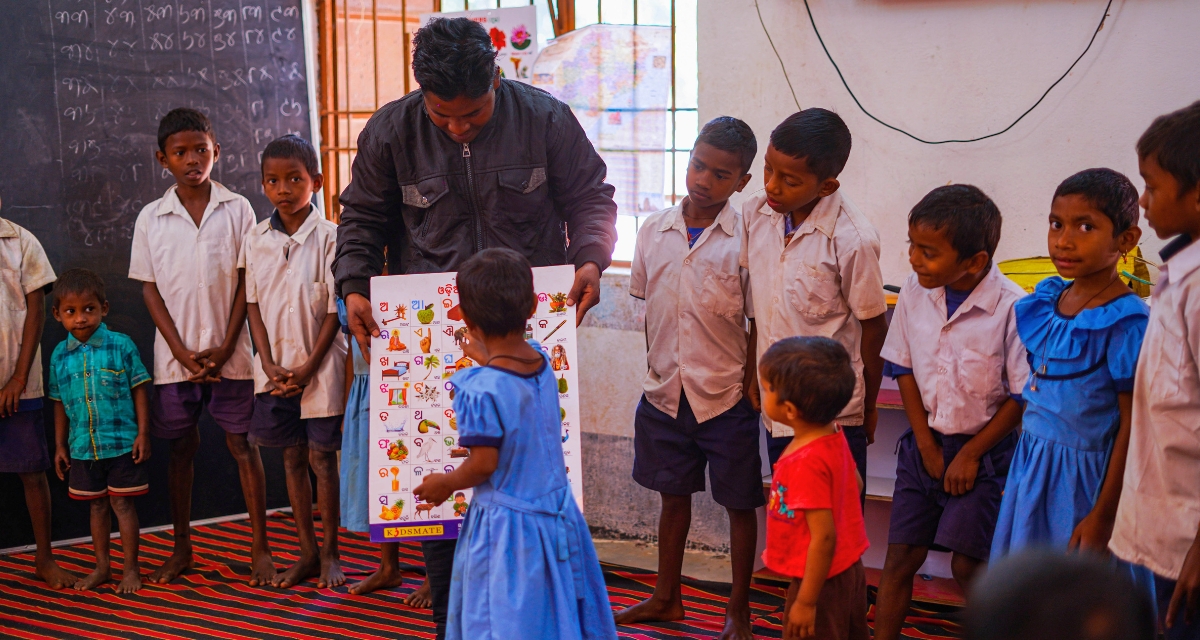 Students recognise the objects in class (Photo - Prativa Ghosh, 101Reporters)
Early gains, weak transition
The MLE programme, introduced in 2006-07, aims to enable tribal children to begin schooling in their home languages before gradually transitioning to Odia and English. The early gains are real. The transition is not.
"While children show strong comprehension in their mother tongue, the shift to Odia in higher classes becomes a critical challenge. Without structured bridging support and bilingual materials, many are unable to transfer their learning," said Dr Sushree Sangita Mohanty, an independent researcher associated with multilingual education initiatives in Bhubaneswar. "Some students can explain ideas in their own language, but they struggle to write or answer in Odia. Without support in both languages, they lose confidence," added Sasmita Bagda, an MLE teacher at Lambua Sahi Primary School.
Outdated materials compound this. "We are still using books printed around 2010-12. Without updated material in Ho, Santali or Mundari, we are gradually pushed to switch to Odia textbooks," said Pan Bankira, an MLE teacher at Dileswar Primary School. The contrast with the Foundational Literacy and Numeracy programme is sharp since FLN schools receive regular, colourful, activity-based resources in Odia, while MLE classrooms are largely limited to ageing basic textbooks. Dr. Mahendra Kumar Mishra, National Advisor for Multilingual Education at the Language and Learning Foundation, traces this to weakened institutional follow-through. "District-level interest and follow-up have weakened over time. Community-level initiatives and coordination between the education and tribal welfare departments have not been consistent," he said.
What the options cost
This uncertainty shapes parental decisions. "Parents start thinking about the future when children reach Class 3 or 4. Since higher classes are mostly in Odia, many prefer to shift them earlier so they can adjust," said Binika Munda, a teacher in Kaptipada block.
The difference is felt directly. "In the MLE school, my daughter speaks freely. She understands quickly and even explains things at home," said Laxmi Tudu, a parent from Ramchandrapur village. "But when my older son went to an Odia-medium school, he stayed quiet for months. He was afraid of making mistakes." Students say it plainly too. "In our language, I can answer without fear," said Minjari Singh, Class 4. "In Odia, I don't always understand, so I don't speak."
Residential schools present another trade-off. Students become fluent in Odia more quickly, but many gradually stop using their mother tongue. Jema Gadsara, a sixth-grade student studying away from her village, said students are encouraged to speak only Odia. After years away, she began forgetting words in Ho when speaking to her parents.
Limited reach
Despite policy support, coverage remains thin. Education experts estimate Odisha has around 12,000 schools where at least 80% of students are tribal, yet the MLE programme is operational in only about 1,500 schools across 17 tribal-dominated districts, reaching around 90,000 children. The reasons are structural: MLE requires trained teachers fluent in specific tribal languages, regular material supply, and ongoing support, none consistently available at scale. Teacher transfers frequently disrupt continuity. Classroom observation specific to multilingual teaching is rare, and learning outcomes in home languages are not systematically tracked.
"Teachers have not received refresher training for many years. New teachers join without MLE orientation. Because of this, many classrooms gradually move back to Odia even in notified MLE schools," said Birsha Singh, a teacher at Haldia Sahi UG High School.
Sapan Kumar Prusty, MLE coordinator for Mayurbhanj, is unambiguous about what is at stake. "It's not a question of whether this is important. This is the child's constitutional right." But he acknowledged the gaps. "The programme needs stronger monitoring, updated materials and regular training. Without that, implementation becomes uneven and the benefits are not sustained."
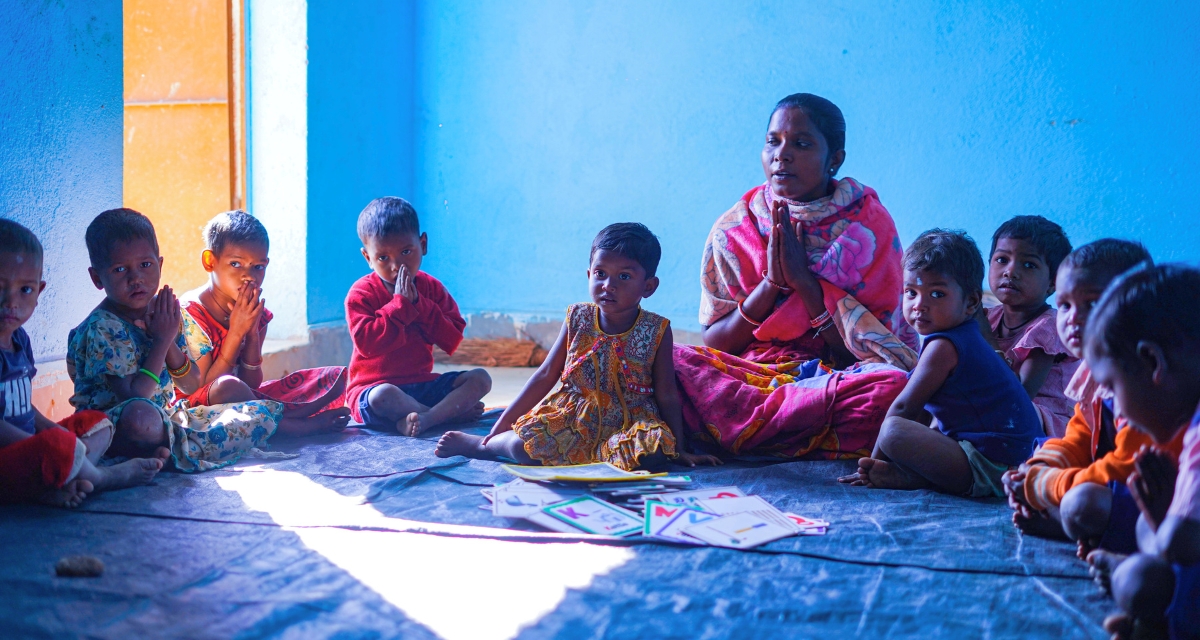 Students with their teacher (Photo - Prativa Ghosh, 101Reporters)
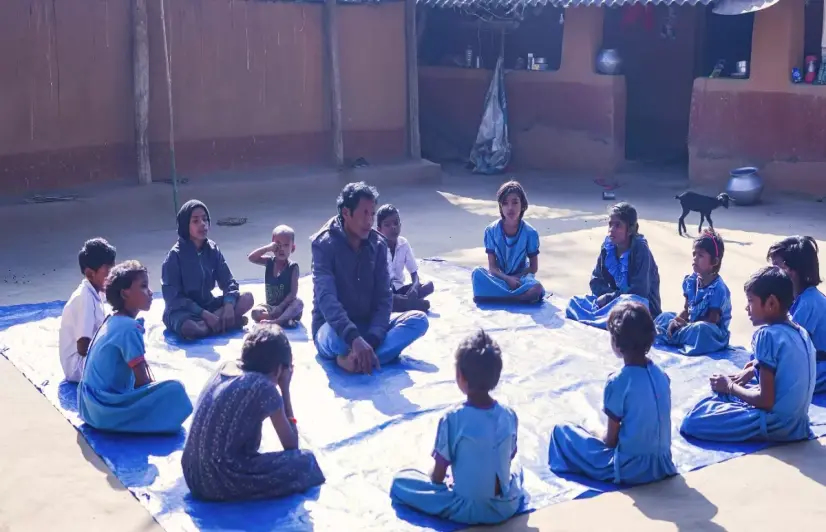
Anil Pradhan of Sikshasandhan, who was part of Odisha's MLE policy drafting process, explained: "Even where the programme exists, often only the MLE instructor understands the approach, other teachers are not oriented to it. If children are not supported for a longer period in their own language, the shift to Odia becomes difficult. The programme needs continuity, training and coordination to make that transition smoother." Cover Image - The teacher talks in the students' mother tongue (Photo - Prativa Ghosh, 101Reporters)
Would you like to Support us
101 Stories Around The Web
Explore All NewsAbout the Reporter
Write For 101Reporters
Would you like to Support us
Follow Us On