Under MP's solar pump scheme, farmers discover loans in their names

Under MP's solar pump scheme, farmers discover loans in their names
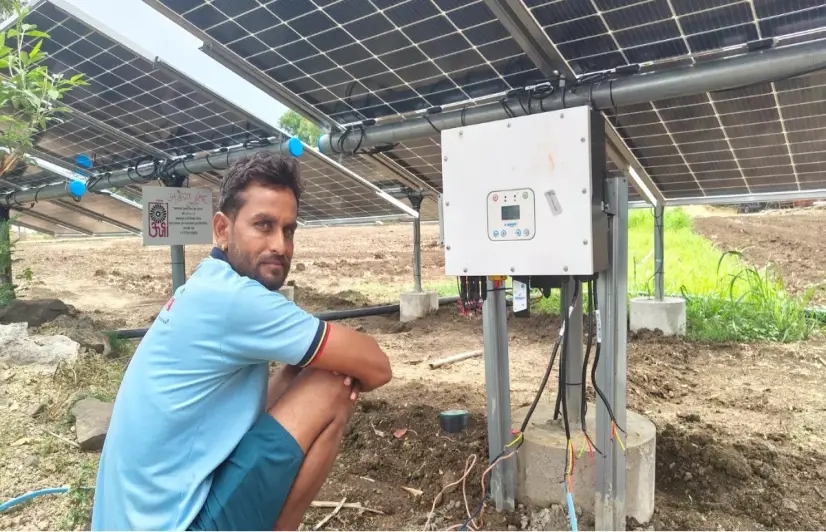
Bhopal, Madhya Pradesh: The monsoon has arrived in Madhya Pradesh. Farmers are sowing kharif crops across green fields where rows of blue solar panels now glisten, soaking up sunlight breaking through the clouds.
For many, solar pumps have transformed irrigation. They no longer wait for erratic night-time electricity supply, no longer irrigate in winter nights, no longer spend heavily on diesel.
But alongside these panels, another reality has entered the fields: loans that many farmers say they never knew existed in their names.
In Khujri village of Ratlam district's Mandsaur tehsil, Anil Patidar (56) is waiting for a solar pump installation. Officials at an awareness camp told him that under the Madhya Pradesh government's Pradhan Mantri Krishak Mitra Surya Yojana, farmers need only contribute 10% of the project cost, with the government covering the remaining 90% through subsidy.
When Patidar visited his bank to complete formalities, he discovered something unexpected: a loan of more than Rs 2.5 lakh had already been sanctioned in his name.
"We were told that we only had to deposit 10% of the amount and the government would pay the rest," he said. "Only when I checked the bank documents did I realise there was a loan in my name."
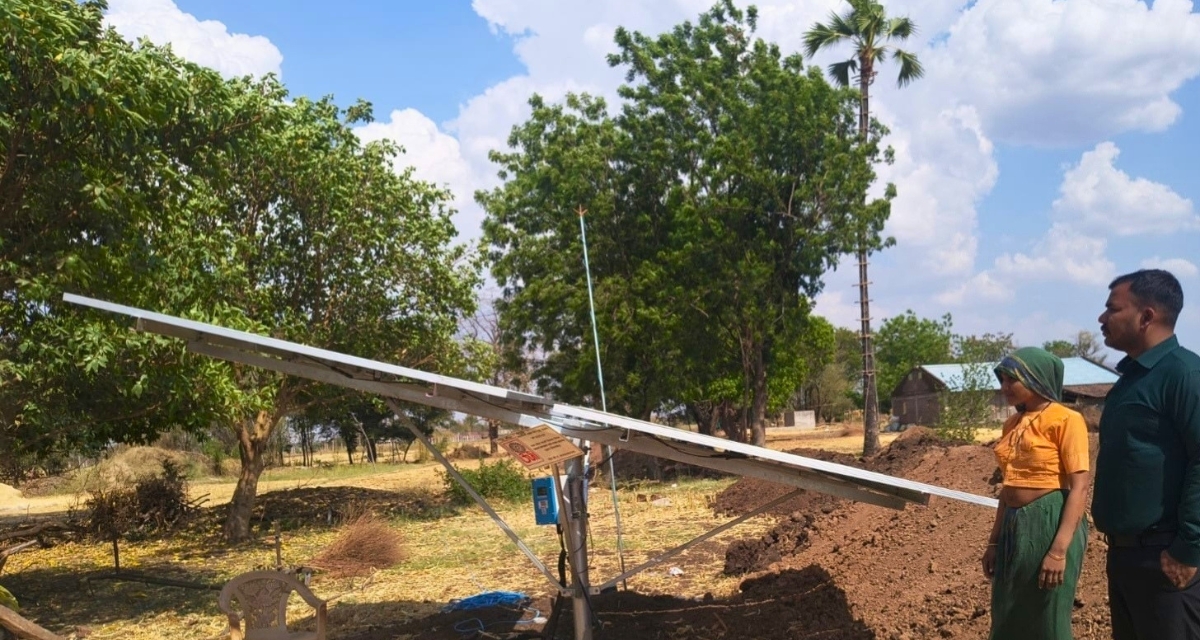 Neemach Renewable Energy Officer Deepak Das conducting a physical verification of solar pumps installed on local farms (Photo - Sanavver Shafi, 101Reporters)
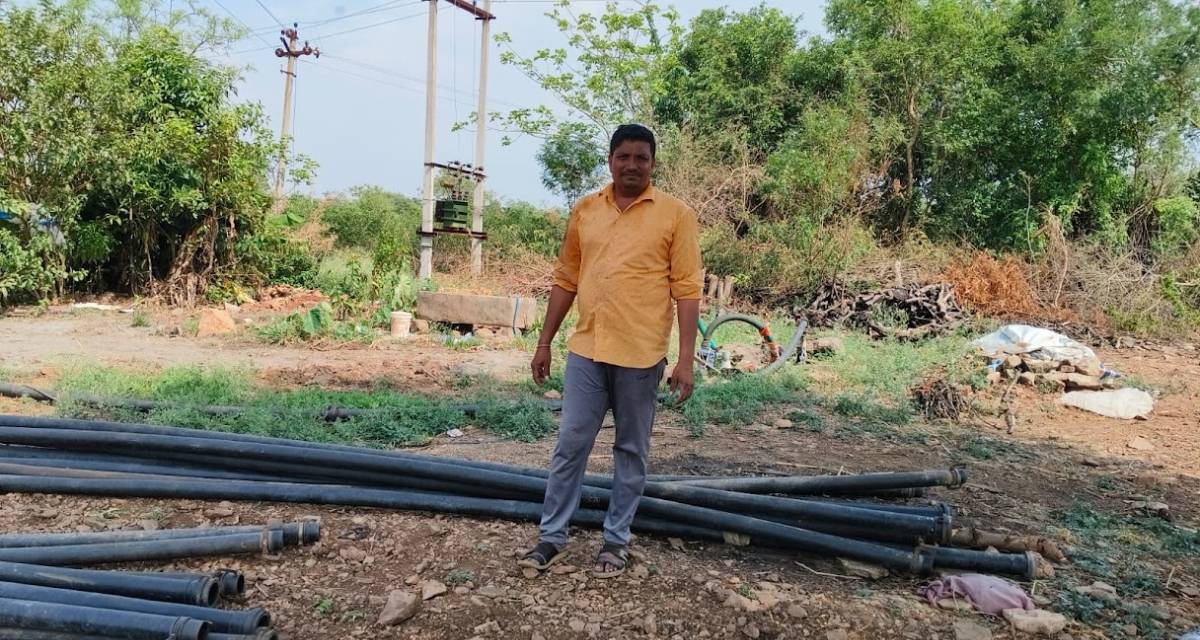
In Barthoon village, also in Ratlam district, Satyanarayan Sharma (68) faces a similar situation. Pipes for his solar pump lie outside his house. The irrigation system has yet to be installed. The loan, however, has already been processed. "If the government is going to repay the instalments, why is the loan in my name?" Sharma asked. "If the government delays payment, who will the bank come after?"
A review of loan agreements, hypothecation documents, Key Fact Statements and digital stamp papers from farmers in Ratlam and Neemuch districts reveals that the scheme's financial structure differs markedly from how beneficiaries say it was explained to them.
Patidar's 7.5 HP AC submersible solar pump shows a total project cost of Rs 4,04,475. Of this: Rs 1,09,537 is recorded as Central Financial Assistance (CFA), Rs 41,537 is Patidar's margin money (approximately 10%), Rs 2,53,402 is a term loan sanctioned by the Central Bank of India for 84 months at a floating interest rate of 8.30% In other words: government assistance accounts for about 27% of the total project cost, the farmer contributes just over 10%, and the remaining 63% is financed through a bank loan in the farmer's name.
Similar is the case for Sharma’s 5 HP DC submersible solar pump. It’s total project cost is Rs 2,95,086. Of this: Government assistance is Rs 80,816 (approximately 27%), farmer contribution is Rs 30,289 (approximately 10%), and the bank loan: Rs 1,83,981 (approximately 63%)
Loan documents from other beneficiaries—Ramsukhi Bai of Basedi Bhati village in Neemuch district and Chandmal Bai Patidar of Piplon village—reflect this same financial structure consistently.
The gap is striking. The government advertises the scheme as offering "up to 90% subsidy." Official banking documents show that government assistance covers only about 27% of costs, while the remaining 63% is shifted onto farmers as bank debt.
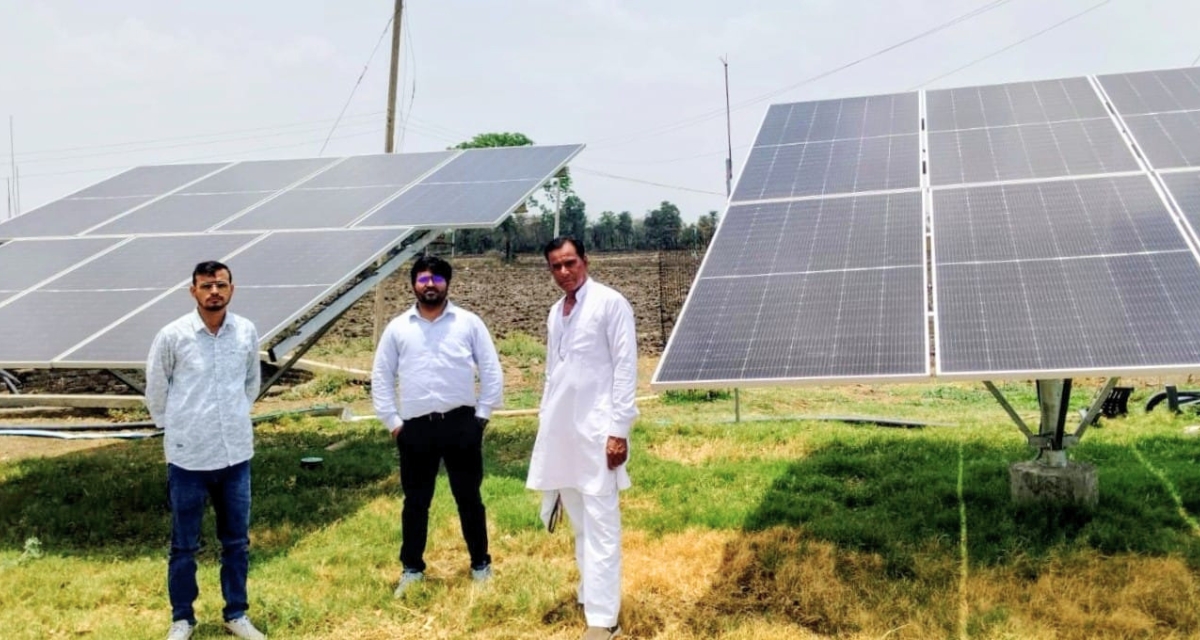 Neemach Renewable Energy Officer Deepak Das conducting a physical verification of solar pumps installed on local farms (Photo - Sanavver Shafi, 101Reporters)
Understanding the scheme
The Union government launched the Pradhan Mantri Kisan Urja Suraksha evam Utthaan Mahabhiyan (PM-KUSUM) in 2019 to promote clean energy and improve farmers' incomes. The scheme has three components, of which Component B—standalone (off-grid) solar pumps for irrigation—is most relevant here. Madhya Pradesh had already been implementing its own Mukhyamantri Solar Pump Scheme, which was merged with PM-KUSUM in 2020.
According to official data, 13,07,190 solar pumps have been sanctioned under Component B nationwide, of which 11,49,988 have been installed. In Madhya Pradesh, 59,400 pumps have been sanctioned and 24,682 have been installed.
Until recently, farmers in the state received a subsidy of around 60%, shared equally by the Centre and state government. On 24 January 2025, the Madhya Pradesh government rebranded the scheme as the Pradhan Mantri Krishak Mitra Surya Yojana and transferred implementation to the Madhya Pradesh Urja Vikas Nigam Limited (MPUVNL). Later that year, Chief Minister Mohan Yadav announced an increase in subsidy to up to 90%, which the state Cabinet approved in November 2025. The 2026-27 Budget allocated Rs 3,000 crore to install one lakh solar pumps.
The government promoted the scheme as a way to reduce farmers' dependence on diesel and expensive electricity, lower irrigation costs and make farming more reliable. Farmers interviewed by 101Reporters confirmed solar pumps do simplify irrigation by reducing dependence on erratic power supply and cutting fuel costs. The problem is not the technology but the financial structure.
Legal risk
A closer examination of the loan agreements reveals clauses with significant implications for farmers if the government delays payments.
Clause 25 states that the farmer and the Madhya Pradesh Urja Vikas Nigam Limited (MPUVNL) are jointly and severally liable for the loan. In practical terms: if the state agency fails to make payments to the bank on time, the bank can seek recovery from the farmer.Clause 24 further states that if delays by MPUVNL affect a farmer's CIBIL score, the bank cannot be held responsible. The farmer bears the reputational and financial consequence of a state agency's default.
The agreements also give banks extensive recovery powers. Clauses 13 and 14 provide that if the loan account is not serviced within the stipulated time, it can be classified as a non-performing asset (NPA). The bank, or an authorised recovery agency, can then enter the farmer's property, seize the solar pump and related equipment, and auction them to recover dues. If auction proceeds are insufficient, the bank can initiate recovery proceedings against the borrower's other assets.
The loan agreements also specify that any delay in repayment will attract penal interest of 2% per annum, compounded monthly—an additional financial burden if the state government's payments slip.
The official assurance
The state's track record on similar commitments raises further questions. According to official records placed before the State Level Bankers' Committee (SLBC), Madhya Pradesh Gramin Bank and Madhyanchal Gramin Bank together have claims of Rs 3,865 crore against the state government for unpaid farm loan waivers. Of this, only Rs 534 crore has been paid, leaving Rs 3,232 crore pending. Das's assurance that MPUVNL will promptly service all solar pump loans operates against this backdrop: a state government with Rs 3,232 crore in outstanding liabilities to rural banks. If the government has not cleared earlier farm loan waiver dues, why should farmers trust that it will prioritise solar pump loan repayments?
How the financing model was decided
The financial structure of the scheme was formally discussed at a meeting of the State Level Bankers' Committee (SLBC) held at Vallabh Bhawan in Bhopal on 17 April 2025. The meeting was chaired by Chief Secretary Anurag Jain and attended by senior state officials, Reserve Bank of India representatives, NABARD, the State Bank of India and other member Banks.
According to the minutes, the Additional Chief Secretary of the state's New and Renewable Energy Department presented the proposed financing framework. During discussions, the State Bank of India objected to any proposal for a fixed interest rate, arguing that lending for seven years at a fixed rate was not financially viable for banks.
To resolve the objection, Chief Secretary Jain constituted a committee comprising representatives of the Indian Banks' Association, NABARD, the SLBC, SBI and the Agriculture Production Commissioner. The committee agreed that loans would carry a floating interest rate instead.
This decision has direct consequences for farmers. Loan documents show that borrowers now receive loans at an annual floating interest rate of 8.30%. The Letter of Interest Variation states that borrowers agree to pay interest at rates notified by the bank from time to time—meaning the rate is not fixed for the loan's seven-year duration.
Congress leader Rahul Raj pointed out the implication: "If the repo rate increases in the future, the borrowers' instalments could also rise. This was a decision made in a bankers' committee, not in farmers' interest."
This raises a critical unanswered question: Does the state government have the financial capacity to service these loans—with floating interest rates—over seven years if interest rates rise significantly? The Rs 3,232 crore in pending farm loan waiver liabilities suggests the state's fiscal position is already strained.
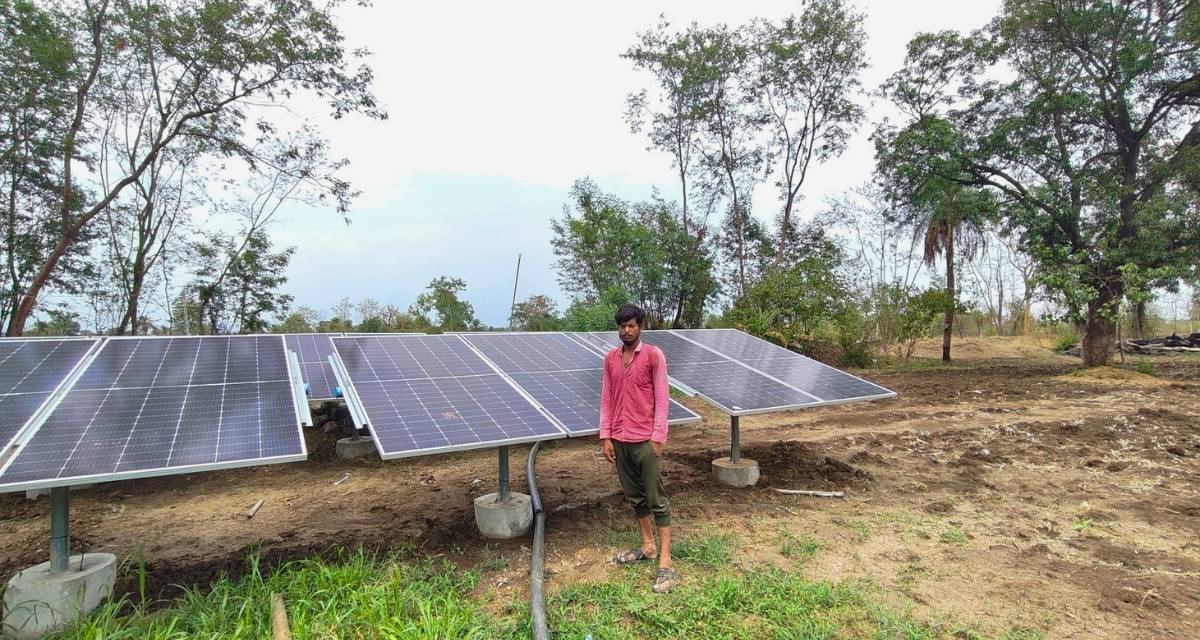 Arvind Dangi, a BPL beneficiary from Barmad village, Berasia, preparing to irrigate his soybean crop (Photo - Sanavver Shafi, 101Reporters)
The installation delay
The uncertainty surrounding the scheme extends beyond the loan agreements. Several farmers who have completed formalities and deposited their contribution say they are still waiting for solar pumps to be installed.
The delay is particularly acute during the current kharif season, when irrigation has become critical. The southwest monsoon reached Madhya Pradesh on 24 June—about 10 days later than usual. Rainfall has remained uneven across the state, with eastern districts recording larger deficits. In Bhopal, Indore, Ujjain and Neemuch, prolonged dry spells have increased irrigation demand for soybean, groundnut and paddy.
Sharma's case illustrates the timing problem. He applied for a solar pump in September 2025 and deposited his 10% contribution in two installments. The Central Bank of India sanctioned the loan. But the pump is yet to be installed. "This season has been particularly difficult," Sharma said. "If the solar pump had been installed on time, I would have been able to irrigate my crop when it needed water." This kharif, he has sown soybean on three acres and groundnut on two acres. With rainfall uncertain, he fears he may have to resow parts of his crop.
Neemuch district alone has installed solar pumps for only 240 farmers so far, while work orders have been issued for 1,525 beneficiaries. Of these, installations are pending for 1,227 farmers—80% of those with approved work orders.
Dinesh Kumar Dhakad, from Bordiya village in Neemuch's Singoli tehsil, applied for a 7.5 HP solar pump in 2023 and deposited nearly Rs 78,000 as his contribution in 2025. The pump has still not arrived. "I am irrigating my fields using a conventional motor," he said. "If the solar pump had arrived on time, I could have avoided spending more on electricity and water."
Similar accounts come from Anil Kumar and Prakash Patidar, whose applications have been approved but whose pumps have yet to reach their fields.
 Dinesh Kumar Dhakad preparing to irrigate his soybean crop in Singoli, Neemach district (Photo - Sanavver Shafi, 101Reporters)
Why the delays?
Several private vendors have been empanelled to implement the scheme, including Shakti Pumps, Surya International, Rotomag Enertec, Oswal Pumps, Mahindra Solarize, PCI Wires and CRI Pumps.
Once a solar pump installation is completed, the bank releases the full loan amount to the vendor through the Energy Department. The vendor then assumes responsibility for maintenance and insurance for five years.
If vendors receive full payment only after completing work, why do installation delays persist? Farmers question this logic. If vendors are paid upon completion, they should have incentive to finish work quickly.
Deepak Das, Renewable Energy Officer for Neemuch district, attributed delays to rising raw material costs, disruptions in the supply chain and a shortage of trained installation staff.
"We have held several meetings with vendors and directed them to arrange equipment and technical personnel from other regions so that the pending installations can be completed as early as possible," he said.
However, Das did not address why, if this is the constraint, the state continues to sanction loans and collect farmer contributions before supply chains stabilise and vendors have the capacity to deliver.
Cover Image - Ramlkhan Dangi, a BPL beneficiary from Barmad village, Berasia, preparing to irrigate his soybean crop (Photo - Sanavver Shafi, 101Reporters)
Would you like to Support us
101 Stories Around The Web
Explore All NewsAbout the Reporter
Write For 101Reporters
Would you like to Support us
Follow Us On