How growing temple construction and technology are transforming a small town

How growing temple construction and technology are transforming a small town
Once known mainly for sandstone cutting, Bayana is emerging as a major hub for temple stonework as machines accelerate production and transform local livelihoods.
Bharatpur, Rajasthan: The small town of Bayana in Rajasthan’s Bharatpur district was for a long time a limited but important center for the stone business. The work there mainly involved sandstone slab cutting. Local traders would cut the stones and sell them. For carving, engraving, and fine detailing, the stones were sent to towns such as Bhusawar, Shri Mahavir Ji, and Hindaun City, where traditional artisans spent months handcrafting floral patterns, images of deities, and other motifs onto them. The finished stones were then transported to temple construction sites across different states.
But over the past few years, this picture has changed rapidly. Demand for carved stones surged with projects ranging from the Shri Ram Janmabhoomi Temple in Ayodhya to temples being built in India and abroad by the Bochasanwasi Shri Akshar Purushottam Swaminarayan Sanstha. Large orders also began coming from Jain temples in Madhya Pradesh and from South India. Today, according to factory owner Manoj Patel, seventy to eighty percent of all orders received by Bayana's stone industry are linked to temple construction. The remaining orders come from government infrastructure projects and private home construction. This surge created a challenge for local stone traders, it became difficult to fulfill large, fast-paced orders through traditional methods alone.
"The stone used to be cut here and then sent to other villages and towns. Large orders started taking too much time. If we had not installed machines, we would have been pushed out of the market,” said Nemichand Sharma, stone trader.
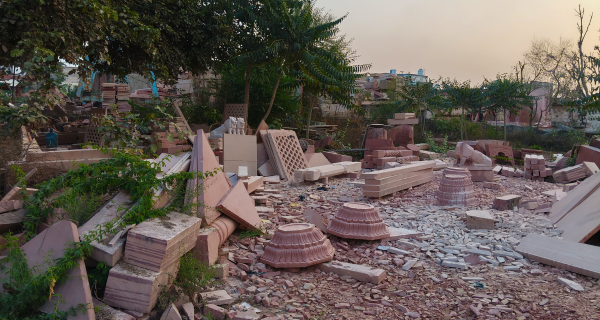 A view of stone cutting at an industrial unit in Bayana. (Photo - Amarpal Singh Verma, 101Reporters)
The CNC revolution
This is when CNC (Computer Numerical Control) machines rapidly entered Bayana. Around 2018, a few factories installed CNC machines for the first time, beginning with just five to seven machines. After 2021, their expansion accelerated sharply, and the highest number of machines has been installed in the last one and a half years. Today, more than 300 CNC machines are operating across Bayana's 250 factories. Smaller factories have four to five machines, while larger units have as many as ten to twelve.
Sharma said the cost of a CNC machine ranges from Rs 15 lakh to Rs 50 lakh, with some machines available at up to Rs 3 crore, though such expensive models have not yet arrived in Bayana.
One reason for this rapid spread has been the changing economics of the machines themselves. Until a few years ago, CNC machines mainly came from China and were very expensive, putting them out of reach for smaller traders. But in recent years, domestic manufacturing of CNC machines has grown within India, bringing prices down and improving availability. As demand for machine-based work grew at the local level, so did the manufacturing ecosystem around it, making access to technology easier for industries in smaller towns.
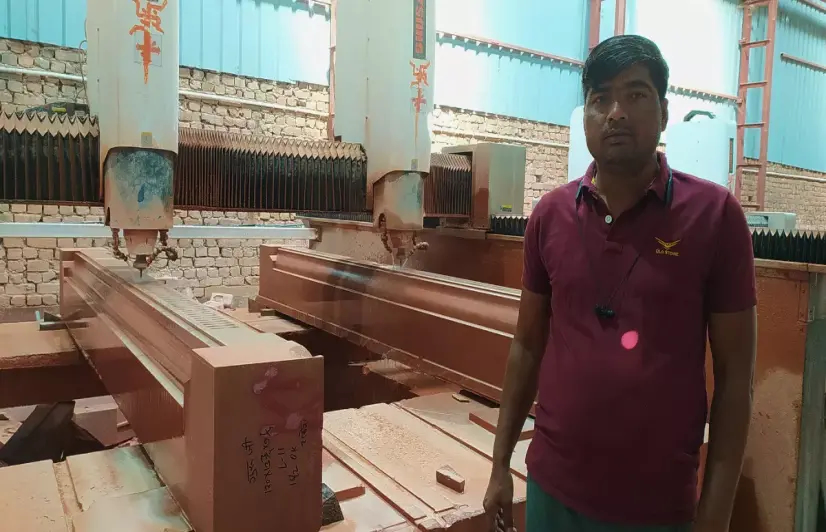
CNC machines have transformed the way work is done in Bayana. Designs are fed into a computer, and a diamond-tipped tool engraves the exact pattern onto the stone with precision. Work that earlier took artisans several days or even weeks can now be completed within hours. Factory owner Manoj Patel explains that different machines serve different purposes: gang saw machines prepare thin slabs; splitting machines handle thicker ones. CNC machines, meanwhile, produce gateways, figures of deities, door frames, doors, idols, small temples, fountains, lattice screens, jharokhas, and decorative items.
"Earlier, this business was worth crores of rupees. Now it has grown into a multi-billion rupee industry. The government earns crores in revenue from here,” said Dinesh Soopa, President, Bayana RIICO Industries Association.
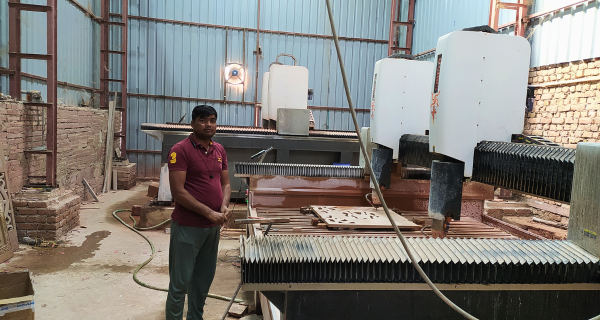 An operator carving stone on a CNC machine at an industrial unit in Bayana. (Photo - Amarpal Singh Verma, 101Reporters)
New livelihoods, new skills
Every CNC machine requires at least one trained operator, and most operators are local young men who learned their trade on the factory floor, no engineering degree required. Young people receive local, hands-on training within six months to a year.
Nemichand Sharma says machine operators initially earn salaries of Rs 10,000 to Rs 15,000 a month. With experience, salaries rise to Rs 15,000-20,000, and skilled operators are now earning between Rs 35,000 and Rs 50,000.
Satyavan Gurjar (22) from Sikandra village near Bayana studied until Class 12 and then spent a few months with a relative learning CNC operation. Three years ago, he joined a factory at Rs 10,000 a month. He now earns Rs 18,000. "My father worked as a laborer," Gurjar said. "The family struggled to survive, but our condition has improved now."
Rammoorti (24), a resident of Bayana, passed Class 10 and initially worked as a laborer. He learned CNC operation on the job within a year and began earning Rs 20,000 a month — now Rs 30,000 after three years. Bunty Gurjar (26) from Palidang village dropped out during the second year of his BA and started as a factory helper. "There I learned to operate CNC machines," he says. "After that, I started earning Rs 15,000. Now I work in another factory for Rs 22,000 a month."
Dharm Singh Chaudhary (27), a resident of Bayana, now earns Rs 20,000 in a factory. He said most operators come from Bayana and nearby villages. "Earlier, they either had no stable work or survived through daily wage labor. But with the increase in temple-related work, new opportunities have opened up."
Operating a CNC machine involves loading a design into a computer, setting the stone and diamond-tipped cutting tool, then monitoring the machine while it runs, watching for clean cuts, checking that tools do not break, and ensuring nothing malfunctions. The work is skilled but learnable. It does, however, carry real risks: silica dust from stone cutting can damage the lungs; stone particles can injure the eyes; and the combination of electricity and water creates a risk of electric shock. Safety precautions such as protective eyewear, dust masks, and maintaining a safe distance from the machine during operation are essential, but are not always consistently followed.
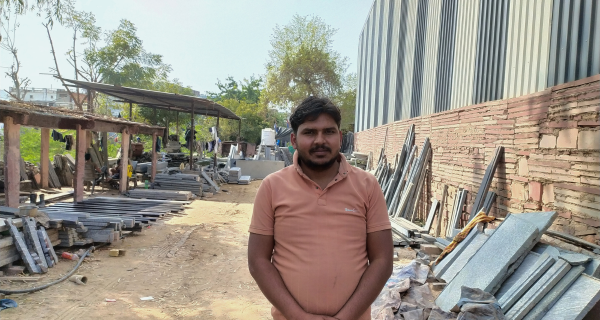 A young man sharing details at a stone-cutting factory in Bayana. (Photo - Amarpal Singh Verma, 101Reporters)
A town transformed
This transformation extends well beyond factory floors. In Bayana's RIICO industrial area, large-scale production is now underway across 250 factories. Factory owner Desraj Gurjar said Bayana is no longer just a town that sells stone, it has become a center that exports finished, carved products. CHECK With more finished goods being produced locally, more raw stone is arriving from the mining areas around Bansi Paharpur, and more finished products are being shipped out.
The increased movement of people and goods has rippled through the local economy. Five new hotels have been built. Demand has risen for restaurants, food shops, transport services, machine repair, electrical equipment, and welding. Transport businesses have grown alongside the stone trade.
Suryakant Pandey, District Industries Officer at the District Industries Centre in Bharatpur, said that Bayana never traditionally had a community of hand-carving artisans. "Therefore, no local jobs were lost. The expansion of engraving and carving work through CNC machines has instead created new employment. Young people who earlier had only daily wage labor or migration as options are now working as technical machine operators and earning better salaries."
The impact on traditional artisans
The picture is more complicated in towns where traditional hand-carving was once the primary livelihood. When asked about artisans in Bhusawar, Shri Mahavir Ji, and Hindaun City, Nemichand Sharma said: "New technology definitely has an impact. It is true that work for those artisans has reduced. But it is also true that the new generation of traditional artisans is not interested in this work anymore. That is why many artisans themselves have now installed CNC machines."
Shiv Das Singal, former president of the Hindaun RIICO Association, confirmed this pattern. "CNC machines are not coming only to Bayana…they are being installed everywhere," he said. "In Hindaun alone, around 40 machines have been installed. Work gets done faster and at lower cost." But Singal acknowledged the human cost: approximately 1,000 traditional hand-carvers in villages around Hindaun are now finding it difficult to get work. Many are shifting to stone cutting, construction, and other labor. "They are finding other work," he said, "but the old craft is fading."
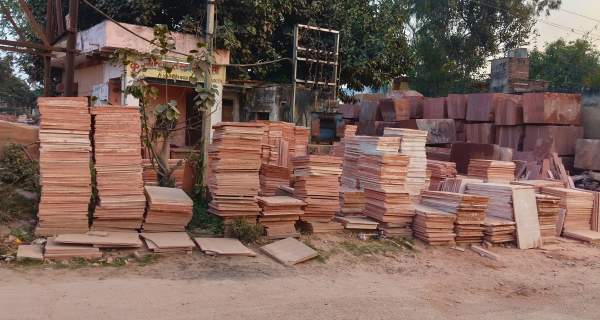 Slabs of stone cut and stacked at an industrial unit in Bayana. (Photo - Amarpal Singh Verma, 101Reporters)
The pollution problem
Alongside the growth, a serious environmental challenge has gone unaddressed. Factories in the RIICO industrial area generate large volumes of stone slurry, liquid waste produced during cutting and carving. According to Rakesh Gurjar of Murraki village, who has been submitting petitions to the district administration on this issue for years, the Bayana industrial area generates approximately 50,000 liters of liquid slurry every day. Rather than being disposed of according to regulations, this waste is dumped on open land, in agricultural fields, and in the catchment area of the Murraki Dam. Once dry, the slurry becomes airborne powder that spreads widely. Local residents warn of long-term consequences for soil fertility and public health.
"Factory owners have been dumping slurry waste on five bighas of railway land for years. When we raised our voice, the railway finally began building a wall there,” said Rakesh Gurjar of Murraki village"
Soopa added,"Factory work has increased enormously, and disposing of stone waste has become a serious issue…We have been demanding a dumping yard from the government for years, but it has still not been built. People are suffering from pollution."
Cover Image - An operator carving stone on a CNC machine at an industrial unit in Bayana. (Photo - Amarpal Singh Verma, 101Reporters)
Would you like to Support us
101 Stories Around The Web
Explore All News