MSP delays cost chickpea growers thousands in Khargone

MSP delays cost chickpea growers thousands in Khargone
Farmers say they are selling Rs 500-Rs 1,000 below support price as procurement begins weeks after arrivals
Khargone, Madhya Pradesh: Bhairam, 32, a farmer from Khargone district, had taken a loan of Rs 60,000 to cultivate chickpea this season. By the time his crop was harvested, repayment was due. With procurement at the Minimum Support Price yet to begin, he sold his produce in the mandi at Rs 5,100 per quintal.
From one and a half acres, he harvested nine quintals. Had procurement begun on time, he would have received the MSP of Rs 5,875 per quintal. Instead, he lost Rs 775 per quintal , a total of Rs 6,975.
“If you sell at the support price, you will get more rupees,” he said. “But there was no option.”
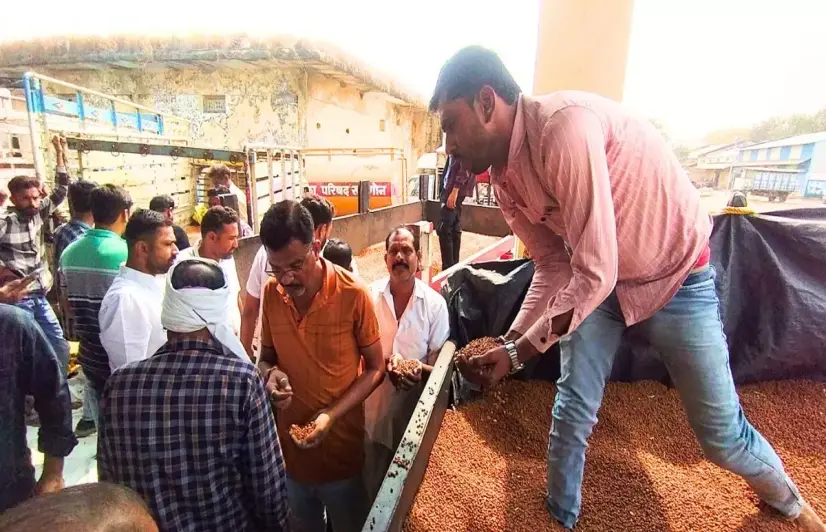
Bhairam is not alone. Across the seven agricultural produce markets in Khargone district in Madhya Pradesh’s Nimar region, farmers are selling their chickpea at prices significantly below MSP, even as arrivals in mandis have increased over the past fortnight.
Farmer Manoharlal Gupta from Ghughariyakhedi village said his produce was sold at Rs5,251 per quintal. “If procurement had started on time, we could have received a better rate,” he said.
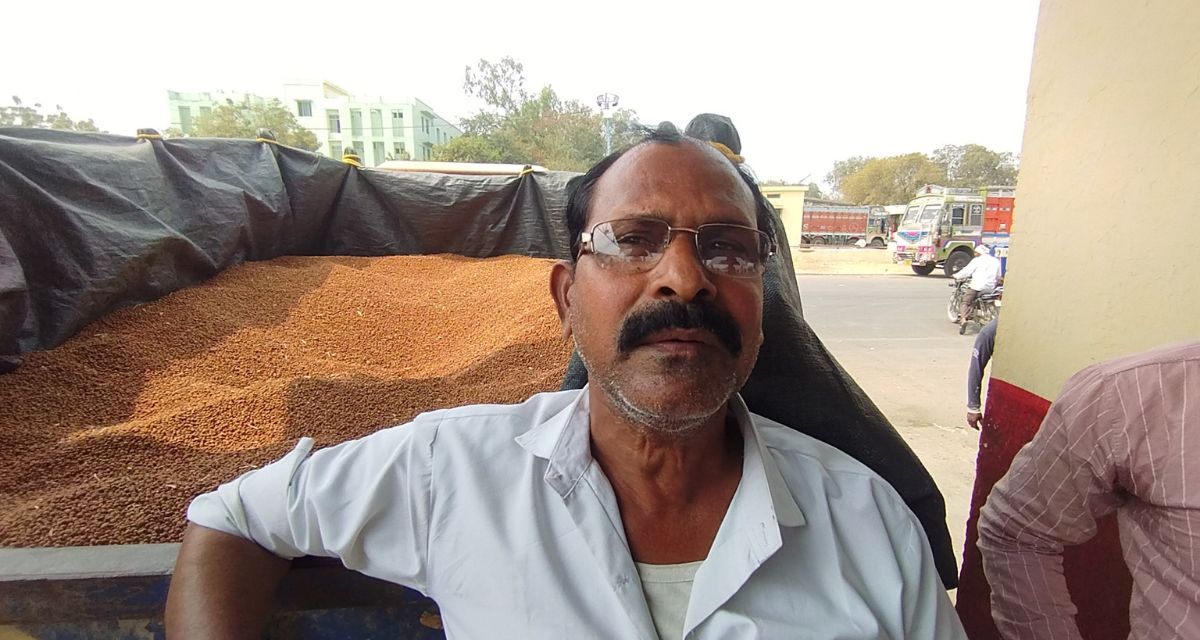 Farmer Manoharlal Gupta reached Khargone's agricultural produce market to sell gram (Photo - Amit Bhatore, 101Reporters)
Another farmer, Mohanlal Gupta from Sagur Bhagur village, said his produce was sold at Rs 5,151 per quintal.
Farmers said they cultivate chickpea each year with the expectation that the government will procure it at MSP, but delays often force them to sell early.
The MSP for chickpea this season has been fixed at Rs5,875 per quintal. In Khargone’s mandis, prices over the past week have ranged between Rs4,800 and Rs5,200, a shortfall of around Rs550 to Rs1,075 per quintal.
With no procurement underway, farmers said they have little choice but to sell in the open market at lower rates.
Khargone district has produced an estimated 3,01,080 metric tonnes of chickpea this season across 1,54,400 hectares, according to data from the Farmers Welfare and Agriculture Development Department. Production has increased compared to 1,85,395 metric tonnes in 2023-24, while the area under cultivation has remained comparable.
Around 50,000 farmers in the district grow chickpea.
Daily arrivals at the main mandi range from 250 to 1,000 quintals. So far this season, arrivals have reached 62,173 quintals, according to data from the Krishi Upaj Mandi Samiti.
At a gap of around Rs600 per quintal, a farmer with 10 acres and an average yield of 50 quintals stands to lose about Rs30,000 in a season.
Officials said 11,762 farmers have registered for procurement so far.
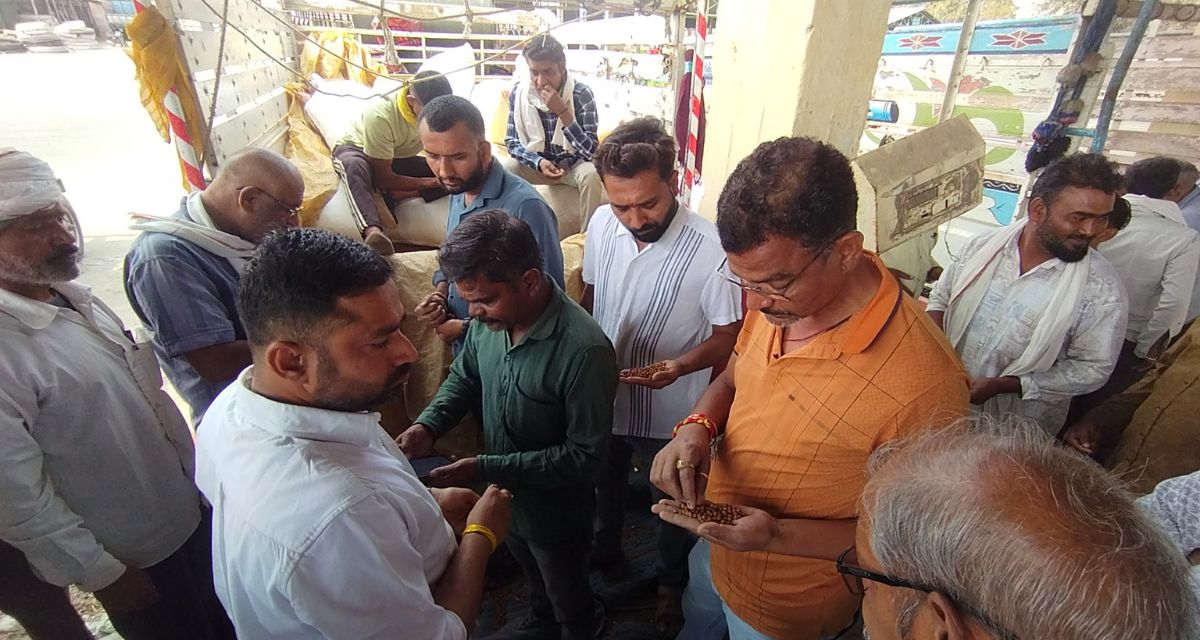 Farmers say they are selling Rs 500-Rs 1,000 below support price (Photo - Amit Bhatore, 101Reporters)
Procurement begins after arrivals
Chickpea harvesting in the region begins from February, with early-sown crops ready by the end of the month. These crops begin arriving in mandis even as procurement processes are still underway.
Early-sown chickpea is ready for harvest by February, meaning arrivals begin weeks before procurement starts.
Procurement at MSP, however, is scheduled to begin only on March 30. SS Rajput, deputy director of the Farmers Welfare and Agriculture Development Department in Khargone, said the delay is linked to crop quality.
“After harvesting, there is moisture in the produce,” he said. “Procurement is started at a fixed time so that fair average quality can be ensured.”
Local officials said procurement also depends on the appointment of agencies and completion of tender processes, which are often finalised only after arrivals begin. Registration for procurement was open from February 20 to March 16 across 70 centres. Farmers and union leaders say this gap between arrivals and procurement is not new.
“Every year after the yield arrives, the purchase starts at the support price,” said Shyam Singh Panwar, former divisional president of the Bharatiya Kisan Sangh. “Registration should be completed before the crop reaches the mandi. Procurement should start as soon as the produce arrives.”
He added that technical issues during registration create further delays. “If Girdawari data is not updated on the portal, farmers face difficulties in registering,” he said.
Last year, arrivals began in late February, while MSP procurement started on March 25. The MSP then was Rs5,650 per quintal.
Similar gaps between arrivals and procurement have been reported in previous seasons as well.
“Every year procurement starts late,” said Rameshwar Gurjar of the Rashtriya Kisan Mazdoor Mahasangh. “By the time it begins, many farmers have already sold their produce.”
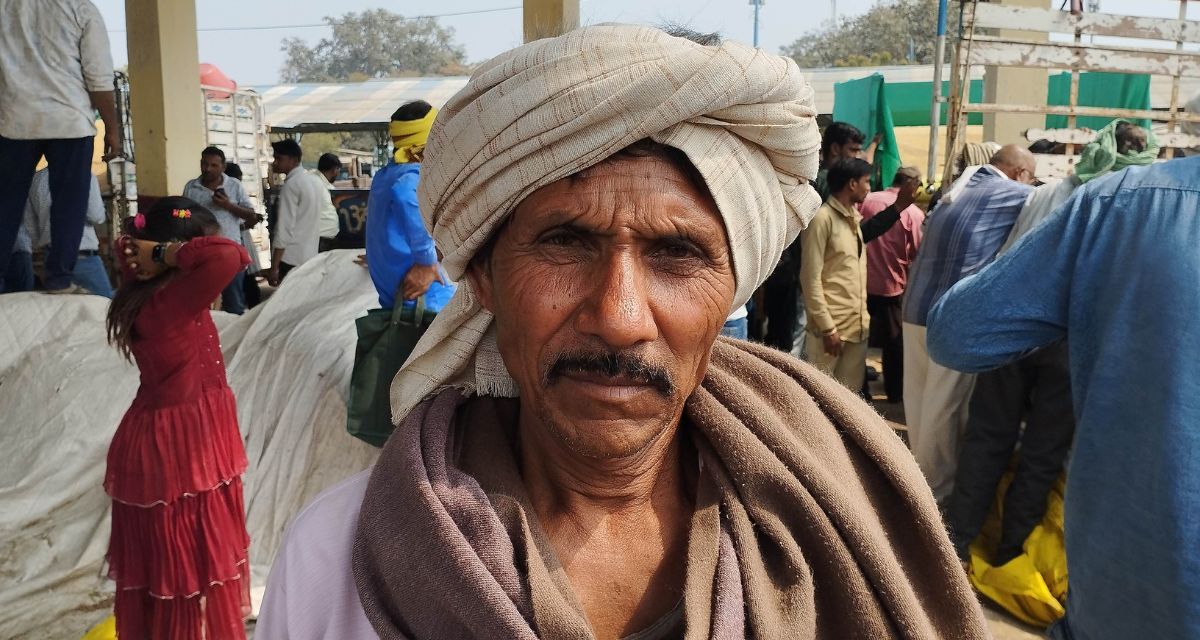 Farmer Jahangiya reached Khargone's agricultural produce market to sell gram (Photo - Amit Bhatore, 101Reporters)
‘No option but to sell’
The delay affects farmers unevenly. Those with access to storage or liquidity can wait. Many cannot. Madan Jamre from Tanda Wadi cultivated chickpea on four acres and harvested 15 quintals. He sold his produce at Rs5,171 per quintal.
“I was not aware of the support price,” he said. “By the time I found out, I had already sold. I needed money, so I could not wait.”
At a gap of around Rs 700 per quintal, he would have lost over Rs 10,000 on his total produce.
The Gangaur festival, widely observed in the Nimar region, is approaching. For tribal communities, Bhagoria — celebrated earlier — carries similar significance. Dilip Jamre, 30, said he sold his produce at about Rs500 below MSP.
“Money was needed for Bhagoria, for worship materials, clothes and household items,” he said. “Since procurement had not started, I sold in the mandi.” He added that the produce can get damaged if kept for long.
Farmers said keeping produce for longer without proper storage can affect quality, pushing them to sell early.
Ajay Sharma, 55, who cultivated both wheat and chickpea, said neither crop has seen procurement begin. “Money is needed for Gangaur,” he said. “There are also other expenses like vehicle instalments. So the produce has to be sold.” Nandram, 50, who cultivated chickpea on four and a half acres and harvested 22 quintals, said storage constraints left him with little choice. “There is no space to store at home,” he said. “Money is needed for the festival. So the produce has to be sold.”
At current price gaps, this translates to a loss of more than Rs 13,000.
Nitesh Maurya, a farmer from Nargaon, said he spent about Rs20,000 per acre on cultivation. From two acres, he harvested 11 quintals. “If the price is lower than the support price, it does not match the cost,” he said.
Rising cost, limited storage
Farmers said cultivation costs, including seeds, fertilisers, labour and transport, have increased. Nilesh Patidar, an experienced farmer, said most small farmers sell immediately after harvest.
“They need money for seeds, fertiliser, labour and the next crop,” he said. “Most do not have storage space.” While cooperative warehouses exist, access remains limited.
Mohan Sisodia, director of a farmer producer organisation, said farmers can store produce in cooperative warehouses and take loans against it. “The storage cost is about Rs8 to Rs10 per quintal per month,” he said.
But for many, this is not a practical option. Piru Gurjar, a farmer from Raybidpura village, cultivated chickpea on four acres and harvested about 20 quintals. “There was no space at home, and no government storage available,” he said. “I had to repay dues for fertiliser, seeds and medicines. I sold in the mandi and lost about Rs10,000.”
Market dynamics
In the absence of MSP procurement, traders remain the primary buyers in mandis. Trader Vinod Jain said prices are determined by demand, supply and quality. “If procurement starts, prices may improve,” he said.
Farmer organisations say the delay creates a window where farmers are forced to sell at lower prices. “Thousands of farmers have already sold their produce at low prices,” said Gopal Patidar of the Rashtriya Kisan Mazdoor Mahasangh. “Many needed money for loans, festivals or household expenses.”
Farmers also allege that traders benefit from this gap, as they are able to buy at lower rates when procurement has not started.
Farmers said challenges do not end even after procurement begins. Disputes over quality standards and delays at procurement centres are common, and in previous years, some farmers have alleged that traders’ produce is sometimes routed through procurement channels.
They also said that delays in procurement are not new. In previous years too, procurement has begun weeks after arrivals start in mandis, forcing farmers to sell early. “Every year, the process starts late,” Gurjar said. “By the time procurement begins, many farmers have already sold.”
Farmer organisations have demanded that registration be completed before arrivals and procurement begin immediately once crops reach mandis.
Change needed
Panwar said the number of procurement centres should be increased and the registration process simplified. He also pointed to technical issues in registration, including problems with Girdawari data. Kailash Agarwal, vice president of the Federation of Madhya Pradesh Chamber of Commerce, said procurement timelines need to align with changing crop cycles.
“Crops are arriving earlier now,” he said. “If the procurement calendar is fixed according to arrival, farmers will benefit.”
Farmers and trade representatives said procurement timelines have not kept pace with changing crop cycles, with harvests now arriving earlier than before.
Procurement at MSP in Khargone is expected to begin on March 30. For the 11,762 farmers who have registered, the option to sell at MSP remains.
But for those who have already sold, at Rs5,100, Rs5,171 or Rs5,251 per quintal, the support price comes too late.
“You know the price,” Bhairam said. “But you cannot wait for it.”
Cover photo - Farmers showing chickpeas to the traders in the market (Photo - Amit Bhatore, 101Reporters)
Would you like to Support us
101 Stories Around The Web
Explore All News