In Balaghat, the insect that glued livelihoods together is disappearing
In Balaghat, the insect that glued livelihoods together is disappearing
Climate change and institutional collapse are threatening the practice of lac cultivation that once supplemented paddy income for thousands of families in this MP region
Bhopal, Madhya Pradesh: After the paddy harvest in October, the fields fall silent. Around this time, Shashank Patel (35) from Chichgaon in Balaghat district asks his workers to tie small resin-coated bundles of twigs onto the branches of palash trees. These bundles contain millions of tiny insects that emerge, crawl, bore into the bark, and leave behind a sticky red resin. This resin has supported livelihoods in central India for generations.
He used to do this on about a dozen trees and then move on to his other work. Lac cultivation required no irrigation, no fertilizers, and no daily maintenance. By April or May, the branches would be covered in a thick amber-colored layer. Patel’s family has been engaged in lac cultivation for 27 years and he has been engaged in it independently for the last nine years. According to Patel, usually farmers who would face the risk of failure from their paddy crop would engage in lac cultivation so that they could use the profit from the latter to cover the losses, if any.
But since 2025, Patel has stopped cultivating lac since he said that the untimely rain and rising heat are affecting both the insect and the resin, eating into the profits.
“Untimely rain has had the biggest impact. Two years ago, in one of our fields, the entire crop was ruined. The insects did not establish at all, almost nothing came out. Even if we had harvested it, the cost would not have been recovered. Heat has less impact, but if there is moisture or rain, the insects cannot spread. Wherever water flows along the branches, lac will not develop there,” he told 101Reporters.
Why lac matters
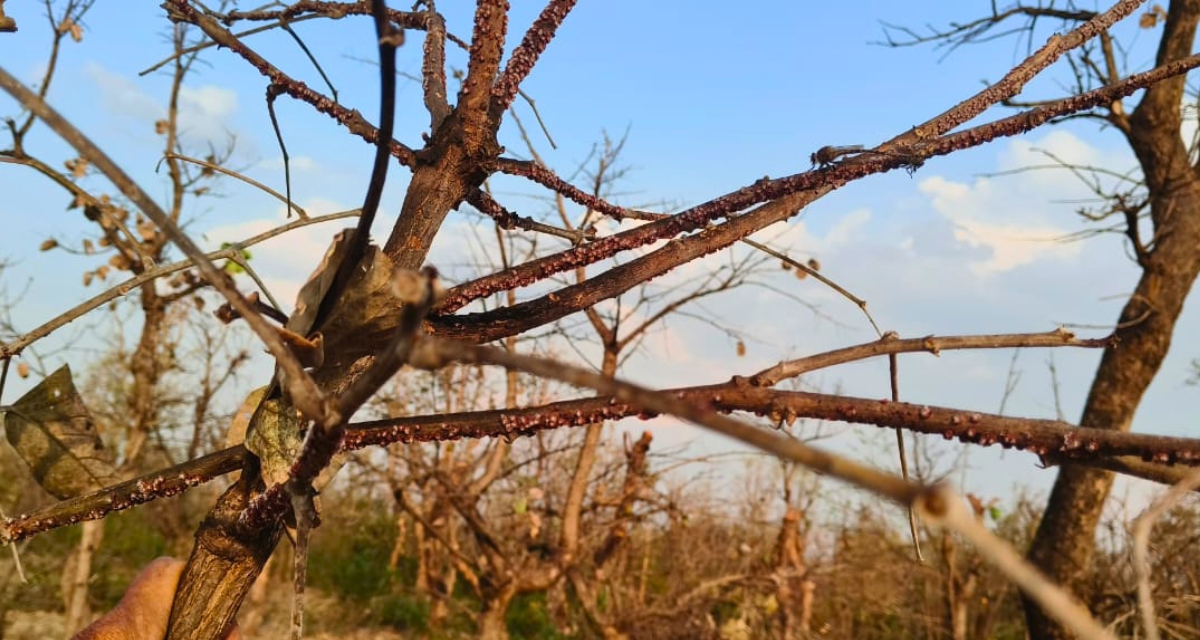
Lac holds a unique place in India’s economic history. It is not exactly grown, but reared, much like a beekeeper produces honey. The insect called Kerria lacca attaches itself to certain trees, feeds on their sap, and forms a hard resinous coating around itself. This coating is scraped off the branches, dried, and processed into shellac, a natural substance used in gramophone records, nail polish, medicine coatings, and even electrical insulators.
Around 300,000 insects are needed to produce one kilogram of lac resin. The female insect attaches itself to a branch, builds a resin coating around itself, lays eggs inside it, and dies there. The next generation develops within that layer, emerges, and the cycle begins again. The lac produced through this process contains 70 to 90 percent resin, while the rest consists of natural dye, wax, and proteins. Kusumi lac, grown on kusum trees, is known for its purity, and processed shellac sells at good prices in Europe and North America.
Decades of decline
The scale of India's fall in lac production becomes clearer through history. After Independence, the country produced nearly 50,000 tonnes annually. But according to Indian Forester (2011), between 2006–07 and 2009–10, the average dropped to 15,508 tonnes — a decline of 15.3 percent.
In Madhya Pradesh, the decline was even sharper. During the XI Plan (2007-2012), the state contributed 13.66 percent of total production, which fell to 12.91 percent by the XII Plan (2012-2017). During the same period, the state recorded an annual growth rate of -32.41 percent, the highest decline compared to Uttar Pradesh, Chhattisgarh, and Maharashtra. Current production figures are not publicly available, a data gap that Dr. Moni Thomas, Principal Scientist at Jawaharlal Nehru Krishi Vishwavidyalaya (JNKV), Jabalpur, sees this as a sign of institutional neglect.
From Rs 10 lakh a year to zero
If Patel represents a farmer moving away from lac cultivation, then Komal Singh Baghel (73) from Barghat in Seoni district represents another concern, the collapse of what was once a fully commercial business.
Baghel has been cultivating lac since 1999. His self-help group leases land from the gram panchayat by paying around Rs 5,000 annually and manages around 1,400 to 1,800 palash trees on that land. They bring brood lac, place it on the trees, manage the crop for six months, and sell it in the Barghat market, from where it goes to Balrampur or Kolkata for processing. After deducting annual costs of around Rs 2 lakh, savings would reach Rs Rs 8 to Rs 10 lakh.
“When lac was doing well, we did not give much importance to paddy. We focused more on lac,” Baghel said. “It covered the expenses that paddy could not.”
But over the last four years, the crop has collapsed. "Earlier we used to save at least Rs 10 lakh. But for the last four years, it has gone to zero. Nothing is left. The crop just dies.”
The insects stopped surviving on the branches. Either the resin did not form at all, or it melted away. “In our Barghat area, not even a kilo of lac is left now,” Baghel said. “Earlier, quintals used to come from here. For four years we kept investing, and everything got wiped out.” Experts say Madhya Pradesh’s production is often recorded under other states because procurement centres are located outside the state.
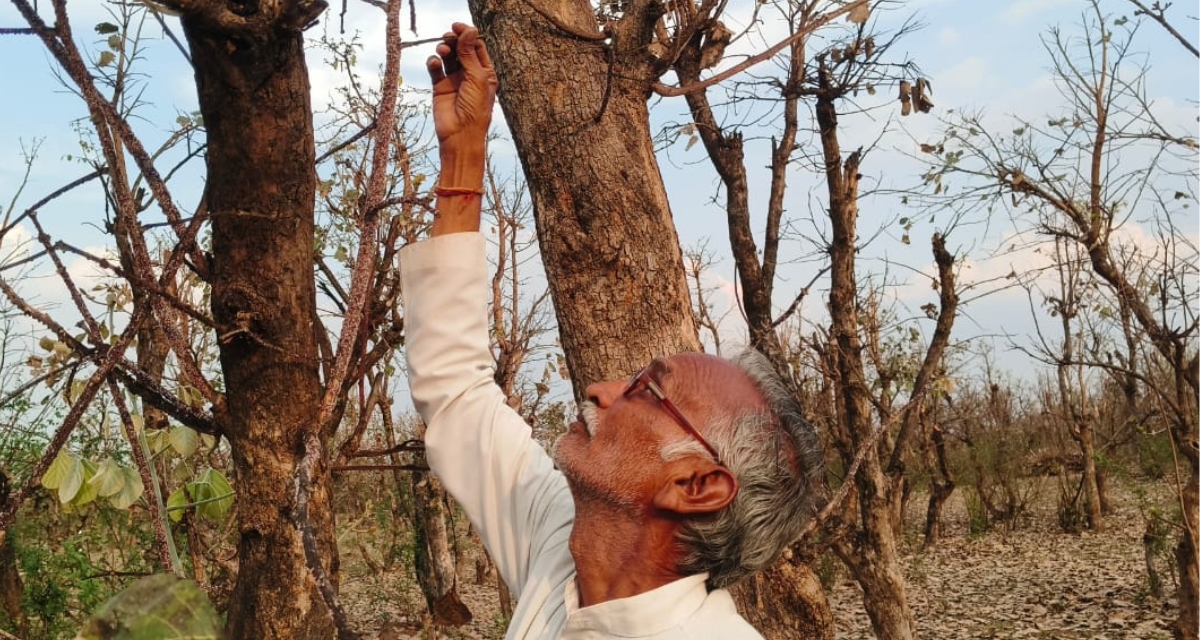 Komal Singh Baghel continues where others have stopped (Photo - Chandra Pratap Tiwari, 101Reporters)
Wrench in the cycle
According to the India Meteorological Department (IMD), March 2022 was the hottest March in 122 years, and that year, 16 states recorded 280 heatwave days. Madhya Pradesh alone recorded 38 heatwave days, affecting lac crops. A 2014 study in Jharkhand found a clear negative relationship between maximum temperatures and lac production during the critical crop development period of March and April. Scientists warn that rapidly changing climate conditions are putting several lac species at risk.
Baghel says he has seen this firsthand. "If the temperature goes above 40 degrees Celsius, the lac insect melts and dies right there," he said. "There was a time, 2007, 2008, 2009, three years went by without any lac. After that it came back. That too was because of the weather. It got extremely hot.” Lac is the only insect-based practice in this area.
Patel connected the threat to changing rainfall patterns. Earlier, rain would stop after Diwali and not return until June. Now, rainfall happens in between. Even light winter showers in January-February leave moisture on the branches, which prevents lac from spreading. “If water runs over the branches, lac will not spread there. Heavy winter rain also kills the insects. And if moisture or rain comes at the wrong time, the brood cannot spread at all.”
Abhinandan Yadav, an entomology professor at Sage University, Bhopal, said the issue is bigger than just the insect, it is also about the trees. When palash or kusum trees weaken because of heat, moisture stress, or poor soil, their sap weakens too, and that affects the insects that depend on it. This impacts both the insect and the quality of the lac produced. He also said that changing weather increases the risk of diseases and pests, further reducing production.
Professor Thomas recalled 2009, when a sudden temperature rise destroyed lac crops across eastern Madhya Pradesh. The resin melted, the insects died, and many farmers never returned to cultivation.
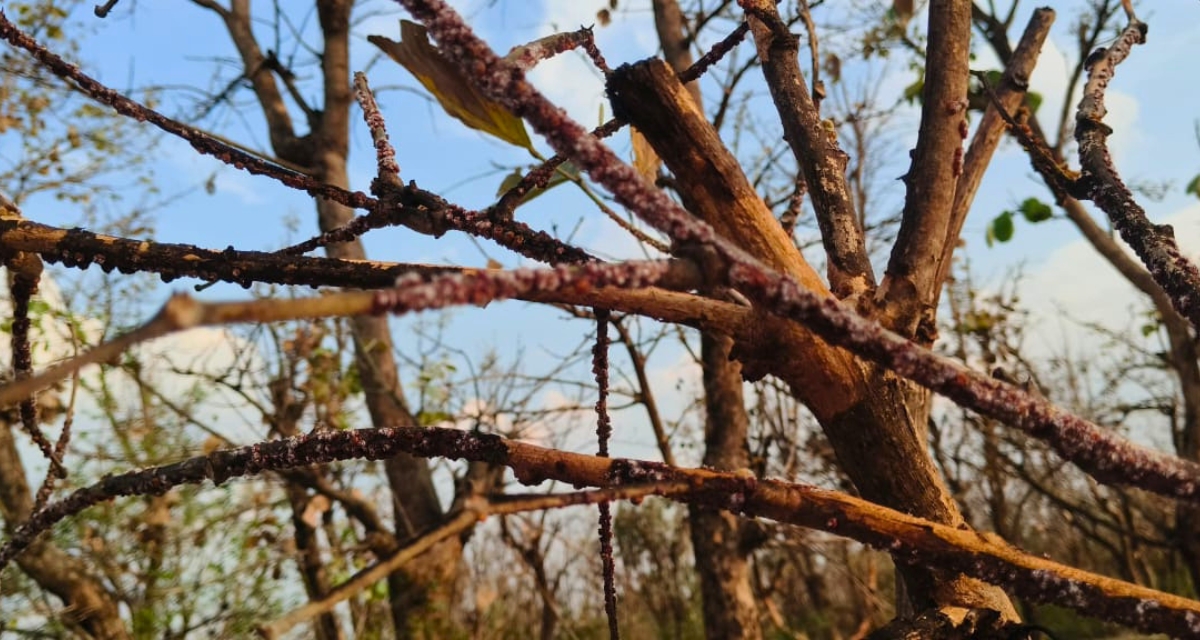 This Lac resin layer decides seasonal income for many households (Photo - Chandra Pratap Tiwari, 101Reporters)
The forest lac needs is changing
Palash is a crucial tree for rangini lac and plays a major role in Madhya Pradesh's production. Its structure and sap are ideal for lac insects, and there is no large-scale substitute for it.
Earlier, Patel’s farm had 5 to 7 palash trees per acre. Now only 2 remain. With just around 25 trees left overall, lac is no longer his main source of income. He is replacing palash with timber trees like teak because, compared to lac, teak offers him a better economic return.
The shift away from lac cultivation in Chichgaon happened in two distinct waves. The first began around 2016, when farmers started quietly moving away from the crop. The second and sharper drop came in the post-Covid years, when many of those who had held on finally gave up. Today, not a single lac farmer remains active in Chichgaon, around 20 to 25 farmers quit farming in this window.
Professor Thomas said when farmers earn from lac, they protect palash trees. When earnings fall, those same trees are cut down. The market and the environment affect each other. He recalls seeing the reverse around 2000, when good earnings made farmers stop cutting palash.
The scheme did not reach farmers
When farmers are asked what the government has done for lac, the answer is almost always the same. "We had heard there were schemes, but they never reached us," Patel said.
A Down To Earth article (May 2004) noted that the government once maintained buffer lac stocks to stabilise demand and supply, and that the forest department never established a minimum support price for lac, leaving farmers entirely at the mercy of traders who captured up to 80 percent of the market value while cultivators received only around 10 percent. These are the kinds of protections farmers in the region had heard of but never seen in practice.
The deeper story of institutional collapse goes back further. A Down To Earth piece (July 2004) reports that the Rewa royal family, specifically Gulab Singh, built a functioning lac economy in the region as far back as 1903, establishing a processing unit in Umaria and eventually 44 godowns across the town by 1941. Village-level officials called mukadams supervised production at the ground level. Thomas’s 2010 paper, "Nationalization of Lac in Madhya Pradesh: Lessons Learnt," documented how Martand Singh of the Rewa kingdom actively promoted lac across his entire territory. A dedicated administrative hierarchy — laakh moharrar and laakh muqaddam — managed production at the ground level. The system survived even after the princely states were dissolved in 1948, but collapsed once the Indian government took over administration, attributed to official indifference and the inability of cultivators to find buyers.
The system was later revived around 1997 by Thomas and his colleagues, and by 2002 Madhya Pradesh had become the third largest lac producer in India, with both the Chief Minister’s office and the MP Laghu Van Upaj Federation actively monitoring the programme. Over time, the Federation shifted its focus to bamboo and then medicinal plants. Officials who were invested in lac retired, and those who replaced them did not share the same priority. The policy infrastructure was simply diluted.
“Despite so much production, lac is not included in Seoni's 'One District One Product' list,” Thomas said. This affects the market. Farmers either sell to local traders or send produce to other states, where they have no control over pricing. According to Patel, middlemen make the biggest profits, and government-backed procurement could change that.
Experimenting with the calendar
According to Dr Thomas there is a way to reduce the risk by change the cropping season. This year, after four consecutive years of losses, Baghel’s group is cautiously experimenting with 50 trees using a new schedule, cultivating lac in June-July instead of the traditional October-November cycle.
The logic: the traditional October-November cycle meant pruning around March-end, after which cold temperatures were killing the lac insects. Switching to June-July means pruning in the first week of April instead. By the time the new lac seeds are tied, the extreme cold period has passed, reducing the risk of insects dying from low temperatures.
There are five self-help groups currently still cultivating lac in the area, four of which are women's groups with 10 members each, around 50 active members in total. Previously there were 20 such groups; 15 have discontinued over the years. Komal Singh is the only farmer from his group still actively cultivating lac this year.
"This year, almost the entire area did not cultivate lac," he said. "If the experiment on 50 trees succeeds, we will ask others to do the same."
Professor Yadav said the solution is not just increasing production. Rangini lac gives higher quantity, but Kusumi lac offers better quality and earns higher market prices. Farmers often compromise on quality in pursuit of more output, while focusing on better quality could bring higher profits even with lower production. He also stressed the importance of brood quality, raw or repeatedly reused brood reduces both production and quality.
Professor Thomas believed this farming system cannot survive on farmers' efforts alone and requires government support. Both experts say that changing crop seasons may help, but large-scale adoption will need research and policy backing.
Patel's family had been connected to lac for 27 years, but he left it because it was no longer profitable. He said if he gets good brood and fair prices, he would start again. Meanwhile, Baghel is still experimenting, with 50 trees.
This story was produced as a part of 101Reporters Climate Change Reporting Grant.
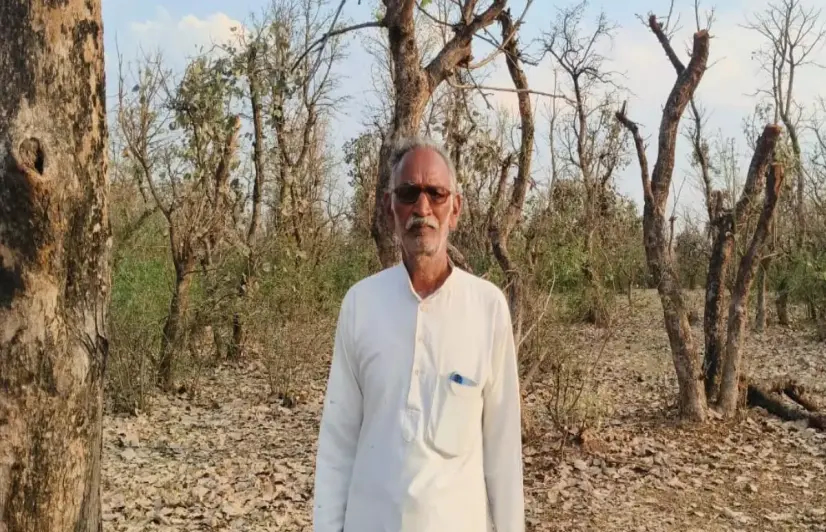
Cover Image: Komal Singh Baghel continues where others have stopped (Photo - Chandra Pratap Tiwari, 101Reporters)
Would you like to Support us
101 Stories Around The Web
Explore All NewsAbout the Reporter
Write For 101Reporters
Would you like to Support us
Follow Us On