Himachal farmers turn to natural farming amid climate stress

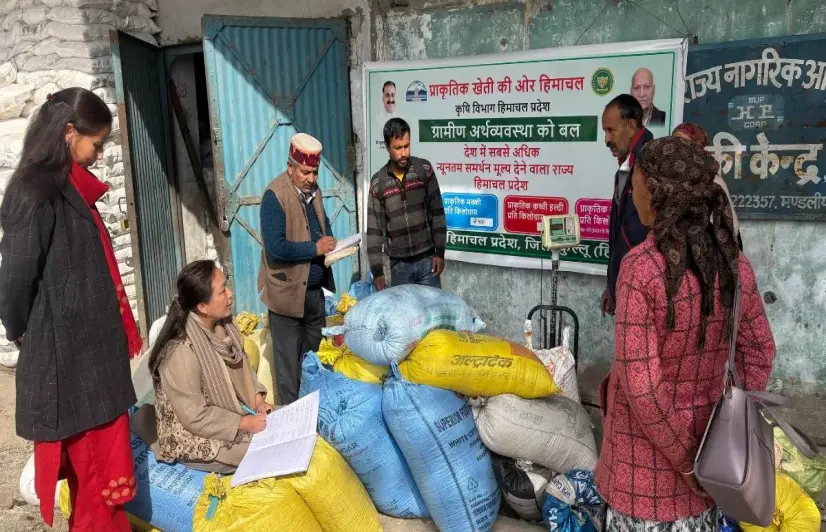
Himachal farmers turn to natural farming amid climate stress
Lower input costs and soil resilience attracts farmers, even as labour, seed systems and market access pose hurdles
Shimla, Himachal Pradesh: In Himachal Pradesh’s fragile mountainous terrain, changing weather patterns, erratic rainfall, rising crop diseases and increasing production risks are no longer occasional disruptions. For many farmers, they have become part of everyday experience.
But Suresh Thakur, who cultivates six bighas in Pahal Panchayat of Shimla district, said these fluctuations do not worry him as much as they once did.
“I started natural farming eight years ago… because of which even though we have not received a drop of rain for the last four months, I am free from worry,” Thakur told 101Reporters. “It took time to gain confidence in the new methodology… but now even if there is damage, I feel it will be limited since my input costs are lower and my crops are better able to withstand weather fluctuations.”
Pointing to his field, he said, “The soil is now soft, crops are less prone to disease, and I am getting good yields even in drought and excess rainfall.”
Thakur attributes this resilience largely to achhadan or, mulching, or keeping the soil covered with crop residue, dry grass or leaves. During dry spells, the mulch layer reduces evaporation and helps retain soil moisture. When rainfall is intense, it cushions the impact of raindrops and slows surface runoff, preventing soil erosion. Combined with mixed cropping of vegetables, cereals and pulses using indigenous seeds, he says the system spreads risk across crops.
Since shifting to natural farming, Thakur’s input costs have fallen from Rs 45,000 to Rs 5,500. His income, he said, has increased from Rs 3 lakh to Rs 4.5 lakh.
Natural farming is emerging in Himachal Pradesh as one approach to adapting agriculture to climate stress.
The lines between natural farming and organic farming may seem blurred, however there are some distinctions. Dr. Manoj Gupta, Professor of Agricultural Economics at Chaudhary Sarwan Kumar Himachal Pradesh Agricultural University, Palampur, said, “While both avoid chemical fertilizers, in natural farming, the farmer makes all the formulations using cow dung and urine on his own farm at minimal cost, whereas in organic farming, his dependence on the market does not end completely.” He further added that natural farming is a better version of organic farming.
The central principle is that soil is a living system. Microorganisms, earthworms and organic matter present in the soil are believed to provide nutrition and protection to crops when not disrupted by chemical inputs.
According to the Himachal Pradesh Department of Agriculture, the state has 9.97 lakh farmers, of whom 2.23 lakh (22.37%) are practising natural farming on 38,456 hectares.
In the plains of Una district, farmer Joginder Pal described a different climate challenge.
“I live in the plains, and waterlogging during the rainy season is common,” he said. “Last year, during the rains, everyone’s fields were flooded. Due to high humidity, the surrounding farmers’ maize crops were almost completely destroyed, but I did not suffer as much damage.”
Joginder said that natural farming improves soil porosity, allowing water to seep into the ground rather than stagnate on the surface. Mulching protects roots and reduces soil compaction. He said neighbouring farmers reported losses of up to 90% in their maize crop during flooding, while more than half of his crop remained intact. Losses in one crop were partly offset by mixed crops grown alongside.
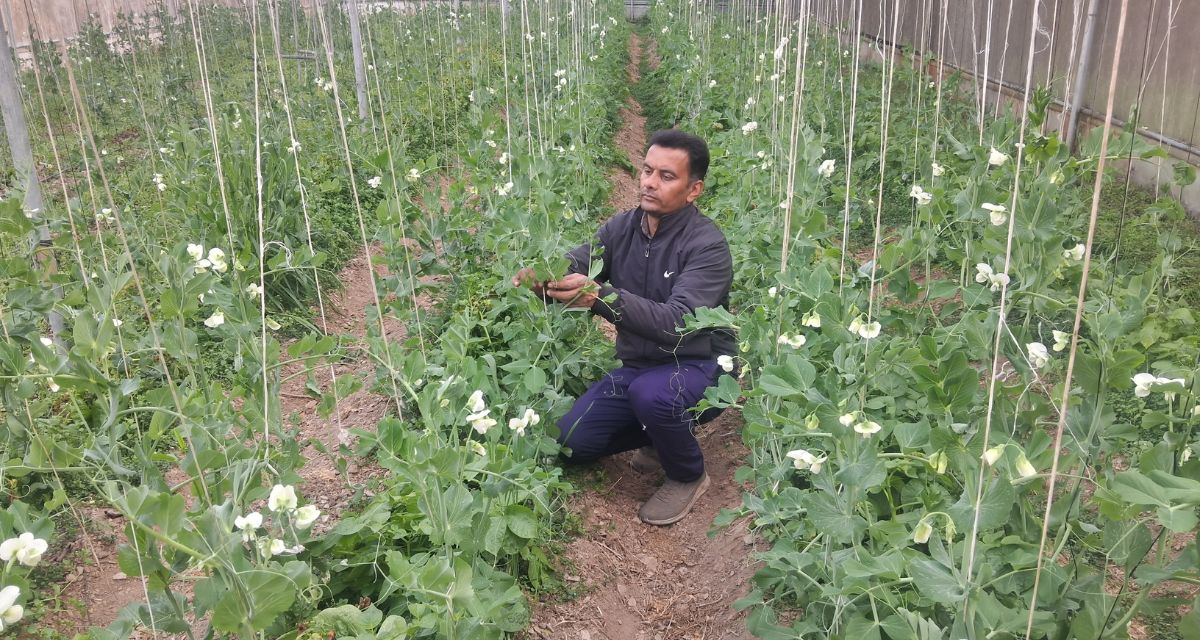 The state has 9.97 lakh farmers, of whom 2.23 lakh (22.37%) are practising natural farming (Photo - Raman Kant, 101Reporters)
Comparing cost
Farmers practising natural farming say lower input costs reduce financial risk.
Thakur said that earlier, a poor season meant heavy losses because of spending on fertilisers, pesticides and hybrid seeds. “Now even if yield fluctuates, the cost burden is less,” he said.
Research findings broadly reflect these economic shifts. The report Natural Farming through a Wide Lens by GIST Impact, supported by the Global Alliance for the Future of Food, found that farmers adopting natural farming recorded a 44% reduction in input costs and a 49% increase in income.
A study by the Academy of Management Sciences, Lucknow, examining the economic impact in Himachal Pradesh, found that adoption reduced cultivation costs by an average of 36% and increased net profits by 28.6%.
State-level research has also examined agronomic impacts. When the programme began in 2018 under the Prakritik Kheti Khushhal Kisan Yojana, later renamed the Rajiv Gandhi Prakritik Kheti Khushhal Kisan Yojana, there were doubts about whether the method would work across Himachal’s diverse agro-ecological zones.
Manoj Gupta, Professor of Agricultural Economics at Chaudhary Sarwan Kumar Himachal Pradesh Agricultural University, Palampur, said research projects were assigned to agricultural and forestry universities to assess adaptation.
Based on findings, modifications were made. The interval for applying Jeevamrit (made with cow dung, cow urine, jaggery, among others) was reduced from 21 days to 14 days after studies on paddy, wheat-pea, gram, maize-soybean and finger millet-soybean combinations showed higher yields with shorter intervals. Application of Ghanjeevamrit (also made with cow dung, cow urine, jaggery but in different proportions) was found to increase soil organic carbon and nitrogen, key indicators of soil fertility.
Between 2018 and 2022, research conducted by Dr Yashwant Singh Parmar University of Horticulture and Forestry in the Spiti Valley found that natural farming combined with mulching resulted in 4% to 8% higher soil moisture compared to conventional farming. Scientists involved in the study said soil moisture remained more stable during the cropping season and organic carbon levels were consistently higher under natural farming across altitudes.
Janardan Singh, Chairperson of the Department of Natural and Organic Farming at the university, said eliminating chemical fertilisers reduces greenhouse gas emissions associated with agriculture and can improve soil health over time.
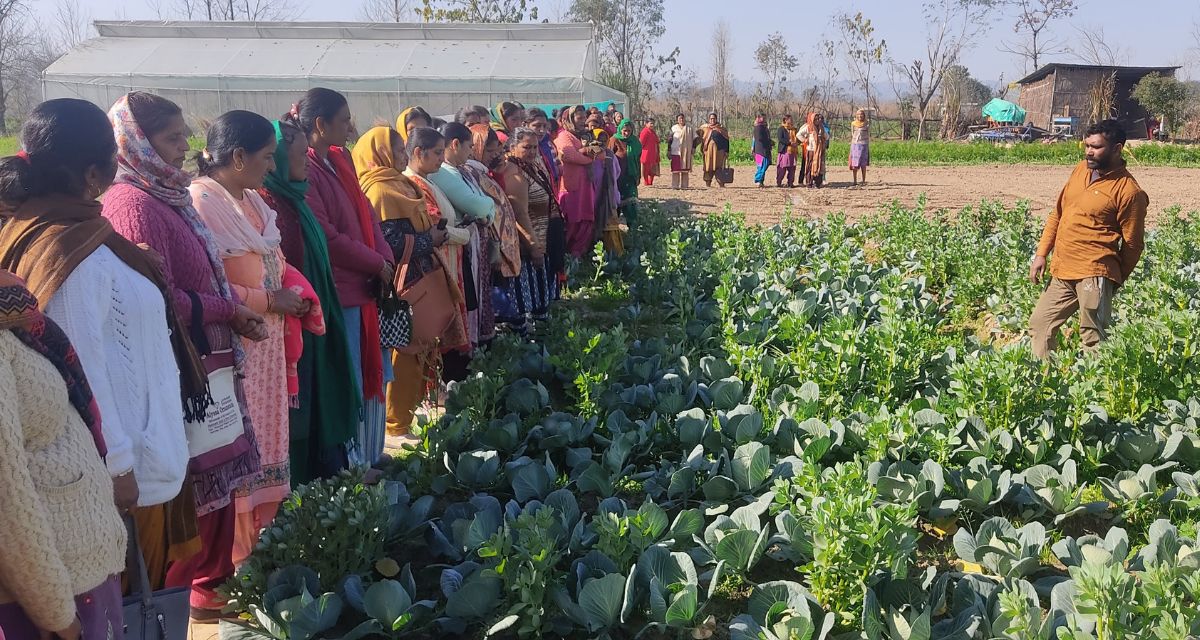 Farmers are currently using a mix of old and new seeds sourced from departments, markets and other farmers (Photo - Raman Kant, 101Reporters)
Government support
To expand adoption, the Himachal Pradesh government provides Rs 30,000 assistance (Rs 25,000 grant and Rs 5,000 market fee support) to farmers purchasing cows, as natural farming relies on cow dung and urine. So far, 2,268 farmers have availed of the subsidy. Beneficiaries are required to purchase indigenous breeds such as local Pahari cows, Sahiwal or Gir varieties. The department has identified specific farms for procurement of certain breeds.
In addition, 1,379 trained farmers have opened resource centres supplying inputs such as Jeevamrit and Beejamrit at minimal prices. Farmers who do not wish to rear cows can access inputs from these centres.
To provide price assurance, the state is procuring naturally grown wheat, maize, raw turmeric and barley at the minimum support price. According to official data, Rs 3.31 crore has been paid to farmers so far.
The government has also imposed a natural farming cess on liquor sales — Rs 2 per bottle on country liquor and Rs 5 per bottle on foreign liquor — to support the programme, and launched the “Him-Bhog” brand to market natural produce.
Chief Minister Sukhwinder Singh Sukhu has said the state has introduced “the highest minimum support price” in the country for naturally grown crops and plans to expand procurement to more crops.
Challenges
Despite policy backing, natural farming faces practical constraints. Farmers are currently using a mix of old and new seeds sourced from departments, markets and other farmers. However, the state lacks a systematic seed bank tailored to its diverse agro-climatic zones.
Somkrishna Gautam from Mandi district said he began conserving traditional seeds in 2018 under a Save Seeds campaign and now preserves 120 varieties of cereals, pulses and oilseeds. Around 500 farmers from six districts are engaged in similar efforts.
Labour intensity is another concern.
According to the GIST Impact report, natural farming requires more labour than conventional farming. The report notes that conventional farming required 277 labour hours per year, while natural farming required 336 hours which s about 21% more. Studies conducted by the State Project Implementation Unit in Himachal Pradesh indicate labour requirements are roughly 20% higher in the state as well.
Joginder Pal explained the difference: “If I cultivate cabbage under natural farming, I prepare inputs, treat seeds, mulch, remove weeds manually and monitor for disease constantly. Everything is done manually.”
He said labour shortages make this difficult and farmers rely largely on migrant workers. However, he added that over time, the need for tillage reduces and crop diseases decline.
“For large-scale farmers, adopting this system is difficult because of the labour-intensive nature of farming. But since most farmers in India have small landholdings, adoption becomes relatively easier,” he said.
Dr JC Rana, project lead for the Alliance of Biodiversity and CIAT, said natural farming has the potential to transform agricultural ecosystems in the Himalayan region. However, he noted that unless the system becomes more labour-friendly, scaling it up could remain challenging. He added that coordinated efforts by the government, private sector and civil society are needed to address climate risks.
Market access remains uneven. A 2023 study by the Centre for Science and Environment found that many farmers were dissatisfied because they were unable to secure significantly higher prices for natural produce. In several cases, produce was sold at rates comparable to chemically grown crops, and benefits came primarily from reduced cultivation costs rather than price premiums.
The study also noted concerns around branding, storage and market linkages. Farmers reported that local traders often offered prices similar to conventional produce, limiting financial gains despite chemical-free cultivation.
Nekram Sharma, a farmer from Mandi district who received the Padma Shri in 2023 for reviving natural farming and the traditional nine-grain cropping system, said farming should not be evaluated solely on short-term monetary returns. “In our pursuit of cash, we have damaged our ecosystem. If we want to protect agriculture and health, we have to rethink how we farm,” he said. He added that government training programmes are necessary, but agricultural officials and scientists need to engage more closely with farmers to address practical difficulties.
The Intergovernmental Panel on Climate Change’s Sixth Assessment Report notes that global warming is increasing pressure on agriculture. India is identified as one of the more vulnerable countries in Asia. Post-AR5 assessments suggest that by 2030, production of major crops such as rice, wheat and pulses could decline by around 2.3%.
In a state like Himachal Pradesh, where geography already constrains agriculture, farmers say that this adaptation is not optional.
Raman Kant is a mentee at Climate Change Media Hub, Asian College of Journalism. The Programme is supported by Interlink Academy, Germany.
Cover photo - Natural farming is emerging in Himachal Pradesh as one approach to adapting agriculture to climate stress (Photo - Raman Kant, 101Reporters)
Would you like to Support us
101 Stories Around The Web
Explore All News