Inside the lab that decides Delhi’s drug cases

Inside the lab that decides Delhi’s drug cases
A look at the national capital’s only authorised narcotics lab, where forensic analysis determines the course of drug cases under the NDPS Act.
Delhi: Inside the Forensic Science Laboratory in Rohini, Delhi, the fate of many criminal cases in the capital is quietly decided. On its third floor, in the Chemistry Division's narcotics unit, experts run tests on samples seized from across the city, trying to answer a deceptively simple question: is this substance actually a narcotic drug?
Overseeing the unit is Dr Kavita Goyal, a forensic scientist with more than three decades of experience. "I joined the unit in 2019 because no one wanted to lead narcotics," she told 101Reporters. "The work is high-pressure and time-sensitive…safely handling and analysing samples, managing exhibits, delivering reports to courts on time. It's a lot to manage."
Whenever police seize a suspected drug, whether in a street-level arrest or a large trafficking bust, the samples eventually reach her team. "We are the only laboratory in Delhi authorised to analyse samples in cases registered under the Narcotic Drugs and Psychotropic Substances Act," Goyal said.
Under the NDPS Act, one of India's toughest criminal statutes, laboratory confirmation can determine whether an accused is released, granted bail, or faces years behind bars. A crime cannot be established without it. Until the forensic report arrives, chargesheets stall, trials slow, and custody decisions remain in limbo.
Over the years, Goyal and her colleagues — 30 in all, and six officers handling NDPS cases within the division — have examined more than 15,000 samples, ranging from small street seizures to sprawling trafficking investigations involving hundreds of exhibits.
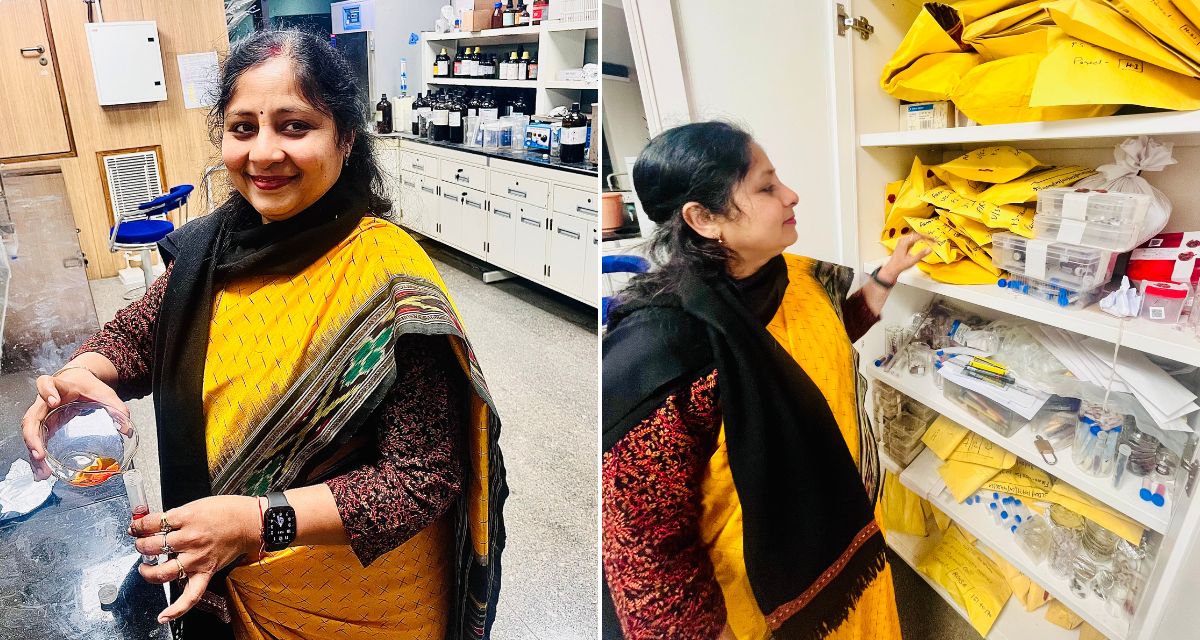 Dr Kavita Goyal, a forensic scientist with more than three decades of experience (Photo - Shikha Sharma, 101Reporters)
Scientific challenges
Her three-decade career spans some of Delhi's most prominent cases. "I have worked on very large, voluminous cases such as the Dhaula Kuan rape case in 2005, the Pushkin Chandra case. All drug seizures by Delhi Police, clandestine drug lab busts, trafficking cases eventually come to us. Even the recent bomb blast in Old Delhi…the chemical components were analysed in our lab," she says.
The narcotics work, however, carries its own particular set of challenges. India's drug landscape is shifting rapidly, making detection increasingly complex. The NDPS Act already classifies hundreds of controlled substances, but new ones keep arriving.
"Now, it's very easy to create a new pharmaceutical drug," Goyal explained. "You take an existing structure, tweak a molecule, and it becomes a completely new compound."
In recent years, the lab has seen a surge not only in traditional drugs like heroin, ganja and charas, but in synthetic drugs like methamphetamine, MDMA and cocaine.
"In cities like Delhi and Mumbai, we see both traditional and designer drugs. But in states like Punjab and Haryana, abuse is often driven by pharmaceuticals. And there are new drugs arriving all the time."
Another challenge Goyal spoke about relates to the nature of substances and how they arrive in the lab. "Most seized substances that we receive never arrive in pure form; they are heavily adulterated. For example, in a heroin case, diacetylmorphine might be present only in trace amounts, while paracetamol or caffeine, which are its adulterants, make up most of the mixture." Isolating the controlled substance from thousands of potential adulterants requires multiple instrumentation techniques and considerable expertise.
Then there is the problem of scale. While most forensic cases involve a handful of samples, narcotics investigations can generate hundreds, sometimes thousands, of exhibits, each requiring individual documentation and analysis.
"In one case I handled, there were nearly 1,700 exhibits," Goyal said. "It took almost a year. If I worked on only one file from start to finish, everything else would be neglected. So we have to process multiple cases simultaneously while maintaining strict deadlines."
Lastly, everything has to be done in a time-bound manner. "Time is of utmost value in narcotics cases, because the accused persons may already be in custody, and delays in forensic reports can stall court proceedings. Then, the nature of some compounds is such that they are volatile, meaning analysis must be completed quickly before results become unreliable," she adds.
Science versus system
The challenges don't arise only from science; they are also shaped by the system in which that science operates.
Under the NDPS (Amendment) Act, 2021, seized contraband must be presented before a magistrate, sealed and officially documented before being sent for forensic examination.
“Sometimes, procedural lapses can exist. For example, earlier, investigating officers could change. Sometimes, seals on exhibits could differ from original records. Sometimes, samples would sit in police storage for extended periods before reaching the lab. When the sample would not reach us on time, the analysis could not begin,” Goyal said.
In recent years, however, the system has begun to adapt. Amendments to the NDPS Act and the rollout of the Inter-Operable Criminal Justice System have introduced clearer procedures, defined timelines and greater accountability. "Earlier, cases could remain open for long periods without clear visibility. Now every case is monitored online. Everything is visible on the portal, so officers are more cautious about delays." Delhi was among the first states to introduce the system, along with Chandigarh and Jaipur, and every case since 2025 carries online tracking.
Goyal also noted a broader cultural shift. "Earlier, forensic evidence was not always given much importance. But in the last five years, I've seen a change," she added, among police officers and judicial officers alike.
The way ahead
Delhi's relative efficiency, Goyal suggests, could owe something to geography and institutional concentration. "Unlike other state labs, we don't have regional laboratories or long distances between agencies. Everything eventually gets deposited here. There is also a growing recognition within the government that drug abuse is a growing and significant concern, and efforts to address this have become more proactive," Goyal said.
Elsewhere, the picture can be different. Many laboratories across the country still struggle with gaps in infrastructure, equipment and trained personnel.
"Forensic science needs not only technology but also skilled people who know how to use it. Crime happens everywhere, so technical upgrading and training are needed everywhere."
In Delhi, until three years ago, the narcotics unit operated out of a single room on the same floor. It now has a National Accreditation Board for Testing and Calibration Laboratories-accredited lab with modern instrumentation, and staff strength has grown from four or five to around thirty, expanding monthly capacity from roughly 30 cases to about 150.
Older cases, however, keep resurfacing and end up taking a lot of time. "I still have to appear in court for cases from 2019," she said.
Minor issues also sometimes persist. For example, the Narcotics Control Bureau's guidelines specify how much contraband should be sent for analysis to the lab, but they are not always followed. "Sometimes the police send much larger quantities than required. That makes it more tedious." Exhibits can also sometimes linger in the laboratory long after analysis is done. "There is a case from 2019 still lying here. The sentence for that offence is only six months, but the material is still occupying space because the case file is pending." Such inefficiencies, Goyal says, place an unnecessary burden on scientists whose role should be limited to analysing evidence, not managing the system around it. "A lot has changed in the system, and with time, more is likely to happen," she adds.
Goyal also argued for stronger national coordination. Forensic laboratories currently operate under varying administrative structures…some under state police, others under home ministries. "In our case, the lab comes under the home ministry. But in some states, forensics is under police control." Ideally, she said, forensic science should function independently, with a national forum connecting laboratories across states.
"At present, we are restricted to our regions. If we discover something here in Delhi, someone in Kerala may not immediately know about it." In other countries, she noted, databases and scientific networks regularly track the emergence of new substances, allowing laboratories to stay ahead. India, she argues, needs something similar — and international organisations could play a role in building awareness about synthetic and designer drugs as traffickers modify chemical structures.
Research, she says, also has to evolve, as most existing work focuses on pure compounds under controlled conditions. But in real-world investigations, substances are almost always mixed. "Research should focus more on real-time samples. The problems we face in the laboratory should guide the research." Developing databases of chemical signatures for mixed substances could also help investigators trace the origin of drugs, much as ammunition or explosives can sometimes be tracked through specific markers.
For Goyal, though, the foundation of the work remains constant. "You cannot tamper with scientific findings. They cannot be created, and they cannot be destroyed." Even the smallest trace can matter. "And sometimes," she says, "that trace can decide the case."
This story was produced for and originally published as part of the Crime and Punishment project in collaboration with Vidhi Centre for Legal Policy. Cover Photo - Representative image/ AI-generated using Canva
Would you like to Support us
101 Stories Around The Web
Explore All News