Why farmers in Rajasthan’s Hanumangarh are selling chickpeas before they ripen

Why farmers in Rajasthan’s Hanumangarh are selling chickpeas before they ripen
Erratic weather and climate risks are pushing farmers to harvest and sell green chickpeas early, reshaping cultivation patterns and creating a new rural supply chain.
Hanumangarh, Rajasthan: In Hanumangarh district of Rajasthan, an old, almost fixed cycle of farming appears to be breaking down. Chickpea cultivation, which for decades followed a predictable sequence, sowing, ripening, harvesting and selling the grain in the market, is no longer following the same pattern.
This shift is not driven by new technology or government schemes, but by farmers’ declining confidence in the weather. Sudden rains, unseasonal showers, hailstorms and strong winds are no longer exceptions but common experiences.
Amid this uncertainty, many farmers are choosing to sell their chickpea crop while it is still in the grain stage, instead of waiting for it to fully ripen. The crop is sold as green chickpeas – the immature grains harvested before drying.
The changing pattern is visible across rainfed villages such as Malwani, Pichkarai, Aradki, Asarjana, Modhuwali Dhani and Ratanpura in Nohar tehsil of Hanumangarh district. A growing number of farmers in these villages now sell their chickpea crop before it ripens.
Atmaram Doodi, a farmer from Malwani village, told 101Reporters how this shift happened.
“I first started selling green chickpeas about ten years ago, but back then it was an experiment. For the last six or seven years, I’ve become completely dependent on it. Now I don’t even wait for the chickpeas to ripen.”
Last year, Doodi cultivated chickpeas on ten bighas of land and sold the entire crop as green chickpeas. This year, he has sown improved seeds on three bighas.
“If this seed proves successful, I will sow chickpeas on my entire land and sell the crop as green chickpeas. Waiting until it ripens has become risky now,” he said.
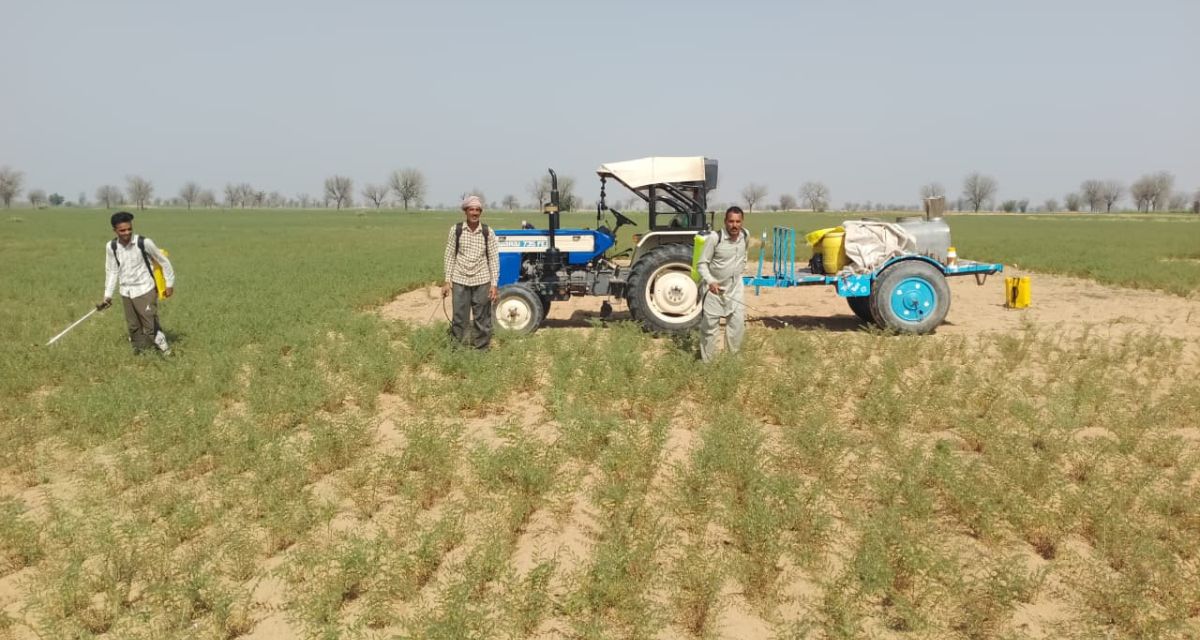
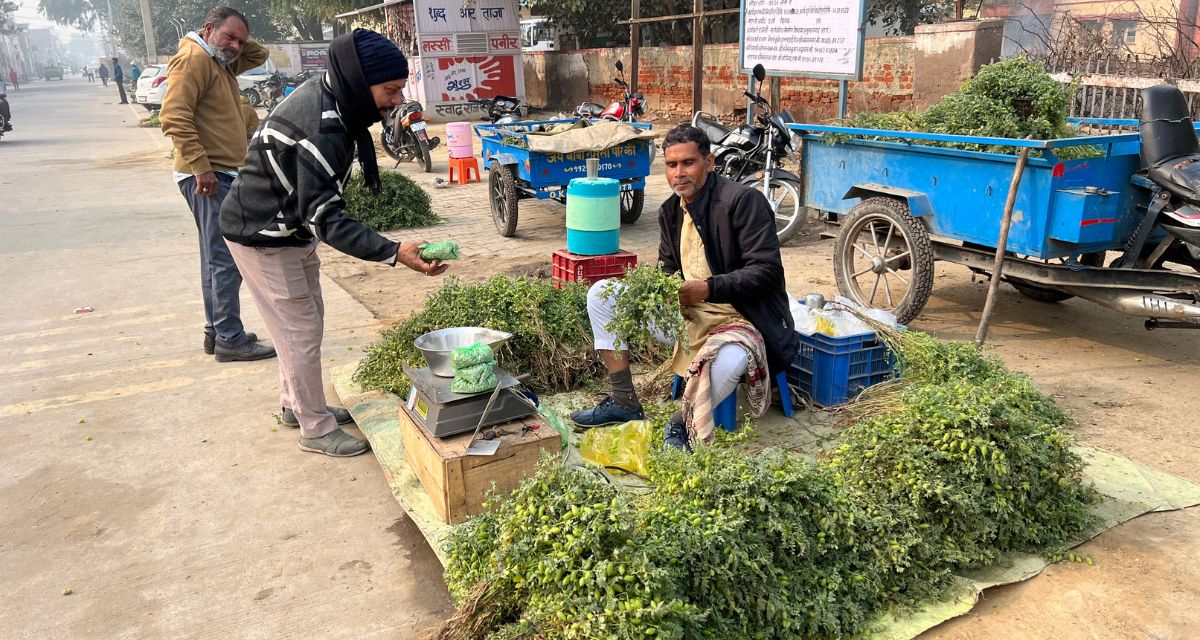 Amidst uncertainty, many farmers are choosing to sell their chickpea crop while it is still in the grain stage (Photo - Amarpal Singh Verma, 101Reporters)
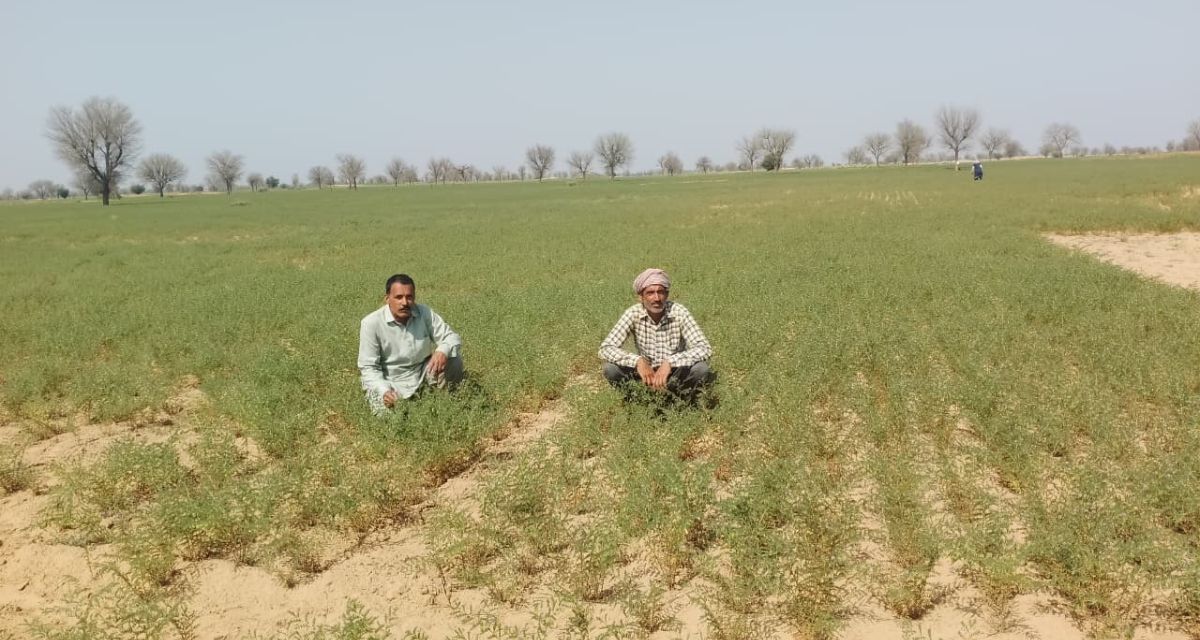
Climate’s curse on farming
For farmers, the main reason behind the shift is not the market but the weather.
Farmers say that March, when the chickpea crop nears maturity, has become the most uncertain period.
“Earlier, we used to be able to predict the weather. In the past few years, weather uncertainty has increased significantly,” said Bhup Singh Saharan, a farmer from Aradki village.
“If it rains before flowering or ripening, the entire crop is ruined. So for the past two or three years, farmers have started selling chickpeas before they ripen.”
Last year, Saharan cultivated chickpeas on 25 bighas of land and sold the entire crop while it was still green.
“If the crop had remained standing and had been hit by hail, it would have been gone. By selling it half-ripe, we at least avoided the loss.”
Kaluram Poonia, another farmer from Malwani village, said farmers now prefer certainty over waiting for higher yields.
“We no longer rely on the weather. We sell the crop as soon as the grains are ready. We get cash, and we don’t have to worry about everything going wrong at the last moment.”
The shift is significant because Rajasthan and Madhya Pradesh together account for a large share of India’s chickpea production. Madhya Pradesh is the country’s largest producer, while Rajasthan ranks third.
Research conducted by Banasthali Vidyapeeth has shown that declining production and quality degradation directly affect farmers’ incomes. In such circumstances, farmers increasingly prioritise stable income over potentially higher profits.
The study also noted that Rajasthan’s agricultural system is highly vulnerable due to low and erratic rainfall, long hot seasons and limited irrigation resources.
Even a 1°C increase in temperature negatively affects crop productivity, with rabi crops, especially chickpea, being particularly sensitive to abnormal heat.
The problem is not just low rainfall but rainfall at the wrong time. Rain just before flowering or ripening can damage both the quantity and quality of the crop.
Economics of green chickpeas
The decision to sell the crop as green chickpeas, hoping to earn double the MSP, stems not only from fear but also from clear economic calculations.
Atmaram Doodi explained the calculation simply. “If the weather is good and there are no diseases, one bigha of gram can yield up to four quintals. But often it is limited to two or three quintals.”
“If we assume three quintals and the price is Rs 5,000 per quintal, we earn about Rs 15,000. But selling green gram brings almost double that.”
Green chickpeas are uprooted along with their roots, stems, leaves and immature grains. One bigha yields about 25-30 quintals of green produce.
“If traders come to the field, they buy it for Rs 14 per kilogram. If we take it to the market ourselves, we get Rs 17-18 per kilogram. There is no need for harvesting or threshing,” Doodi said.
This allows farmers to earn roughly twice the minimum support price of gram – Rs 5,875 per quintal – while reducing labour and risk.
The trend is not limited to Nohar. Farmers in Bhadra tehsil villages such as Bhirani, Dabdi, Berwali, Sagada, Suratpura and Amarpura are also increasingly selling chickpea crops before they ripen.
Krishna Jangra, a farmer from Bhirani village, said he adopted the method last year. “I sowed chickpeas on two and a half bighas and sold them before they ripened. This method is better. There is no fear of bad weather.”
New rural economy
The growing demand for green chickpeas has created new employment opportunities in villages and nearby towns: for wholesalers, transporters, pickup drivers and street vendors.
Man Singh and his brother from Dabli Rathan village buy green chickpeas directly from farmers.
“In December, we first bring green chickpeas from Jawada and nearby areas in Madhya Pradesh, where they sell for Rs 15–20 per kilogram. We bring them here in pickup trucks and sell them for Rs 30–35.”
Retailers then sell them to customers for around Rs 70–80 per kilogram in the early part of the season.
When supplies from Madhya Pradesh decline, traders start sourcing the crop from Rajasthan – including Badi Sadri in Chittorgarh, Dudu in Ajmer, Kishangarh and Jaisalmer.
Hanumangarh’s crop reaches the market in March.
Aslam Khan, a trader from Aradki village in Nohar tehsil, transports green chickpeas to markets in Haryana and Punjab.
“We take them to Fatehabad, Sirsa, Hisar and Rohtak in Haryana, and to Mansa, Bathinda, Patiala and Amritsar in Punjab, as well as Delhi,” he said.
“In March, we buy green chickpeas here for about Rs 8 per kilogram and sell them in Punjab and Haryana markets for Rs 30-Rs 40. Even after expenses, there is a profit.”
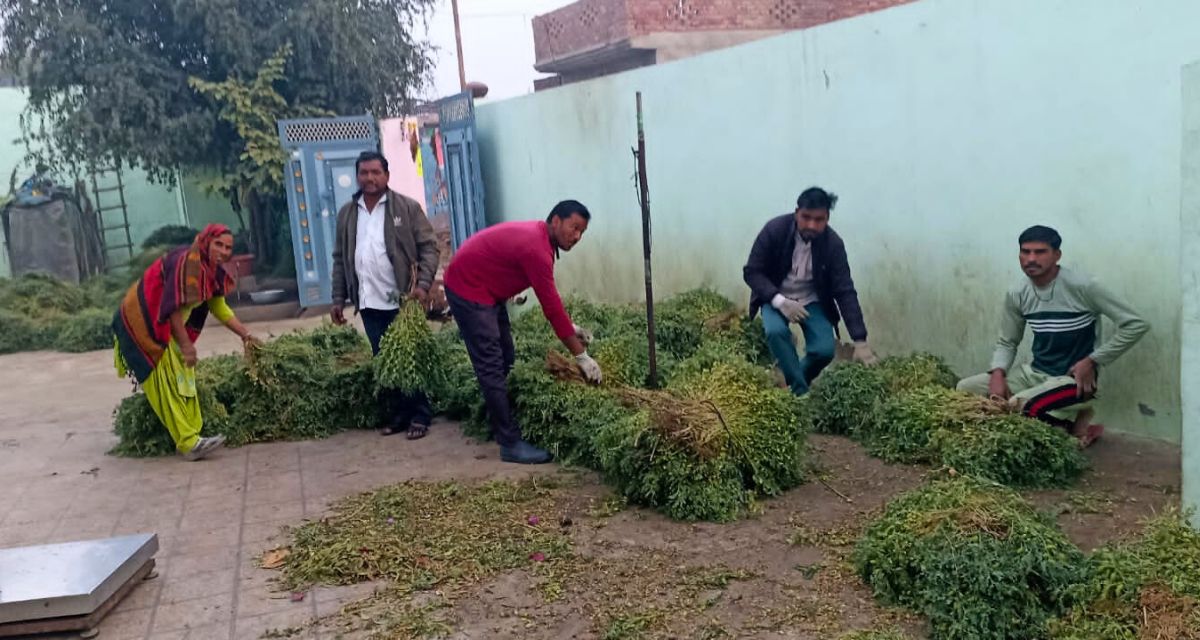 The growing demand for green chickpeas has created new employment opportunities for villagers (Photo - Amarpal Singh Verma, 101Reporters)
Changing consumption patterns
The extended availability of green chickpeas, now lasting nearly six months, has also influenced eating habits.
Green chickpeas are no longer just an everyday vegetable but have become popular at weddings and other events.
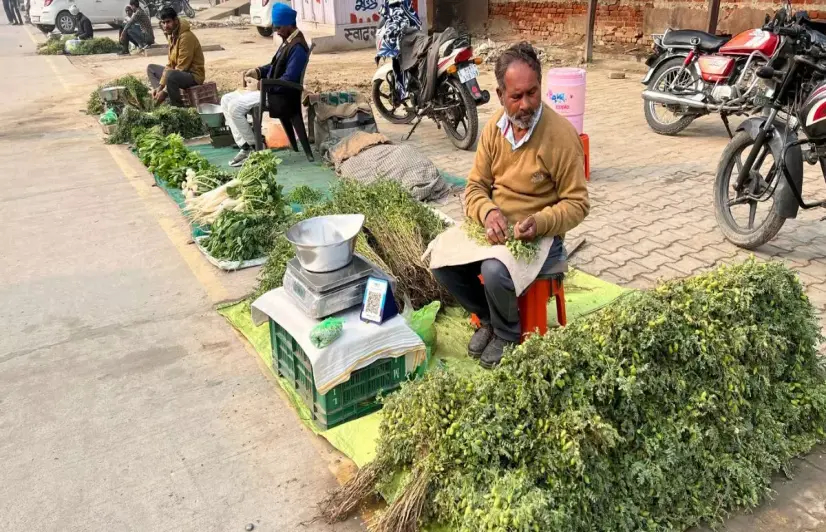
Budh Singh, who sells green chickpeas on the roadside in Sangaria, said the crop now provides steady work.
“There is demand for them for several months. This gives us continuous employment. We also sell radish, spinach, fenugreek and mustard greens.”
Retailer Malkit Singh said the crop sells quickly.
“People buy green chickpeas eagerly. Whatever stock we bring gets sold.”
The trade has also created work for women in the area.
Women collect unshelled chickpeas from retailers, shell the grains and return them. They earn about Rs 10 for shelling one kilogram, and typically process around 10 kilograms a day.
Agriculture officials say the trend reflects farmers’ attempts to adapt to growing climate uncertainty.
Madan Joshi, a retired assistant director in the Agriculture Department, said selling chickpeas before they ripen is a practical response.
“It is not a policy decision but a decision based on experience – reducing risk, ensuring income and clearing fields earlier.”
Professor Santosh Rajpurohit, former state president of the Rajasthan Economic Council, said rising health consciousness has also increased demand for rain-fed green chickpeas.
However, he noted that climate uncertainty remains the main factor shaping farmers’ decisions.
Selling chickpeas early reduces labour, eliminates weather risks and often provides better returns.
“When farmers sell their produce in the traditional way, they remain worried about rain until it reaches the market,” Rajpurohit said.
“Adopting new methods gives them greater confidence.”
This story was produced as a part of 101Reporters Climate Change Reporting Grant.
Cover photo - Shopkeepers selling green chickpeas on the pavement in Sangria of Hanumangarh district (Photo - Amarpal Singh Verma, 101Reporters)
Would you like to Support us
101 Stories Around The Web
Explore All News