In Madhya Pradesh, Railway Line Threatens a Major Forest Stretch Along the Malwa Plateau


In Madhya Pradesh, Railway Line Threatens a Major Forest Stretch Along the Malwa Plateau
Indore, Madhya Pradesh: Bhuru Dawar has never seen the map. He was born in Baigram, a scatter of homes a kilometre or two from Choral, in the forest that takes its name from the small river running through it. He knows these slopes the way people know the rooms of their own house: where the mahua falls first in spring, which patch of anjan his goats prefer, where the tendu grows thick enough to fill a bundle before noon.
When we spoke to him in October, Bhuru did not know a railway line was planned through the forest.
He knew about the highway. For years, villagers had watched trees being felled as the road through the ghats was widened into four lanes, with timber carted away. "Lakhs of trees get cut," he said, "and they tell you a few thousand."
The proposed line from Mhow to Sanawad, part of the Ratlam-Indore-Khandwa gauge conversion project, cuts through the forest that Bhuru and other Adivasi families depend on. While the Railways says the project is overdue and will give Indore a direct broad-gauge link towards Mumbai and southern India, reducing travel time, a petition against the project says around 2.5 lakh trees are at risk. The consequences could extend beyond the trees marked for felling, affecting wildlife, the local environment and livelihoods.
The matter has now reached the courts. On October 16, the Madhya Pradesh High Court’s Indore bench stayed the felling of trees in the Choral range. The next hearing is scheduled for November 30. The stay has temporarily halted the cutting, but it has not settled the larger question: what happens to a forest when development projects take away not just its trees, but the lives and livelihoods sustained by it?
A number nobody owns
The petition filed by Indore-based activist Karan Bairagi, through advocate Manish Yadav, says the original railway alignment would have affected 40,000 to 50,000 trees. It alleges that the route was subsequently changed to ease the gradient and reduce travel time by half an hour, putting more than 2.5 lakh trees at risk.
But the source of this estimate is unclear. Yadav said the petition relies largely on figures published in news reports. Mukesh Kumar, public relations officer of Western Railway’s Ratlam division, declined to comment, saying the matter was before the court.
Indore’s Divisional Forest Officer (DFO), Lal Sudhakar Singh, also questioned the figure. “There is no source,” he said. “I don’t know how they arrived at it.”
His own count is smaller, though hardly small. About 1.24 lakh trees were marked in Indore district, he said, but those standing above the line’s tunnels will be spared, bringing the felling to around 90,000 to 96,000. For the whole line, the Free Press Journal reported in March, about 1.51 lakh trees are marked, and 16 tunnels and viaducts would spare about 17,000.
There is little agreement on how reliable these estimates are. The DFO says the trees to be cut were counted by hand, one by one. Abhinav Dhanodkar, an Indore lawyer who has fought several tree-felling cases, does not agree with the method. “They take a Google Earth view and draw a straight line on it,” he said. “This is where the train will go, so these trees are to be cut.” Dev Kumar Vasudevan, a Mhow resident who has watched these forests for four decades, fears the actual number could be higher than the official estimate. “There is no guarantee that the number cut won’t be twice the number approved,” he said. The actual number of trees to be felled along the entire route remains unclear.
But the railway line is not the first project to cut into this forest.
Vasudevan, a Mhow-based environmental activist, says several infrastructure projects have affected the forest over the years.
In 2018, Nai Dunia reported that a company laying the Narmada–Gambhir pipeline had felled around 200 trees between Simrol and Baigram without permission or marking. The Conservator of Forests later confirmed this.
Power lines and the highway followed. Sachin Gupta, who reports for Patrika and lives in Choral village, believes the pipelines led to more tree-cutting than was officially recorded because contractors also cleared tracks for their vehicles. “I saw it happen in front of me,” he said.
Each project was approved separately. There is no consolidated assessment of how much forest cover has been lost to these projects over the years.
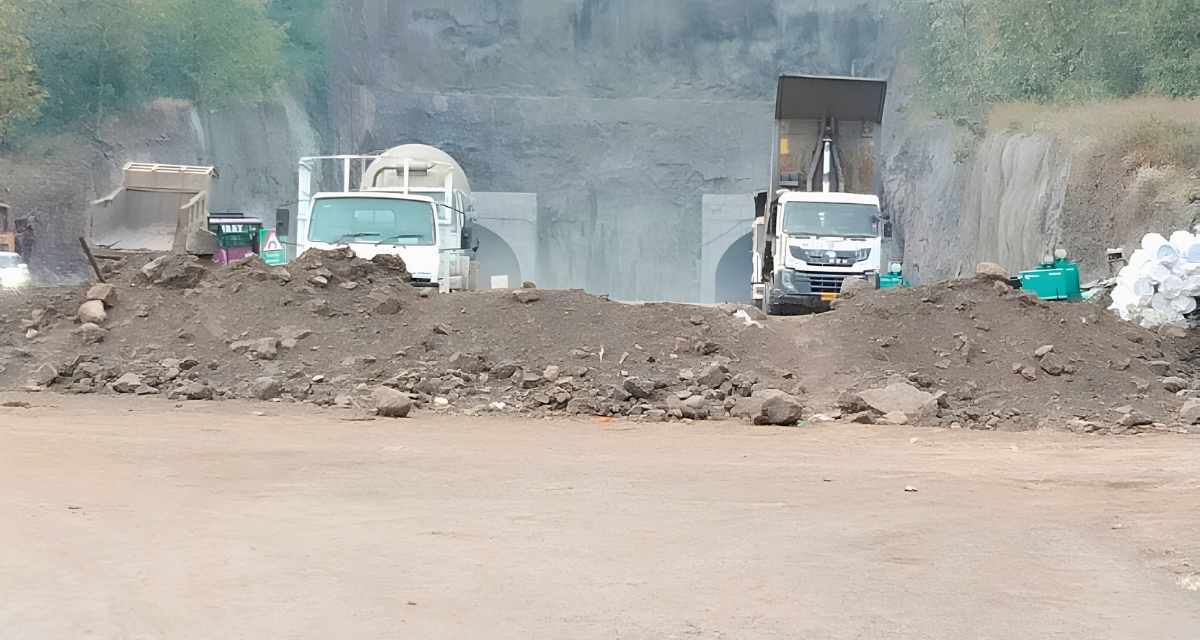 An image of a construction site in the forest; several projects have affected the forest over the years (Photo - Aditya Singh Parihar, 101Reporters)
A forest that feeds a family
For families living around Choral, the loss of forest cover also affects their livelihoods.
Bhuru depends on the forest for his income. His family collects tendu leaves, mahua and wild fruits to sell in local markets. Anjan leaves are used as fodder for their cattle. “The forest is the life of the Adivasi,” he says. Those who leave the forest for cities often end up working as labourers, he says. He cannot imagine living away from it.
A railway line may not displace entire villages, and no rehabilitation plan has been made public. But the absence of physical displacement does not mean there is no loss of livelihood. Families who depend on forest produce can lose access to it even if their homes remain untouched.
The Forest Rights Act, 2006, recognises the rights of communities that depend on forests for their livelihoods. It also provides for the recognition and settlement of forest rights before forest land is diverted for other uses. Madhya Pradesh’s PESA rules give gram sabhas in Scheduled Areas further powers over land and forests. But Dhanodkar says no one he met in these villages had heard of either law.
The DFO confirmed there are “10 or 12” forest rights claims in the project area. The district collector will settle them, he said, and claimants will be compensated. Yet in the same conversation he described the Centre’s approval as complete, with work already under way in parts of the forest.
The process of settling forest rights claims, therefore, appears to be continuing even as the project moves ahead.
Dilip Badsare, who runs a small private school in Choral, says, “People will enjoy the sight of a train winding between the hills. But what use are bare, dry hills?” He wishes the Railways had chosen a route that added maybe an hour to the journey, but saved the trees.
What a tree count leaves out
The impact of the project could extend beyond the loss of forest produce. Environmentalists and local residents say the forest also plays an important role in preventing soil erosion, supporting wildlife and influencing local weather conditions.
Vasudevan describes Choral as an important forest area along the edge of the Malwa plateau, where the land slopes towards the Narmada valley and the plains of Nimar. It is one of the few large stretches of forest remaining between Indore and Barwaha. The forest has teak, salai, anjan and mahua trees, among other species.
According to Vasudevan, the tree cover helps hold the soil on the steep slopes and retain moisture during the dry months. He is concerned that further fragmentation of the forest will affect these functions.
The railway line will pass through the forest, creating gaps in the existing tree cover. Vasudevan says this could increase exposure to heat and wind, dry out the soil and encourage the spread of invasive species such as lantana. It could also affect wildlife movement.
Choral is part of a tiger corridor, although tiger sightings in the area are now few. Leopards are also increasingly being seen in townships around Mhow and Indore. Vasudevan believes the loss of forest habitat has contributed to animals moving closer to human settlements. “These were all forest areas originally,” he said. “[Because of habitat destruction] A lot of animals have already been displaced. More will be.”
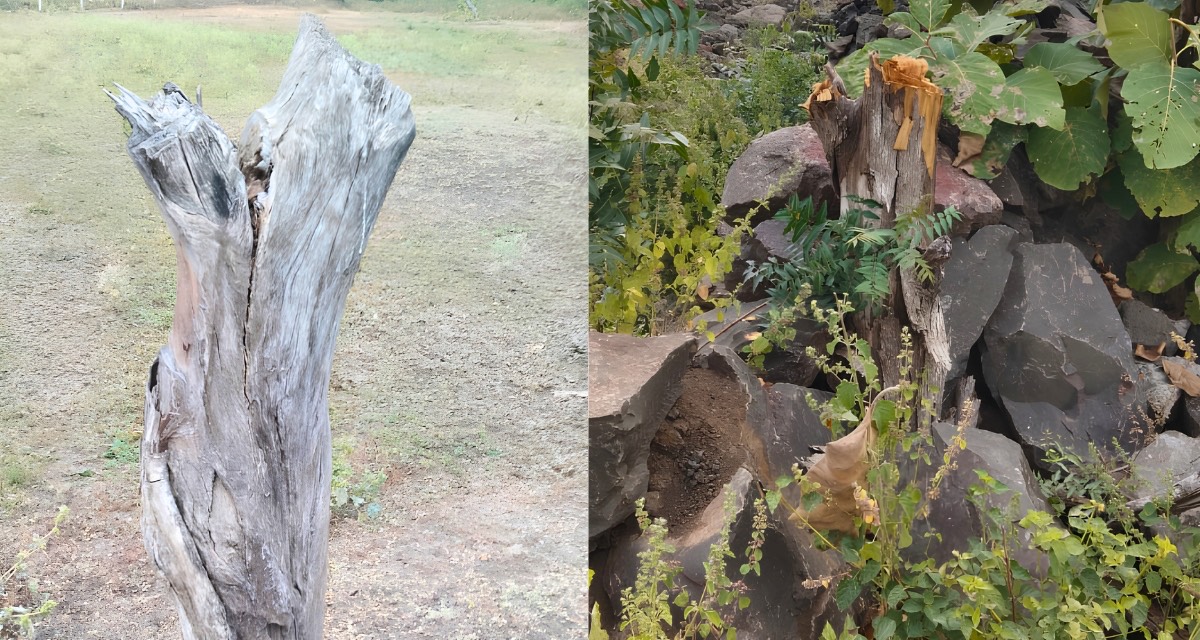 Images of felled trees; a large number of felled trees can disrupt the ecological balance of the forest (Photo - Aditya Singh Parihar, 101Reporters)
The effects could also be felt in Indore and Mhow, particularly in local temperatures, Vasudevan says. He points to the traditional saying Subah-e-Banaras, Shaam-e-Awadh, Shab-e-Malwa, which describes the pleasant nights of Malwa. The plateau is about 500 metres above sea level, allowing it to cool relatively quickly after sunset. Vasudevan says the forest along its edge also helps shield the region from hot winds coming from Nimar. He fears that further loss of forest cover could change these conditions. “Most of us are afraid,” he said, “that shab-e-Malwa will soon be a thing of the past.”
Sudhindra Mohan Sharma, an Indore geologist and groundwater consultant, also believes the forest plays an important role in regulating local environmental conditions. He says its removal could increase soil erosion, reduce soil moisture and affect humidity and night temperatures in the surrounding areas.
“Without the forest, soil erosion on our plateau will increase. Soil moisture will fall, humidity in the air will fall, and our night temperatures will rise. Once it is cut, the heat will travel up, and so will the hot winds,” Sharma said.
There is, however, no study quantifying the likely impact on temperatures in the region. “We have not studied it. No one has quantified it,” Sharma said. “No one has even asked.”
Bhuru says rainfall patterns have also changed. The rain, he says, doesn't come like it used to.
These effects are not reflected in the number of trees marked for felling or in the compensation paid by the Railways. According to Nai Dunia, the Railways has paid Rs 40 crore as the trees' net present value, as part of about Rs 150 crore deposited with the Forest Department. Moreover, replacement trees are to be planted some 100 km away, in Dhar and Jhabua.
Vasudevan says plantations elsewhere cannot replace the existing forest and the ecological functions it performs. “A forest like Choral has always been there. The whole ecosystem, the forest floor, everything is so rich. When we lose that, it cannot come back,” he said. “Compensatory planting can never make up for it, especially when it is far away.”
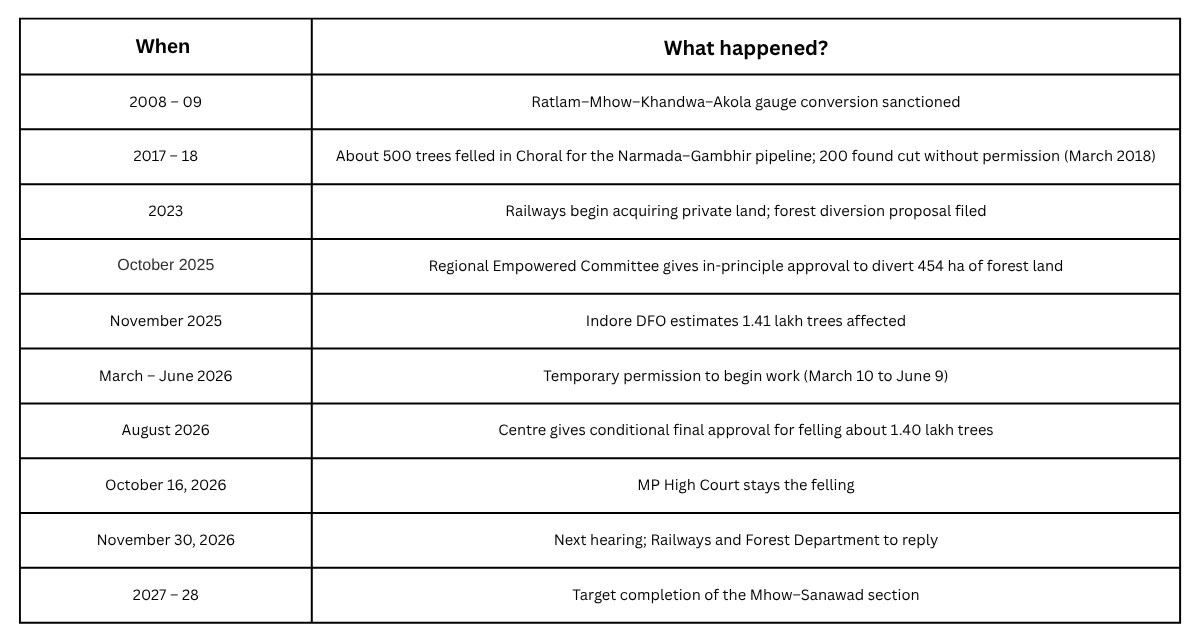 A table showcasing the project timeline (Photo - created on Canva, 101Reporters)
For now, the fate of the forest rests partly on what happens in court. The Railways is due to file its reply when the court sits on November 30. It may then have to explain on record what it intends to cut, and why.
Cover Image - Bhuru Dawar has watched trees fall for the highway near his home in Baigram. He did not know a railway line was coming next (Photo - Aditya Singh Parihar, 101Reporters)
Would you like to Support us
101 Stories Around The Web
Explore All News