Kashmir’s apple growers have to pay to replace a winter that once came free

Kashmir’s apple growers have to pay to replace a winter that once came free
Srinagar, Jammu and Kashmir: For Kashmir’s apple growers, the decision of when to sell their crop is increasingly becoming a question of how much they can afford to spend on keeping it.
For years, growers could leave apples in traditional sheds after harvest and rely on the Valley’s winter cold to slow their deterioration while they waited for prices to improve. Now, with winter temperatures becoming less reliable, more growers are paying to move their crop into controlled-atmosphere (CA) stores, where it can be held for several months.
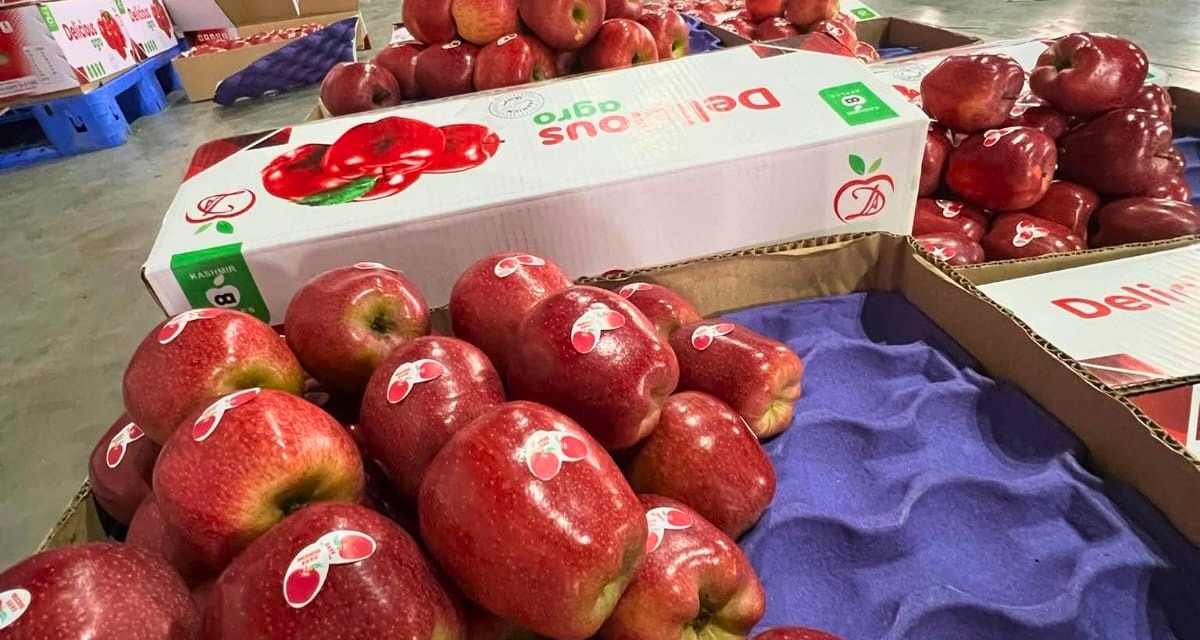 Inside a cold storage facility (Photo - Irfan Yattoo, 101Reporters)
The shift is giving growers more time to sell, but it is also adding another expense to a crop already burdened by the rising costs of cultivation, packaging and transport.
For Javid Ahmad Wani, an apple grower from Gosu village in Pulwama district, that additional expense has become part of the cost of holding on to his crop. Last year, he stored 200 crates in a CA facility in Lassipora, paying a monthly charge for each crate. The apples remained in storage for five to six months, he said.
Winter can’t be relied upon
The growing reliance on such facilities comes as winter temperatures and snowfall patterns in Kashmir have shifted. Data from the Meteorological Department show that winter maximum temperatures increased at several stations across the Valley between 1980 and 2024, with increases ranging from 0.5°C in Kokernag to 1°C in Kupwara.
Dr Mukhtar Ahmad, director of the Meteorological Department in Kashmir, said changes in weather patterns had been observed across the region over the past two decades. Temperatures and snowfall during Chillai Kalan, the 40-day period from December 21 to January 30 traditionally associated with the harshest winter conditions, had also changed, he said.
“We are witnessing warm temperatures, not the chilling minus 7 to 8 degrees that traditionally kept apples cold. Snowfall is also not enough during peak Chillai Kalan,” he said.
A study titled Sustainability of winter tourism in a changing climate over Kashmir Himalaya, also found a rise in winter temperatures using December-to-February data from 1981 to 2010.
At Pahalgam, average minimum winter temperatures rose from -6.02°C in 1981–1990 to -4.12°C in 2001–2010, while average maximum temperatures increased from 5.1°C to 7°C. At Gulmarg, average minimum temperatures rose from -6.86°C to -5.45°C, while average maximum temperatures increased from 1.92°C to 2.17°C.
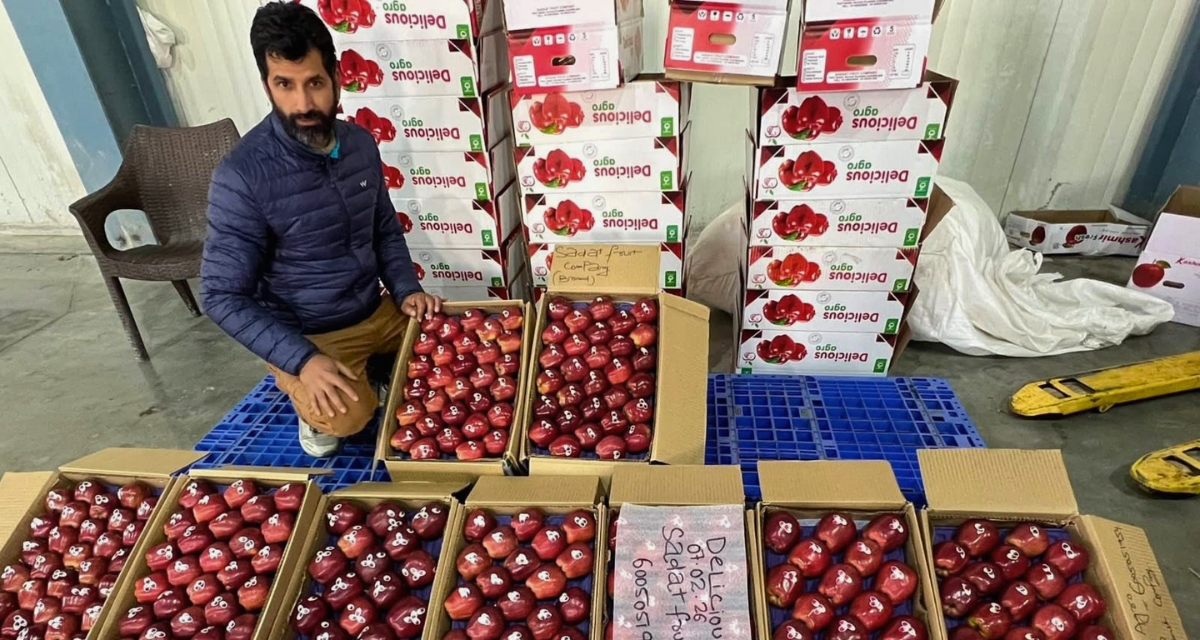 Inside an apple packing store (Photo - Irfan Yattoo, 101Reporters)
The temperature records document warming, but do not establish how many fewer days apples can now be stored in traditional sheds. Growers and horticulture experts interviewed for this story instead describe a growing uncertainty over how long ambient cold can be relied on to preserve the harvest.
Dr Nowsheen Nazir, chief scientist in the Division of Fruit Science at the Faculty of Horticulture, Sher-e-Kashmir University of Agricultural Sciences and Technology of Kashmir, said warmer winters were putting pressure on traditional storage practices.
“Kashmir apple growers used to trust winter to do the work of storage. That trust is fraying,” she said.
CA storage is one response to that uncertainty. It allows growers to keep apples for several months and decide when to sell them rather than putting their entire harvest on the market soon after picking. But the cost of doing so can be significant.
Rising cost of storing apples
Wani said he was charged Rs 35 a month for each 17-kg crate at the CA facility in Lassipora. Storing the apples for five to six months cost him approximately Rs 180 to Rs 220 per crate. He said charges could rise during peak periods, particularly when transport disruptions increased demand for storage.
For Amir Ahmad Khan, an apple grower from Dachnipora in south Kashmir, the expense begins even before his apples reach a CA facility. The nearest one available to him is in Lassipora, around 32 kilometres away. Transporting each 20-kg box costs him approximately Rs 100 to Rs 110, in addition to storage charges.
The additional investment does not guarantee that growers will recover their costs.
When the Srinagar-Jammu highway was disrupted by landslides last year, Khan said, cold stores were already full. Growers in his area had to sell premium apple boxes for around Rs 300, he said, compared with the Rs 1,500 he estimated they could have fetched had they been able to store the fruit and sell it later.
“Earlier, we could store packed apples for months at home. Now it has become a compulsion either to send them to stores or sell them at cheaper rates in the market,” Khan said.
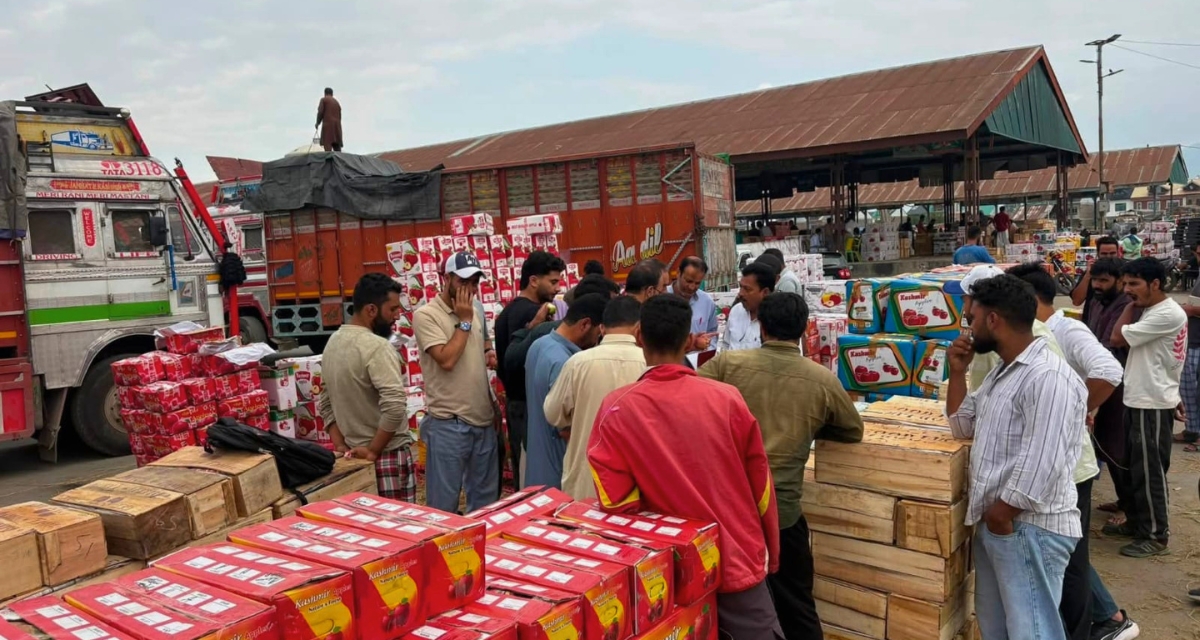 Inside the apple Mandi in Sopore (Photo - Irfan Yattoo, 101Reporters)
For growers who cannot secure storage space at all, the risks can be greater.
Noor Mohammad Dar, a grower from Tikkin village in Pulwama, produces around 300-400 boxes of apples annually. In 2024, he stored his crop in a CA facility and later made a profit of around Rs 200 Rs 300 per box, he said.
In 2025, however, he could not secure storage space. With the highway disrupted by landslides and cold stores full, he sent his apples to Delhi. More than 120 boxes of Kulu Delicious apples were spoiled during transportation, he said.
Dar said he could not recover even the money he had spent on pesticides and other agricultural inputs.
The difficulty is not only that storage is expensive. There is also not enough of it.
Less storage, uneven access
According to the Economic Survey 2025-26, Jammu and Kashmir produced 21.09 lakh metric tonnes of apples in 2024-25. Of this, 20.79 lakh metric tonnes came from Kashmir and 30,393 metric tonnes from Jammu.
Against an estimated CA storage requirement of 6 lakh metric tonnes, the Union Territory had a capacity of 2.92 lakh metric tonnes. That met about 49% of the stated requirement, leaving a shortfall of approximately 3.08 lakh metric tonnes. Existing capacity was equivalent to about 14% of annual apple production.
The government expects capacity to increase to 3.07 lakh metric tonnes as additional facilities are developed. Most existing facilities are concentrated in Lassipora in Pulwama and Aglar in Shopian, leaving growers in other apple-producing areas with fewer options.
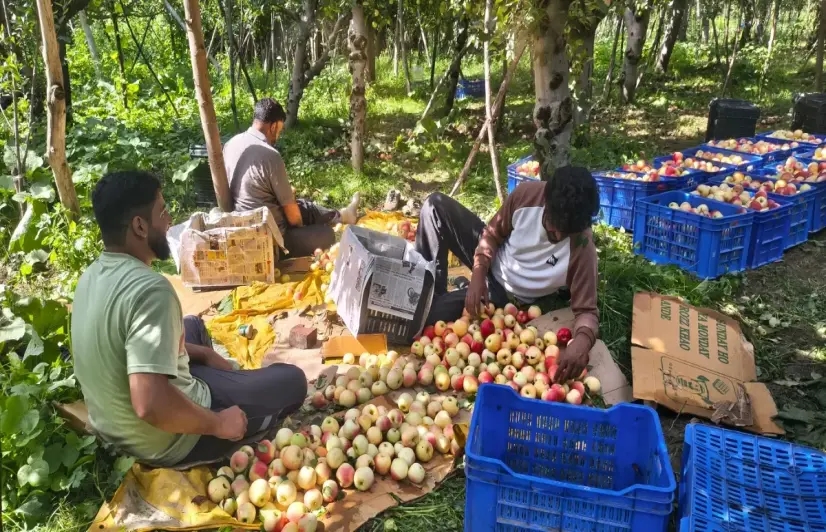
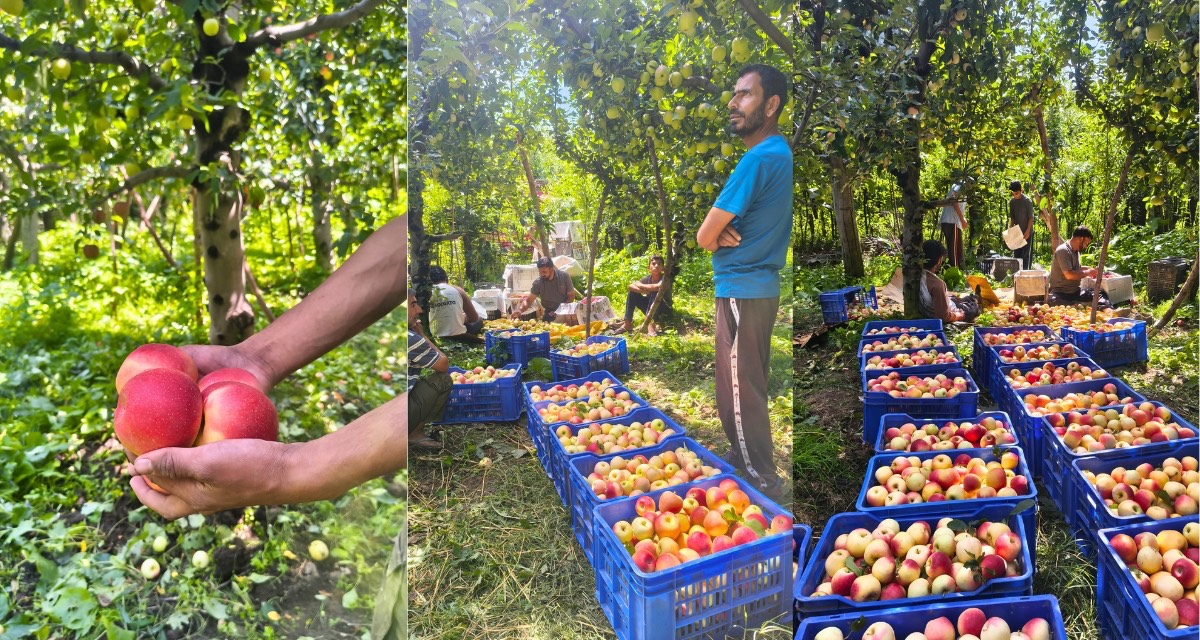 Farmers working in apple orchards (Photo - Irfan Yattoo, 101Reporters)
Mohammad Amin Wani, an apple grower from Handwara and president of Handwara Fruit Mandi, said Kupwara district had no CA storage facility despite being a major apple-producing area.
Wani produces around 5,000-5,500 boxes annually from his orchards. The nearest CA facility is in Sopore, he said, but storage space there is often already reserved. Some growers have to send their produce to south Kashmir, 110-115 kilometres away, adding to their transportation costs.
“If storage will be constructed, it can definitely help growers in the region,” Wani said.
The government has been expanding CA storage capacity in response to the shortage.
Agriculture Production Minister Javid Ahmad Dar said the government had built two CA stores in north Kashmir: one with a capacity of 25,000 metric tonnes at Mazbug, Sopore, and another with a capacity of 5,000 metric tonnes at Bahrampora, Rafiabad. Both facilities were developed by the Himachal Pradesh Horticultural Produce Marketing and Processing Corporation, he said.
Government data list 76 CA storage facilities across Jammu and Kashmir, with a combined capacity of 2.92 lakh metric tonnes. Much of the infrastructure has been developed through private investment supported by government subsidy schemes.
Vikas Anand, director of horticulture in Kashmir and mission director of the Mission for Integrated Development of Horticulture in Jammu and Kashmir, said eight more facilities had been approved and another 10 were being planned. He acknowledged that north Kashmir continued to need additional capacity.
The 2026-27 budget proposed Rs 600 crore in government subsidy for 40 new CA stores, with a focus on districts outside the Pulwama-Shopian belt, according to information provided by the government.
But expanding storage infrastructure addresses only part of the problem. The recurring cost of storing the crop still falls on individual growers.
Asked about support for these expenses, Agriculture Production Minister Javid Ahmad Dar said the government recognised the need to improve access and affordability.
“We recognise that access and affordability for individual growers also need attention. We are examining how existing support mechanisms can be strengthened so that small and medium apple growers are not left out because of storage costs,” he said.
Dar said the department would assess the existing subsidy framework and the support reaching growers who depended on CA facilities to hold their produce beyond the harvest season. He did not specify a scheme that currently pays growers’ recurring storage charges.
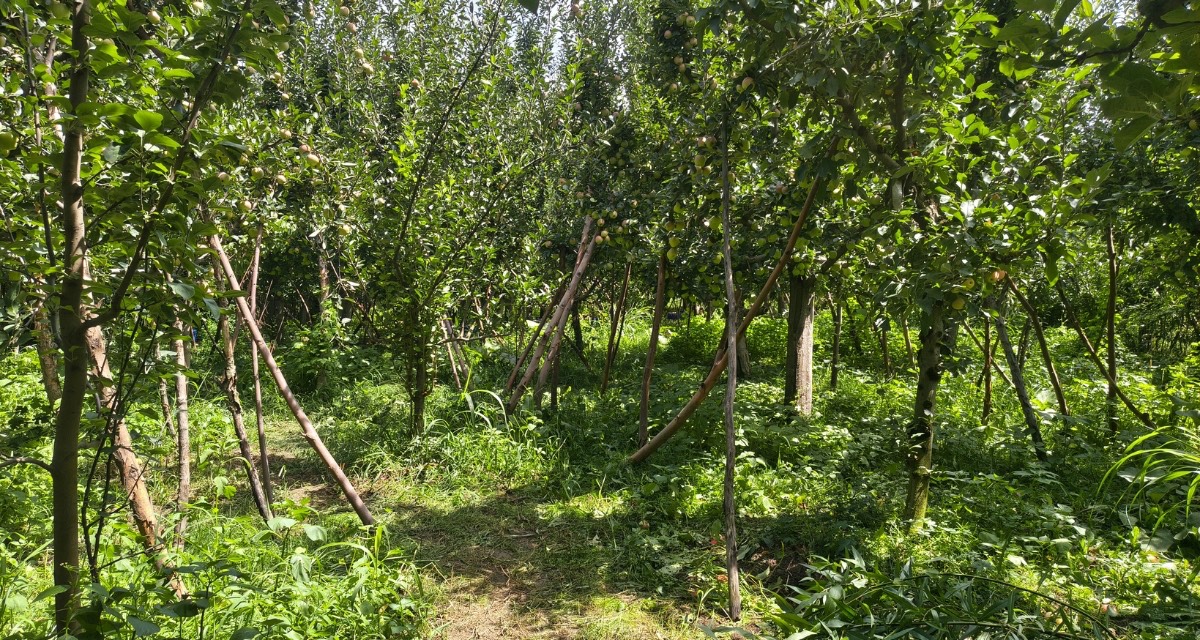 An image of the apple orchard (Photo - Irfan Yattoo, 101Reporters)
For Mohammad Arif Dar, an apple grower from Yadipora village in north Kashmir’s Baramulla district, that is an important distinction.
Apple cultivation already involves substantial expenditure on pesticides, fertilisers, labour, packaging and transportation, he said. Storing the crop adds another cost, while the price farmers eventually receive remains uncertain.
“Now the cold is not as dependable, and if we want to hold our crop for longer, we have to pay for storage. We are, in a way, paying to recreate the conditions that nature once provided us for free,” Dar said.
Growers, he said, were not opposed to modern storage facilities, but wanted to know whether the additional investment would improve their income.
“Adaptation should not become another burden on the farmer,” he said.
Cover Image - Farmers working in apple orchards (Photo - Irfan Yattoo, 101Reporters)
Irfan Yattoo is a fellow of the Climate Change Media Hub at the Asian College of Journalism. The programme is supported by Interlink Academy Germany.
Would you like to Support us
101 Stories Around The Web
Explore All News